Featured Post

Breakdown of Navier-Stokes Equations

Find PDF version here. Abstract: Given limited energy and a small mass density or large kinematic viscosity, this work shows why...

Showing posts with label graviton. Show all posts

Monday, February 7, 2022

Quantizing Gravity without the Graviton

Abstract:

This paper shows the connection between "dark energy" and gravity, the equivalence between matter and space, and how gravity works without the graviton or gravitational waves. It also suggests an alternate way to quantize gravity using smaller units--of mass, space and time--than the Planck units.

The same force acting on different masses will cause each mass to move at a different rate: F = ma, where m is mass and a is acceleration. However, the same "gravitational force" causes different masses to fall at the same rate. How can this be? Einstein proposed that when a body appears to be falling to earth, it is really at rest, and the earth is accelerating towards the body at a given rate. Thus the body's mass is irrelevant.

Below is a diagram of Alice who is surrounded by four bodies, including Bob. Bob and the others appear to be either moving away from Alice or towards her, depending on how you follow the arrows. But if we go from left to right, we can think of Alice as the one who is moving away from the surrounding bodies. If we go from right to left, we can think of Alice as the one who is moving towards the surrounding bodies. As a consequence, the surrounding bodies can have any mass and the rate at which Alice and the surrounding bodies diverge or converge will be the same.

Equations 1 and 2 below were derived from Einstein's field equations. Equation 3 was derived from a Friedmann equation where k is set to zero due to spacetime being flat at a large scale where the mass density (rho) is a small number and so is the curvature which is represented by the cosmological constant.

At 4 and 5 we set up a couple of substitutions to be made at 7 and 8 below. Equation 6 shows how mass and space are equivalent. Divide any mass by the vacuum-mass density to get the equivalent volume. Equation 7 shows the universe must expand faster than light as the radius r tends to infinity; otherwise, light speed in a vacuum is not conserved! If both sides of the equation are multiplied by the universe's mass, then the universe's energy is conserved no matter how big or small the universe becomes.

Also, the vacuum-mass density rho correlates with outward pressure, and that pressure is not diminished by an increase in distance r, so the outward pressure continues and so does the universe's expansion. At equation 8 we see that gravity looks similar to equation 7. As the speed of gravity increases, it is offset by the increase in spacetime curvature. As a result, the constant c and energy are conserved.

Equation 9 below shows that gravitational waves are caused by gravity and angular frequency, so they cannot be the cause of gravity. In fact, if angular frequency is zero, there is still gravity but no gravitational waves.

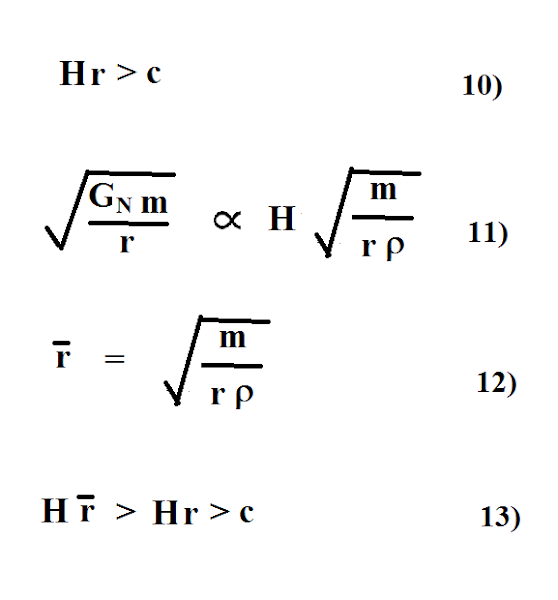
Now, let's imagine Alice and Bob are so far apart that Bob is moving away from Alice faster than light (see 10 below). Alice starts out with very little mass, but decides to go off her diet. As a result, she gains an enormous amount of mass. So much so that she becomes a black hole (see equation 11). The distance between her and Bob is the same but it is now less than Alice's Scharzschild radius. So are Alice and Bob still diverging or are they now converging?

We know that no signal, limited to light speed, ever reached Bob. This includes gravitons, gravitational waves, light, etc. At 12, Alice's mass is converted to it's equivalent space. Finally, the inequality at 13 shows that Bob is still moving faster than light if Alice is at rest, but Alice is no longer at rest--she's moving faster than Bob towards Bob. Thus Alice and Bob are converging as if a "gravitational force" is present.
Take a proton and electron. Equation 14 below shows acceleration depends on both their respective charges, their masses and distance r. Clearly there is an information exchange between them. At equation 15 it's a different story: acceleration only depends on the mass of the proton and distance r. It is clear the two masses don't exchange information. It's as if the proton simply accelerates towards the electron.

Now, let's consider Alice, Bob and Carl below. How fast Alice accelerates depends on the distance of the targets, the targets being Bob and Carl. Surely Alice needs to know the distance of each target so she can adjust her rate of acceleration accordingly?

Consider the diagram below. The numbers in each section add up to the total volume of the 3X3X3 cube. At 17 the volume of each cube is divided by its square. If we multiply each term by the square of Hubble's parameter it becomes apparent that Alice is accelerating less than Bob and Bob is accelerating less than Carl. These three are diverging as if they are in an expanding universe.

Now, let's add mass to the red section. Let's convert it to its equivalent volume which is 100 units. That brings the total to 101 units. Notice that the state of Bob's section (blue) and the state of Carl's section (green) do not change. Each have their previous volume. Also notice that the square areas do not change. This implies no information exchange between Alice, Bob and Carl. But now Alice is accelerating more than Bob and Bob is accelerating more than Carl. The three are converging is if they are in a gravitational field.

The rate of acceleration depends on distance but, as demonstrated above, this does not imply an information exchange between the parties. To drive this point home, imagine we divide up our universe into volume cells, each cell expands at a given rate independently of every other cell. More cells cause a greater rate of expansion, but each cell has no clue how many cells an observer is looking at or what the other cells are doing. The cells exchange no information. Thus the rate of expansion is really up to the observer. Now, suppose you add more volume (cells) to the system without increasing the space. This was done when mass was added to Alice's section (red). Mass's equivalent volume doesn't change the distances between Alice, Bob, and Carl. The result is what we call gravitational acceleration (see equation 20 below). Again, each cell need not know the state of the others. The rate of acceleration depends on the distance the observer chooses to consider.

Now let's turn to quantizing gravity. The popular choice is, of course, the graviton, but the graviton causes a major setback. If we assume the graviton is a real thing, surely we can come up with a reasonable estimate of how many gravitons are in the universe. For example, we could figure the total gravitational energy of the universe and divide that by the average energy of the graviton. At 21 below we plug in the entire mass of the universe to get the gravitational energy, but we don't get units of energy. Instead, we get velocity squared. One could argue that there is no gravitational energy, so there are no gravitons. Equation 22 is an attempt to counter this argument. It uses two masses which give an energy term, but how much gravitational energy there is depends on how much of the universe's total mass we assign to m and m'. Also, whatever gravitational-energy total we arrive at will be exceeded by a single black hole singularity and a single particle that have virtually zero distance between them.

At equation 23 we switch to a smaller scale. We assume the gravitational energy produced by an electron and proton is nEg, where Eg is the energy of one graviton and n is the number of gravitons. Therefore two electron-proton pairs produce 2nEg or 2n gravitons? Not so fast. Since gravitons have energy, they also produce gravitons. At 24 they produce up to an infinite number of gravitons if the distance r limit is zero! So how many gravitons are in the universe? It depends on how you crunch the numbers.

By contrast, it is much easier to estimate how many photons are in the universe, since photons don't produce photons. Electromagnetic energy is a function of charge and not energy or mass. So as long as photons don't have charge, they don't infinitely reproduce themselves. We can take the total luminous energy of the universe and divide it by a photon's average energy to get a reasonable estimate of how many photons there are.

For the above reasons, the graviton is untenable. So then how should we quantize gravity? Gravity is a function of mass (defined as energy divided by light speed squared), space and time. Thus it would make sense to quantize these fundamental dimensions. We could ask, what is the shortest length or time, and, what is the smallest mass? The popular response is, the Planck length, the Planck time and the Planck mass, respectively. But are these really the smallest units? The Planck mass clearly is not the smallest mass. An electron mass is smaller. Also, the Scharzschild radius of an electron is much shorter than a Planck length. The time it takes for a photon to travel the shorter distance is less than the Planck time. So what are the smallest units? Here are the smallest units I have found so far. I call them the Hubble units:

We could take the Hubble length, for example, and quantize equation 13 as follows:

At equation 29 the first term has alpha Hubble lengths; the second term has beta Hubble lengths. The smallest rate of expansion is Hubble's parameter times one Hubble's length. Now, one probable objection to this scheme is space is chaotic and stochastic on the quantum scale, so how can we have such nice, neat units? The Hubble length, for example, could be an expectation value (average) of all the chaotic activity that may make up space. We can think of the Hubble units as perhaps the smallest average units that can be derived from fundamental constants and Hubble's parameter.

In conclusion, unlike the other fundamental interactions, gravity does not appear to have any means for bodies to communicate with each other, nor is communication necessary. Thus the graviton is unnecessary. Further, the graviton fails to conserve energy like its electromagnetic counterpart the photon. A better way to quantize gravity is to quantize space, time and/or mass.

Acknowledgments:

Amber Strunk. Education and Outreach Lead. LIGO Hanford Observatory.

Peter Laursen, Astrophysicist and science communicator at the Cosmic Dawn Center, University of Copenhagen.

References:

1. Parikh, Wilczek, Zahariade. 2020. The Noise of Gravitons. arxiv.org.

2. Feynman, R.P. 07/03/1963. Quantum Theory of Gravitation. Acta Physica Polonica. Vol. XXIV.

3. Graviton. Wikipedia.

4. Carlip, S. 12/1999. Aberration and the Speed of Gravity. arxiv.org.

5. Van Raamsdonk, M. 05/17/2010. Building up spacetime with quantum entanglement. arxiv.org.

6. Hanson, R.; Twitchen, D. J.; Markham, M.; Schouten, R. N.; Tiggelman, M. J.; Taminiau, T. H.; Blok, M. S.; Dam, S. B. van; Bernien, H. (2014-08-01). Unconditional quantum teleportation between distant solid-state quantum bits. Science. 345 (6196): 532–535.

7. Gravitational Wave. Wikipedia.

8. de Rham, C., Tolley, A.J. 03/17/2020. Speed of Gravity. arxiv.org.

9. Carroll, S.M. 12/1997. Lecture Notes on General Relativity. Enrico Fermi Institute.

10. Marsh G.E., Nissim-Sabat. 3/18/1999. Comment on an article by Van Flandern on the speed of gravity. Physics Letters A Vol. 262, pp. 257-260 (1999)

11. Suede M. 11/29/2012. The Speed of Gravity: Why Einstein Was Wrong and Newton Was Right. Blog commentary re: Tom Van Flandern.

12. Cornish N., Blas D., and Nardini, G. 10/18/2017. Bounding the Speed of Gravity with Gravitational Wave Observations. Phys. Rev. Lett. 119, 161102

13. Van Flandern, T. 1999. The Speed of Gravity What the Experiments Say. Meta Research University of Maryland Physics Army Research Lab.

14. Nix, E. 08/22/2018. Who Determined the Speed of Light. History.com.

15. Speed of Gravity. Wikipedia.

16. Tests of General Relativity. Wikipedia.

17. Decross, M. et al. Gravitational Waves. Brilliant.com.

18. Lawden, D.F. 1982. Introduction to Tensor Calculus, Relativity and Cosmology. Dover Publications, Inc.

19. Stefanovich, E. V. 09/16/2018. A relativistic quantum theory of gravity. arxiv.org.

20. Light-time correction. Wikipedia.

21. LiĆ©nard–Wiechert potential Wikipedia.

22. Kopeikin, S. M. Fomalont, E. B. 03/27/2006. Aberration and the Fundamental Speed of Gravity in the Jovian Deflection Experiment. arxiv.org.

23. Faber, J. A. 11/24/2018. The Speed of Gravity Has Not Been Measured From Time Delays. arxiv.org.

24. Yin Zhu. 08/18/2011. Measurement of the Speed of Gravity. arxiv.org.

25. Perihelion of Mercury’s Orbit. macmillanlearning.com.

26. Belenchia A, Wald, R.M., Giacomini, F., Castro-Ruiz, E., Brukner, C., Aspelmeyer, M., 03/22/2019. Information Content of the Gravitational Field of a Quantum Superposition. Gravity Research Foundation.

Friday, August 14, 2020

The Beautiful Destruction of the Graviton


ABSTRACT:

In his paper titled "Aberration and the Speed of Gravity," S. Carlip argues that gravity propagates at light speed, and, its "action at a distance" and the lack of observed aberration is canceled by velocity dependent interactions. However, the underlying assumption of his thesis is that gravity is caused by gravitational radiation propagating at light speed. Another assumption held by much of the physics community is the quantization of gravitational waves will lead to a spin-2 massless particle known as the graviton. In this paper, I show why gravitational waves and gravitons are not the root cause of gravity. Gravity emerges from an entangled relationship between spacetime and matter.

Modern physics has two conflicting ideas: 1. gravity propagates at light speed, and 2. the equivalence principle. Why are these two ideas in conflict? The first proposes that gravity works in the following manner: a person holds a pen in his hand and drops it. Before it hits the floor, however, the floor must emit gravitons that propagate at c to create a field of gravity, so the pen can receive the gravitational information; otherwise, the pen won't fall.

The second idea is often set forth using a thought experiment where the person holding the pen is in a spaceship. The thrust of the engines cause the floor to accelerate toward the pen when the pen is dropped; otherwise, the pen would float freely in space and never make contact with the floor. In this scenario, no gravitons or gravitational field are needed. The floor is on a collision course with the pen and does not need to send a signal to the pen to let it know it's coming. According to Einstein, this is indistinguishable from gravity.  Therefore, this great idea and the one that precedes it create a paradox: the first idea implies a force is causing the pen to fall, so a force-carrying particle is necessary.  The second idea implies there is no force. 

That begs the question: does gravity require gravitons? Let's examine what may be a source of gravitons and strong evidence that gravity's velocity is c: gravitational waves. Equation 2 below is a gravitational-wave equation:

From equation 2 we derive equation 3 which emphasizes that c is a component of rest-mass energy and not propagation speed.

Does gravity exist if there are no gravitational waves? To find out, we take angular frequency to zero. The time (t') it takes for no waves to propagate a distance r is also zero. The final result is equation 5:

Where there are no gravitational waves there is zero angular frequency and zero strain measured at distance r, but on the left side of equation 5 we see Newtonian gravity is not zero. Thus, the magnitude of gravitational acceleration does not depend on the magnitude of gravitational waves nor their quanta. Further, a zero time delay (t') implies action at a distance.

A comparison between electric waves and gravitational waves reveals why photons are observable and gravitons are not. The wave equation i below represents an electric field (photons) propagating at c. Equations ii through iv demonstrate how the removal of the electric field (photons) leads to no electromagnetic force:

By contrast, if the gravitational field (gravitons) is removed, Newtonian gravity still exists:

What's been shown so far is not surprising when you consider problems surrounding the hypothetical graviton:

1. Since electromagnetic force is around 1037 times greater than gravity, one might imagine a graviton with 1037 times the Compton wavelength of an electron. The graviton's wavelength would span much of the known universe! Not exactly quantum scale.

2. Or, one could imagine one graviton (with the same Compton wavelength as an electron and same speed as a photon) per 1037 photons. If it takes 1037 photons one second to interact with X number of atoms, the graviton would take 1037 seconds to interact with X number of atoms--many orders of magnitude longer than the age of the universe! Further, each graviton interaction would have the same strength as a photon interaction or electromagnetic force.

3. One expects gravitons to spread out to form a field. It is not clear how the gravitons of a black hole can escape each other (if they have a light-speed limit) and not clump together due to mutual attraction (caused by their spin, angular momentum, mass-energy equivalence, etc.).

4. Gravitational wave wavelengths are inconsistent with hypothetical graviton wavelengths.

5. There's a renormalization problem.

6. The graviton has never been observed.

Assuming gravitons are not the root cause of gravity, what exactly is? If we begin with the spacetime metric (equation 6), we can derive equations 9 and 10 below:

Imagine, for the sake of argument, there is a graviton propagating at velocity c. Equation 9 shows if the graviton's energy (E) changes, the spacetime must also change instantaneously; otherwise the constant c would have a different value during the time it takes the graviton to emit another graviton which then transports information to surrounding spacetime. In other words, if the speed of gravity is limited to c, there would be a time lag where c is no longer c! The same holds for Planck's reduced constant at equation 10. The very constants physics relies on would fail to be constant if gravity is required to propagate an information-carrying particle no faster than c.

A careful examination of equation 9 reveals the graviton's energy, when divided by Planck's constant, has the same dimension as frequency, and the spacetime has the same dimension as wavelength. Frequency and wavelength have an entangled relationship. If you measure the value of one, you instantaneously know the value of the other.


In the case of our graviton, a change in its energy instantaneously updates its surrounding spacetime. Our graviton does not need to emit a graviton--and neither does any particle, planet, star, or black hole.

Thus, if the graviton is ever discovered, it is not the root cause of gravity. Gravity is the result of an entangled relationship between matter and spacetime. Matter has a certain energy and moves in certain ways because of a certain configuration of spacetime, and spacetime has a certain configuration because matter has a certain energy and moves in certain ways. Like frequency and wavelength, one does not exist without the other. This new hypothesis is consistent with "action at a distance" observations but inconsistent with the highly contraversial Jovian deflection experiment (see endnote 22).

Acknowledgements:

Amber Strunk. Education and Outreach Lead. LIGO Hanford Observatory.

References:

1. Parikh, Wilczek, Zahariade. 2020. The Noise of Gravitons. arxiv.org.

2. Feynman, R.P. 07/03/1963. Quantum Theory of Gravitation. Acta Physica Polonica. Vol. XXIV.

3. Graviton. Wikipedia.

4. Carlip, S. 12/1999. Aberration and the Speed of Gravity. arxiv.org.

5. Van Raamsdonk, M. 05/17/2010. Building up spacetime with quantum entanglement. arxiv.org.

6. Hanson, R.; Twitchen, D. J.; Markham, M.; Schouten, R. N.; Tiggelman, M. J.; Taminiau, T. H.; Blok, M. S.; Dam, S. B. van; Bernien, H. (2014-08-01). Unconditional quantum teleportation between distant solid-state quantum bits. Science. 345 (6196): 532–535.

7. Gravitational Wave. Wikipedia.

8. de Rham, C., Tolley, A.J. 03/17/2020. Speed of Gravity. arxiv.org.

9. Carroll, S.M. 12/1997. Lecture Notes on General Relativity. Enrico Fermi Institute.

10. Marsh G.E., Nissim-Sabat. 3/18/1999. Comment on an article by Van Flandern on the speed of gravity. Physics Letters A Vol. 262, pp. 257-260 (1999)

11. Suede M. 11/29/2012. The Speed of Gravity: Why Einstein Was Wrong and Newton Was Right. Blog commentary re: Tom Van Flandern.

12. Cornish N., Blas D., and Nardini, G. 10/18/2017. Bounding the Speed of Gravity with Gravitational Wave Observations. Phys. Rev. Lett. 119, 161102

13. Van Flandern, T. 1999. The Speed of Gravity What the Experiments Say. Meta Research University of Maryland Physics Army Research Lab.

14. Nix, E. 08/22/2018. Who Determined the Speed of Light. History.com.

15. Speed of Gravity. Wikipedia.

16. Tests of General Relativity. Wikipedia.

17. Decross, M. et al. Gravitational Waves. Brilliant.com.

18. Lawden, D.F. 1982. Introduction to Tensor Calculus, Relativity and Cosmology. Dover Publications, Inc.

19. Stefanovich, E. V. 09/16/2018. A relativistic quantum theory of gravity. arxiv.org.

20. Light-time correction. Wikipedia.

21. LiĆ©nard–Wiechert potential Wikipedia.

22. Kopeikin, S. M. Fomalont, E. B. 03/27/2006. Aberration and the Fundamental Speed of Gravity in the Jovian Deflection Experiment. arxiv.org.

23. Faber, J. A. 11/24/2018. The Speed of Gravity Has Not Been Measured From Time Delays. arxiv.org.

24. Yin Zhu. 08/18/2011. Measurement of the Speed of Gravity. arxiv.org.

25. Perihelion of Mercury’s Orbit. macmillanlearning.com.

26. Belenchia A, Wald, R.M., Giacomini, F., Castro-Ruiz, E., Brukner, C., Aspelmeyer, M., 03/22/2019. Information Content of the Gravitational Field of a Quantum Superposition. Gravity Research Foundation.

Tuesday, December 4, 2018

Why the Graviton Can't Be Found

Why hasn't the graviton been discovered yet? A thought experiment could shed some light on this question. Imagine a universe with only a Higgs field and nothing else. No strong, weak or electromagnetic interactions, no spacetime as we understand it. The basis of this universe is just the Higgs, so the only boson available is the Higgs boson. It's true the Higgs can decay into other particles, but let's focus on it while it is a Higgs.

Now, in such a universe, there should be no gravity, since there are no gravitons, right? (We performed a similar thought experiment in a previous post involving photons. Click here to read all about it.) Let's lay out the mathematics and see. First, we define the variables:

If we find gravity in our Higgs-only universe, that would explain why the graviton hasn't been found--it isn't necessary--so let's begin with the Higgs Lagrangian (L) at equation 1 below. At 2 we convert the Lagrangian to the Hamiltonian (H). To make the math less cumbersome we set the kinetic term equal to chi at 3.

We make a substitution at 4. Equation 5 is a Hamiltonian (H') with the same energy as H, but a different mass and kinetic energy. Equations 4 and 5 represent two adjacent fields whose centers of mass are r distance apart. At 6 we show the equality or conserved energy of the two fields. At 7 and 8 we equate the kinetic and potential energy differences.

Here is an overly simplified, crude diagram for illustrative purposes only:

As you can see the two adjacent fields are outlined with imaginary boxes and labeled blue (high kinetic energy/low mass) and red (low kinetic energy/high mass). The white dots represent the masses. Now, equation 8 fails to take into account distance r, so let's convert mass m as follows:

At equation 11 we have distance r where we want it. Equation 11 is the value of the kinetic-energy difference between the two fields. Classical kinetic energy is a function of velocity squared. What we want to know is the value of the velocity squared:

Now that we know the value of velocity squared, we can do one more step and determine the value of the gravitational constant for this Higgs universe (Gh):

We made a substitution at 14 above and end up with Newtonian gravity! And no gravitons! Equation 14 reveals that gravity is the net velocity squared of kinetic energy differences. If we divide both sides by another r, we get gravitational acceleration. Given these results, one could postulate that gravity is the net motion resulting from motion differences. And motion differences are caused by mass differences. Einstein suggested that matter curves spacetime. However, that assertion is very specific to our universe. A more general assertion is mass disturbs the status quo, whatever that may be, and causes kinetic energy variations. At the quantum scale, gravity does not seem to need its own boson. Information is passed using whatever boson is available. In this case, it's the Higgs.

Now, for extra credit, let's derive Einstein's field equations from equation 14:

If you are feeling ambitious, you can work backwards and derive the Higgs Langrangian from Einstein's field equations.

Update: Here is a couple of videos that falsify the graviton:

Wednesday, June 29, 2016

String Theory's Graviton and Spin-2 Particle Controversy

According to the current physics dogma, the graviton is a spin-2 particle. One argument for this involves the fact that Einstein's field equations are rank-2 tensors. Rank-2 tensor corresponds with spin-2 particle? If that's the case, then a 1/2-spin electron should correspond with a 1/2-rank tensor--but there is no such tensor! Just when you've given up hope that the graviton is a spin-2 particle, another argument is thrown against the wall to see if it will stick. In the following video, Leonard Susskind presents that argument:

There is a rule that says that left-moving energy must equal right-moving energy along a closed string. Each point along the string (represented by sigma) could serve as a starting point and the end point (equal zero and 2pi); i.e., the closed string and its points are invariant. Because right-moving and left-moving energy adds to zero, and because the invariant string and its points are equivalent, the closed string must have right-moving energy and left moving energy, and those two energies must be equal. Clear as mud, right? But that's essentially the argument in favor of spin-2 particles. Here is how the graviton is represented:

The a's and b's in parenthesis are the creation operators for the x and y axis, respectively. Complex numbers are used to show angular momentum. Notice there are two angular-momentum creation terms; one for left motion and one for right motion. There are two possible states: the two angular momenta going clockwise or counter-clockwise. Now compare this setup to the photon's:

The photon has only one momentum or one spin. There is no right-left motion business. And why should there be? When angular momentum completes a cycle, the total displacement is zero. If there is a vector moving left, there is an equal, opposite vector moving right. No need for an extra spin. An extra spin is redundant. This is why the left-right-motion argument fails to justify a spin-2 particle. Nature only requires one spin to complete a cycle that adds to zero. Here is the math:

Take the integral of the entire cycle of the spin (360 degrees) and you get the equivalent of the right-left-motion business--which is zero.

Bearing all this in mind, does the graviton (assuming it exists) need to be a spin-2 particle?

Wednesday, June 22, 2016

Why A Quantum Gravity Theory May Be Impractical

Finding that elusive graviton would be a boon to the Standard Model--but is a quantum theory of gravity practical?

According to the Wilkinson Microwave Anisotropy Probe, the ground-state energy density of the vacuum of space is E-10 joules per cubic meter.  This is essentially the energy of nothing.  Energy less than this is less than nothing.  For all intents and purposes, energies less than the vacuum don't exist.  For the graviton to exist, it should have an energy density greater than E-10.

Suppose we take two protons and place them a Bohr radius apart.  How much is the gravitational energy?  What is the gravitational energy density?

The formula used to measure gravitational energy is E = Gmm/r.  Where E is energy; G is Newton's constant (E-11); m is the proton mass (E-27) and r is the bohr radius (E-11).

E = (E-11)(E-27)(E-27)/E-11 = E-54 joules.

To determine the energy density, divide by the the volume, the cube of the Bohr radius:

E-54/E-33 = E-21 joules per cubic meter!

This is approximately 100 billion times less than the vacuum energy density!  No wonder the graviton has not been found.

Our gravitational energy formula suggests that we could reduce the radius to an infinitesimal size.  Surely we would get an astronomical amount of gravitational energy and gravitons would be as common as sand on on the beach.

There are a couple of problems with this strategy:  1.  Gmm/r can't be greater than (m^2c^4 + p^2c^2)^.5--the total energy of the protons.  2.  Most of that energy is due to the strong force and the quarks that make up the protons.  For quarks and protons to exist, they need the lion share of the available energy.

To get an energy density greater than the vacuum's there needs to be a lot more particles than just two protons.  According to the gravitational-energy formula, when you double the mass, you increase the gravitational energy four times.  The chances of finding a graviton increase exponentially as you add more mass.  Or does it?

When you add more mass, you add a haystack of particles for the graviton to hide in.  You might say that the graviton has its own uncertainty principle: the closer you get (quantum scale), the harder it is to find.  If you step back and look at the big picture (the mass of a double-star system) you can detect a very faint gravitational wave.  Such a wave has little or nothing to do with quantum physics, since you need huge masses just to get started.

These are some of the reasons why a quantum gravity theory may be impractical.

Update:  An elementary particle such as an electron at rest needs E-14 joules of energy to exist.  The gravitational energy of a proton, using the proton's classical radius, is (E-11)(E-54)/E-15 = E-50 joules.  This is not nearly enough energy to create an elementary particle such as the electron--so it appears the graviton does not exist at the quantum level, unless its energy requirement is a thousand billion trillion trillion times lower than the electron's.    


Saturday, June 18, 2016

That Mysterious Thing Called Gravity

Imagine you are jumping off a high-rise. From your perspective, you are falling straight down to the street below. Einstein, however, would argue that it's relative: the street could be falling to you while you stay suspended in space. If this is the case, then your mass would not matter. You could weigh a ton or be massless and the street would still accelerate toward you at 9.8m/s^2. He would also argue that your spacetime is curved. But you are falling in a straight line toward the street or vice versa. So what is curved spacetime?

Look at the left diagram. There's a circle that represents earth and there's an arrow pointing down. So where's the curve? You are accelerating. That means your change in distance per change in time is changing. If you plot on a graph the total distance you fell for each time period, you end up with a curve. If you know calculus then you know that acceleration is the double derivative of distance, and, when you calculate the double integral of acceleration, you get the curved graph you see at the far left.

The middle diagram shows how a big planet (A) has less spacetime curvature along distance (ds) than planet B. Yet, planet A has more gravity due to its superior mass density. Here is where Einstein's theory of general relativity seems to break down. Data from NASA and some number crunching confirm this lack of correlation between curved spacetime and gravity:

At the previous photo, at the far right diagram, you can see a photon passing by a planet. It goes along a curve. But is it because the space is actually curved? Or is it because it simply gets pulled off its course by a gravitational field? Imagine you have a rubber ball in your hand. You can increase the mass density of the ball by squeezing it. When you do this, you will feel the ball's counter-pressure against your hand. With this pressure and counter-pressure, you are simulating gravity. Anything that gets caught between the ball and your hand will experience the pressure, whether the thing has mass or not. Its mass won't matter. It will experience the same pressure as anything else.

How Mass Density Shrinks Time and Space

A line with unit bars serves as a 1D space to demonstrate how time and space shrink when particles (the two dots) move closer together. The total distance of of the space (s) is 6 units. The total time (t) is the time is takes a photon to go from each point to the other and the time it takes the photon to go from each point to the end of the space closest to each respective point. Actually, just add the number of unit bars and pretend they are time units.

In the first example, the two points are at the extreme ends of the 1D space. s=6 units. t=12 units ([6 units to the right of the left point] + [6 units to the left of the right point] = 12).

As the points move closer together, the distance between them shrinks, so does the time it takes for a photon to traverse between them. But something strange also happens: Notice that the total time (t) shrinks while the total distance (s) remains constant. In the next example, the photon must go 4 units from each point to the other (a total of 8). The right point is 1 unit from the end of s. The left point is 1 unit from the beginning of s. So t = 8 + 1 + 1 = 10.

In the next two examples you can see as the points move closer, time (t) decreases while distance (s) stays constant. Unfortunately, Energy (E) increases. This violates energy conservation. So space (s) must shrink to compensate. But shrinking space only increases the mass density and reduces the time a photon takes to traverse that space, so t shrinks which increases E, so s has to shrink some more!

Hopefully, when a critical minimum distance is reached the electromagnetic force (EM) will prevent a total collapse of time and space. On earth, we feel space pressing down on us, trying to reach an energy equilibrium, but the EM pushes back. We can feel it pressing against our feet as we stand on solid ground.

Is Gravity Fundamental Like the Other Forces?

Imagine a group of scientists riding an elevator. The elevator rises at 9.8 meters per second per second. The acceleration beneath their feet is indistinguishable from gravitational acceleration. They have a theory: This acceleration, they now call gravity, is caused by curved space-time. It is one of the fundamental forces of nature. It is not the electromagnetic force, for instance. But wait! The elevator is powered by electricity! If it weren’t for the electromagnetic force, this force they call gravity would not be happening.

Gravity would be nowhere if it weren’t for mass and energy. What exactly is mass and energy? They are different forms of the same thing, but if you look at them closely you will note they consist of the strong force, the weak force, the electromagnetic force. The truth is, anything that has energy (that includes all the fields, particles, and forces your physics textbook can offer) can cause acceleration that we interpret as gravity. Heck, the above-mentioned elevator could be powered by a guy pulling on a rope attached to a pulley. Are gravitons produced when he does this? The scientists in the elevator think so.

Here’s a question to ponder: Would the elevator still work if gravitons weren’t involved?

So far the scientists have not found any gravitons. They have discovered bosons for the other forces. This does not surprise me. The electromagnetic force, the strong force, and weak force can all be found inside the atom. At their root, they are very small forces, so finding them at the quantum level is easy. Gravity, on the other hand, is a big force. It requires massive amounts of stuff before we even notice it. And, according to General Relativity theory (GR), it requires curved space--which is a big space.

Quantum space is flat, so why would we find gravitons there? According to GR, you need a big curved space before you can begin to find that elusive graviton--assuming it is there to be found. Scientists have found gravity waves, and why not? They are ripples in space-time. But even gravity waves fail to yield that graviton that is needed to fill that gaping hole in the standard model. Gravity waves are hard to detect and require large orbiting masses just to get a light bulb's worth of gravity-wave energy.

The graviton reminds me of the purple pixel. Suppose you see the color purple on your computer screen and you wonder what it is made of. You decide that purple is made of little, tiny purple pixels, so you get out your microscope and examine some purple you printed. You discover the red, blue and green pixels--they are the fundamental colors. You even create a standard color model. All you need now to complete your model is that elusive purple pixel. You can’t find it anywhere! Yet you see purple!

Hey, maybe the purple you see is really just a collection of the pixels you have already discovered. Maybe gravity is a collection of all the stuff that make up large masses and energy. There is no purple pixel--and maybe there is no graviton.

Gravitational waves suggest that Einstein was right: that gravity is caused by curved space-time. He successfully predicted that light would bend in the presence of a gravitational field. According to our good professor, the light follows a geodesic path, a curve in the fabric of space. But can gravity exist in the absence of curved space-time?

Imagine you are in a rocket flying through space in a straight line. The rocket is accelerating at one g. You experience gravity. Space along your path shrinks and so does time, but these vectors are shrinking, not curving. You are still flying straight. The changes in in time and space are caused by your acceleration you call gravity. They do not power your rocket and cause the acceleration. It is the energy in your fuel tank that is behind your g-force.

Imagine you are skydiving over the equator. You jump out of the plane. You, along with the earth, are spinning, so you don’t fall straight down. Your path is curved. “Ah hah!” you cry out, “there is a correlation between gravity and curved space-time.” Then you skydive over the north pole. The earth spins east; you do not spin with it this time. You fall straight down. You skydive at various locations and find to your amazement that the curvature of your path varies but the pull of gravity remains constant.

Imagine a satellite orbiting the moon at the lowest possible orbit. It follows a steeper curve than if it orbited the earth. The earth-orbit curve is one-tenth the moon’s; yet the earth’s gravity is more than ten times the moon’s.

Gosh! What happened to the correlation between space-time curvature and gravity?

We do have gravity waves, though--so let’s chalk one up to Herr Einstein.