Featured Post

Breakdown of Navier-Stokes Equations

Find PDF version here. Abstract: Given limited energy and a small mass density or large kinematic viscosity, this work shows why...

Showing posts with label general relativity. Show all posts

Saturday, May 25, 2024

Using Quantum Physics to Find the Best Model for Gravity, Gravitational Waves, and the Vacuum

ABSTRACT: According to Einstein's theories of relativity, nothing is faster than light; yet, observations made by Newton, Laplace and Van Flandern led them to believe gravitational information is much much faster than light, virtually instantaneous. To thicken the plot further, LIGO observed gravitational waves propagating within the light-speed limit. Then there's the vacuum energy problem where the vacuum seems to have up to infinite energy! By making use of quantum physics and changing an initial assumption about the vacuum energy, it is possible to connect the dots between quantum physics and General Relativity. By exposing a fundamental flaw in the rubber-sheet model for curved spacetime, it is possible to create a superior model that reconciles the speed of gravitational waves with the illusion of faster-than-light gravitational information.

Quantum physics is probabilistic as opposed to deterministic. Given a vacuum that is composed of numerous (omega) energies it only makes sense to multiply each energy by a probability. The alternative is to simply add all the energies and get up to infinity! Assuming each energy has a wave function, each probability can be determined by squaring each wave function. Each energy is represented by the Hubble energy (Hubble's parameter * Planck's constant) multiplied by n. At equation 1 below, we calculate the vacuum mass density (rho). At equation 2 we determine the cosmological constant:

Now, let's introduce a particle with mass m (or it could be massless: m = E/c^2). It could be located anywhere and everywhere. Its location (x,y,z coordinates) is uncertain at best. We could add m multiple times to cover all its possible locations, but that would lead to a rediculously big number. Or, as we did with the vacuum, we could multiply each m location by a probability (see equations 3 and 4) and that will give us the expectation value for m which is really just m. Thus, multiple m's at multiple locations don't amount to more than just m. The velocity of m is also uncertain, but we can calculate its expected value at equation 5. At 6 we determine the expectation value for the wavelength of m.

At equation 7 we see how multiple locations of m impact its gravity:

The gravity of m is also at multiple locations along with m, but probabilties cut it all down to size. The size being the left side of equation 7: the gravity of the expectation value: m.

At equation 8 below, we redefine m as one or more particles (expected values). At 9 and 10, we calculate the final velocity and the final wavelength, respectively.

At 10 we have the De Broglie wavelength formula. At 11 we below can see that if mass m or final velocity v changes, the final wavelength lambda must instantaneously change to keep Planck's constant a constant. After a few algebraic steps, we derive the Schwarzshild radius at 16.

Note that any change of mass m causes an instantaneous change of its wavelength (lambda prime). This means that when a black hole's singularity mass changes, its Schwarzschild radius instantaneously changes! Equation 17 below confirms this. The light-speed constant c on the left side is not a constant unless mass m and Schwarzschild radius changes are synchronized. Thus, we don't have to wonder how the singularity sends information out as far as the Schwarzschild radius, assuming such information is limited to light speed. It doesn't need to. Every mass simply has, and is defined by, a corresponding wavelength and Schwarzschild radius.

But wait! It gets even better! The diagram below shows the total radius r (in black), the Schwarzschild radius (in red) and the remaining distance (in blue). Let's assume the circle below contains the volume (V) of the entire universe (or any volume you like). If mass m owns the volume as far out as the Schwarzschild radius, then the vacuum's claim along the total distance r is reduced. The rest of the universe owns only the volume along the remaining distance.

One can infer that the remaining distance (in blue) must change instantaneously in response to a change in the Schwarzschild radius (in red) which in turn changes instantaneously to a change in the average wavelength which responds instantaneously to a change in mass m.

Equation 18 shows that proper time, out to radius r, is also reduced and is proportional to the square root of the remaining distance over r. The reader may recognize a variation of the Lorentz factor on the left side. One may also infer that proper time is reduced instantaneously given its dependency on the remaining distance.

Using the diagram above, we can set up equation 19 below. From there we can navigate to Einstein's field equations at 21. At 22, we can further verify the instantaneous relationship between matter, spacetime, and gravity. Again, the constant c is not constant unless spacetime curvature responds instantaneously to a change in the stress-energy tensor.

So far we have shown how matter interacts with spacetime. We should now take a look at how vacuum mass interacts with spacetime. All masses project a Schwarzshild radius regardless of how concentrated or diffuse they are. In each diagram below, the gray area represents the mass concentration. Note that each diagram has a mass of m and the same Schwarzschild radius.

Vacuum mass, like the star and black hole, also curves spacetime. The cosmological constant is that spacetime curvature caused by vacuum mass density. We add this to the field equations:

So a question arises: Why does vacuum mass density and its curvature cause the universe to expand? Below, term A implies term B, and, term C implies term D. Term B shows how matter (E) accelerates. When distance r is larger, the rate of acceleration is less. When r is smaller, the acceleration rate increases. This is because matter (E) is fixed. Contrast this with term D. At term D, the opposite happens: Acceleration increases as r increases and vice versa because vacuum mass is not fixed. It is proportional to volume. Both B and D contribute to spacetime curvature, but are seemingly opposite forces.

At equation 25 we set a scalar version of the Einstein tensor equal to the sum of the curvature caused by mass m and the curavature caused by vacuum mass. From there we derive equations 30 and 31 which show the tug of war between an expanding universe and gravity.

We can simulate the net acceleration rate at equation 31 with an accelerating rocket (see diagram A below). If we throw a shot put across, it will appear to fall along a curved path. Throwing the shot put gives it kinetic energy which may be lost and converted to gravitational waves (GWs, purple curved lines). At diagram B we have a fixed container with a magnetic field. Equations 31 and 32 demonstrate the time-delay difference between gravity and electromagnetism. Imagine t1 is the time it takes to initiate the rocket engine and the electromagnet. The magnetic field takes an additional r/c seconds to develop, since photons must propagate from the floor of B to the shot put (distance r) at speed c. After t1 + r/c seconds have passed, the shot put falls and takes time t2 to hit the floor. By contrast, the shot put at A immediately falls after t1 seconds.

Thus gravity's total time t is t1 + t2 seconds (equation 32). Electromagnetism's total time t is t1 + r/c + t2 (equation 33). Also note that the gravitational waves (GWs) do not cause the shot put to fall, but rather, it is the shot put's lost kinetic energy that causes the GWs.

Observations confirm that the GW strain (h) is consistent with 35 below and not 34. At 34 we have the curvature of the complete energy of the source; whereas, at 35, we just have the curvature of kinetic energy of the source. Notice at 36 and 37 electric and magnetic waves are proportionate and correlate with their respective fields. By contrast, GWs do not correlate with the full gravitational field.

The accelerating-rocket thought experiment above seems like a good approximation of gravity and gravitational waves; however, it seems to contradict the famous rubber-sheet model of gravity. Imagine placing the shot put on a rubber sheet. The shot put will depress the rubber sheet. Such depression, however, does not happen instantaneously. The depression curve takes time to form. As it's forming, one can imagine GWs propagating outward from the center of mass. But what happens if the shot put is moving fast (v > 0) and not at rest (v = 0)? One can imagine it not depressing the rubber sheet:

Imagine the earth is covered with a rubber sheet and the shot put has enough velocity v to orbit. It won't fall towards earth's center, so it won't depress the rubber sheet. We model this fact with equation 39:

One might erroneously conclude that if a mass moves fast enough, it won't curve spacetime! This could not be further from the truth. The truth is velocity enhances the curvature of space time:

Thus the rubber-sheet model has a fundamental flaw. The accelerating-rocket model is superior. It creates the illusion that gravity's speed is faster than light. This is consistent with observations made by Newton, Laplace and Van Flandern. I say "illusion" because nothing in the accelerating-rocket thought experiment exceeds the speed of light.

Given all the forgoing information, we can set up a timeline model for curved spacetime and gravitational waves (GW):

Equations 41 through 44 take into account the instantaneous interplay between matter and spacetime along with gravitational waves that don't exceed the light-speed limit. Equations 45 through 47 below confirm that 41 through 44 are correct; otherwise, the constant c would not be constant if the curvature of spacetime had to wait for gravitational waves or gravitons to propagate.

Acknowledgements:

Amber Strunk. Education and Outreach Lead. LIGO Hanford Observatory.

References:

1. Parikh, Wilczek, Zahariade. 2020. The Noise of Gravitons. arxiv.org.

2. Feynman, R.P. 07/03/1963. Quantum Theory of Gravitation. Acta Physica Polonica. Vol. XXIV.

3. Graviton. Wikipedia.

4. Carlip, S. 12/1999. Aberration and the Speed of Gravity. arxiv.org.

5. Van Raamsdonk, M. 05/17/2010. Building up spacetime with quantum entanglement. arxiv.org.

6. Hanson, R.; Twitchen, D. J.; Markham, M.; Schouten, R. N.; Tiggelman, M. J.; Taminiau, T. H.; Blok, M. S.; Dam, S. B. van; Bernien, H. (2014-08-01). Unconditional quantum teleportation between distant solid-state quantum bits. Science. 345 (6196): 532–535.

7. Gravitational Wave. Wikipedia.

8. de Rham, C., Tolley, A.J. 03/17/2020. Speed of Gravity. arxiv.org.

9. Carroll, S.M. 12/1997. Lecture Notes on General Relativity. Enrico Fermi Institute.

10. Marsh G.E., Nissim-Sabat. 3/18/1999. Comment on an article by Van Flandern on the speed of gravity. Physics Letters A Vol. 262, pp. 257-260 (1999)

11. Suede M. 11/29/2012. The Speed of Gravity: Why Einstein Was Wrong and Newton Was Right. Blog commentary re: Tom Van Flandern.

12. Cornish N., Blas D., and Nardini, G. 10/18/2017. Bounding the Speed of Gravity with Gravitational Wave Observations. Phys. Rev. Lett. 119, 161102

13. Van Flandern, T. 1999. The Speed of Gravity What the Experiments Say. Meta Research University of Maryland Physics Army Research Lab.

14. Nix, E. 08/22/2018. Who Determined the Speed of Light. History.com.

15. Speed of Gravity. Wikipedia.

16. Tests of General Relativity. Wikipedia.

17. Decross, M. et al. Gravitational Waves. Brilliant.com.

18. Lawden, D.F. 1982. Introduction to Tensor Calculus, Relativity and Cosmology. Dover Publications, Inc.

19. Stefanovich, E. V. 09/16/2018. A relativistic quantum theory of gravity. arxiv.org.

20. Light-time correction. Wikipedia.

21. Liénard–Wiechert potential Wikipedia.

22. Kopeikin, S. M. Fomalont, E. B. 03/27/2006. Aberration and the Fundamental Speed of Gravity in the Jovian Deflection Experiment. arxiv.org.

23. Faber, J. A. 11/24/2018. The Speed of Gravity Has Not Been Measured From Time Delays. arxiv.org.

24. Yin Zhu. 08/18/2011. Measurement of the Speed of Gravity. arxiv.org.

25. Perihelion of Mercury’s Orbit. macmillanlearning.com.

Tuesday, May 23, 2023

Why Entanglement and Faster Than Light Speed Are Consistent with Relativity

ABSTRACT:

This paper shows why entanglement is not limited to the quantum realm, and shows how entanglement and superluminal speed is not only possible, but consistent with special and general relativity.

Imagine two photons. Photon A and photon B are propagating in opposite directions. According to the velocity addition formula, their combined velocity v is as follows:

Now, imagine two observers, Alice and Bob. Alice looks at each photon individually and notices that they each propagate at c. Bob looks at both photons at once and notes that their combined velocity is c. At this point, you probably have some questions: How does photon A seem to know that photon B is propagating in the opposite direction? It's not like photon B can send a signal to photon A (a signal that would have to be faster than light) to let photon A know that it needs to cut its velocity in half along with photon B so their combined velocity will be no faster than light. Further, how do A and B seem to know that Bob is watching them both? They also seem to know that Alice is watching only one of them. The one she's watching seems to adjust its velocity to c just for her benefit. It's as if the photons are entangled with each other and also entangled with all observers.

Einstein described quantum entanglement as "spooky action at a distance"--yet, where would the velocity addition formula be without "spooky action at a distance"? Below is a mathematical derivation of the entanglement of two particles with velocities v1 and v2:

Equation 7 above shows that, at any distance r (the distance between the two particles), any change of velocities (v1, v2) must lead to an instantaneous change in velocity v; otherwise, light speed c would not be constant in a vacuum. Note that the terms on the right side are in units of frequency and wavelength. To maintain a constant light speed requires any change of frequency to be instantly offset by a change of wavelength. Additionally, this entangled relationship between frequency and wavelength is shown by equation 9 below:

At 11 above is a scalar version of Einstein's field equations. Equation 10 shows that velocity v can be infinite if distance r drops to zero. How is this possible given that infinite energy is required to accelerate mass m to light speed? Equation 9 provides the answer: the infinite velocity is achieved with just the rest-mass energy (E). No force acts on mass m. If a force acts on mass m, then momentum p will be greater than zero. It is this momentum that requires infinite energy to reach light speed. Since infinite energy is not available, mass m cannot reach light speed in this way--and--here is the ironic part: to reach a speed faster than light requires no outside force or energy--just the rest-mass! Albeit, equation 9 shows that superluminal speed is offset by extreme curvature of spacetime. This offset happens instantaneously (yes, more "spooky action at a distance") to ensure that the rest-mass energy is conserved.

Below is a proof that shows the absurdity of assuming it takes a time of r/c seconds for a change of frequency (a change of velocity or mass density) to update a change of wavelength (velocity or curved spacetime), where r is distance and c is the speed of a graviton:

Ironically, the very speed of light itself depends on instantaneous "spooky action at a distance." We can conserve the energy of our two-particle system in the following manner:

The speed of light also depends on the speed of our expanding universe--even if that speed is faster than light:

Equation 19 above shows that velocity Hr could be faster than light; yet the right side of the equation never exceeds c or light speed.

So far, it appears that gravity and dark energy have infinite velocity potential and that spacetime and matter are entangled--which enables "spooky action at a distance" beyond the quantum realm. So ... are there any experiments or observations that lend support to such weirdness? At the time of this writing, I know of no direct observation of superluminal speed. However, black holes lead to the inference that light speed is not enough to escape a black hole's gravity that has a potential meeting or exceeding light speed (see equation 10 above). Additionally, no light can reach us from galaxies that are beyond the cosmological horizon. The "spooky action ..." on a cosmological scale is consistent with astronomical observations cited by Laplace and Van Flandern.

At equation 21 below we define the frequency (f) of an electric field. Albeit, there is a problem. It is assumed that the electric field extends to infinity! At any distance r, an observer allegedly experiences an electric field. If the electric charge q is beyond the cosmological horizon, i.e., r > c/H, an observer at that distance never observes q's electric field nor its frequency f. So at 22 we create a new variable s that equals zero if r > c/H. Equation 23 shows that the observer observes zero evidence of frequency f. Equations 24 through 26 show that variable s should also be applied to gravitational waves (GWs) (and their frequencies), since they are limited to light speed and can't reach an observer if they originate beyond the cosmological horizon.

It is clear that an electric field and GWs have a limited observable range. There is one field, however, that truly has an unlimited range: the vacuum field or "dark energy" if you prefer. An observer at any distance r would never claim there is no evidence of such a field. Thus our new variable s is inapplicable. Velocity v at equation 27 below never equals zero unless r equals zero. At 28 we create a new variable Sv that is always equal to one. As a result equation 29 can be substituted for equation 27.

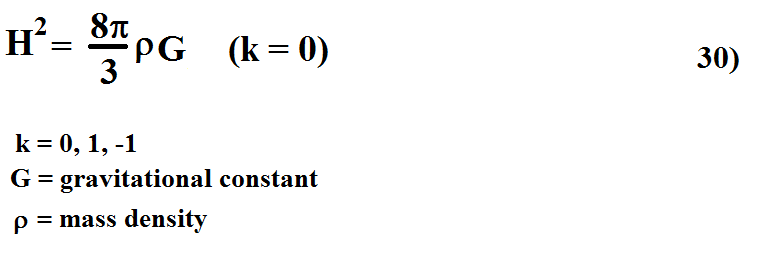
We bring back the Friedmann equation at 30 below. According to the WMAP spacecraft, space is nearly flat, so we set k to zero.

Let's assume a gravitational field has a limited range of r = c/H. The diagram below shows a sphere with volume V divided into an alpha section and a beta section. The alpha section is within the c/H limit for observer O; the beta section is not. This creates an inequality at 31. If gravity depends on gravitons limited to light speed, the Friedmann equation is invalid if distance r is greater than c/H.

Next, lets assume the vacuum and gravitational fields both exist everywhere. The equality is restored and the Friedmann equation is always valid:

This seems inconsistent with GWs that cannot penetrate the c/H barrier. Let's examine GW equations and see if we can reconcile this apparent inconsistency.

At 33 above we begin with a GW power equation for two rotating black holes. With a little algebra we derive equation 37. At 37 we assume gravity has an unlimited range, so we multiply that part by Sv which equals 1. We further assume GWs that are more than c/H meters away from an observer cannot be detected. So we multiply P and the frequency by s, where s equals 0. Equation 37 confirms that gravity overcomes the c/H barrier and GWs may not. GWs do not carry gravitational information. If there was zero frequency, the black holes would still have gravity and there would be no GWs. The source of GWs is the kinetic energy needed to maintain the orbits of the black holes. Over time this energy is converted to massless waves that propagate no faster than light. Equation 38 below shows how gravity can exist in the absence of GWs (notice that the s's cancel):

<

class="separator" style="clear: both;">

Conclusion:

It appears that vacuum and gravitational fields extend to infinity unlike the electric field. Both gravity and dark energy have the potential for speed greater than light; yet, ironically, this does not violate the light-speed limit. In fact, the light speed limit itself depends on "spooky action at a distance"--i.e.--entanglement of frequency and wavelength. This entanglement is also essential to the velocity addition formula that ensures that two velocities never exceed light speed.

References:

1. Flanagan, Eanna. Hughes, Scott A. 2005. The Basics of Gravitational Wave Theory. New Journal of Physics.

2. Van Flandern, T. 1999. The Speed of Gravity What the Experiments Say. Meta Research University of Maryland Physics Army Research Lab.

3. Siegel, Ethan. August 30, 2018. Our Motion Through Space Isn't A Vortex, But Something Far More Interesting. Forbes

4. Tzortzakakis, Filippos, LIGO Analysis: Direct Detection of Gravitational Waves. Journal of Research Progress Vol. 1.

5. Roberts, Tom, Schleif, Siegmar. 2007. What is the experimental basis of Special Relativity?

6. Friedmann equations. Wikipedia

Friday, February 8, 2019

An Analysis of Alcubierre's Warp Drive

"By a purely local expansion of spacetime behind the spaceship and an opposite contraction in front of it, motion faster than the speed of light as seen by observers outside the disturbed region is possible."--Miguel Alcubierre

To read Alcubierre's original warp drive paper, click here. First, let's derive Alcubierre's warp-drive metric from Einstein's field equations. Here is a list of variables required:

We begin with equation 1, Einstein's famous general relativity equation, then we do a little algebra and contract the tensors to simplify the math:

Next, we put together the metric. Equation 12 below is the finished product:

Coordinates y and z are set to zero because the spaceship is moving along the x axis. Velocity v is further defined below. It is a function of the warp-bubble shaping function and the difference between the spaceship's position and the total distance along x.

At 15 notice the value inside the warp bubble is 1 and outside is zero. This allows time to dilate outside the warp bubble, while inside the bubble there is no time dilation. More on this later. For now, let's continue defining the other components:

Below is a crude diagram representing the warp bubble moving along the x axis:

"It is then easy to see that for the spaceship’s trajectory we will have: dτ = dt ."--Miguel Alcubierre

From Alcubierre's metric we can derive a Lorentz equation (see 19 below) that shows how time dilation is avoided. Since the value of the bubble shaping function is 1 inside the warp bubble the velocity v and velocity x/t cancel each other, so there's no time dilation inside the warp bubble. The function value is 0 on the outside, so there x/t is not cancelled and any time dilation would take place outside the warp bubble.

At 20 above, we see that proper time (t') equals coordinate time (t).

"The metric I have just described has one important drawback, however: it violates all three energy conditions (weak, dominant and strong). Both the weak and the dominant energy conditions require the energy density to be positive for all observers."--Miguel Alcubierre

It appears that negative energy density is required to achieve speeds greater than light speed. Negative energy density implies negative energy and negative mass. Check out the following equation system:

Notice that when v > c, the only way to get a value for m' that is real and not imaginary is to plug in -mv^2, a negative energy that has negative mass (-m). For photons, where v = c, mass m' is zero as expected. Particles that move faster than light (e.g. tachyons) have negative mass. Thus it seems such exotic matter is required to achieve superluminal speed. However, consider a satellite orbiting a black hole at radius r:

The black hole has positive mass, i.e., positive energy density. If we increase that positive energy density, we can imagine the satellite orbiting faster and faster. There seems to be no upper limit to velocity v in this gadanke experiment, since there is no apparent upper limit to positive mass m. Further, using Einstein's field equations we can show that unlimited positive energy density (pressure, heat, etc.) can yield unlimited velocity:

At equation 30 above it is plain to see that any increase in positive energy density on the right side will cause a corresponding increase in velocity on the left side. So it appears exotic matter is not really needed to achieve superluminal speed. But then there's this:

"[L]ight itself is also being pushed by the distortion of spacetime."--Miguel Alcubierre

This is an unfortunate choice of words. It gives the impression that the distortion of spacetime can push light faster than light. At least that's what needs to happen if the spaceship is going faster than light; otherwise, the ship's electromagnetic energy could be left behind! Let's see what happens to photons when spacetime is distorted:

On the left side of equation 36 we have a mass particle with velocity v. On the right we have a photon with frequency f. If velocity v increases due to spacetime distortion, the velocity of the photon does not increase; rather, its frequency increases. Now, just for fun, what would happen if we assume the photon's velocity could increase?

On the right side of equation 38, the denominator has c'--a special photon velocity that can rise above c. What is the consequence? A paradox! When energy density increases, so does the spacetime curvature on the left side. This causes c' to increase wich causes the spacetime curvature to reduce which causes c' to reduce and so on. Bottom line: you end up with some very screwed-up physics!

If we can't show that photons go faster than c, at least we can show that other particles can ... or can we? Imagine the spaceship moving toward a star system at velocity nc, which is greater than c. The star system sends photons toward the spaceship at velocity c. What is the combined velocity? It's not nc + c. The velocity addition formula reveals the answer:

As Einstein himself could have told you, the combined velocity is no faster than light! This means no matter how fast distorted spacetime moves the spaceship, if there are any photons along its path (and there will be!), it will move no faster than light.

So how should we interpret equations 30 and 33? Why does it appear that superluminal speed is possible? Equation 33 makes sense if we place ourselves inside the spaceship and allow time dilation to happen.

At 43 above, we multiply the real velocity by t to get the distance. The perceived velocity v is that distance over proper time t', the time experienced by the observers in the spaceship. Let's see what we can derive:

At 51 above, we see that as epsilon gets closer to 1, the perceived velocity gets closer to infinity. The real velocity (epsilon-c) never goes faster than light.

We can determine the value of alpha for equations 30 and 33 (see equation 55):

Now equations 30, 33 and 52 make sense when you consider that observers outside the spaceship will see it going no faster than c, but observers inside the spaceship will swear they covered distance vt in time t', which could be faster than light.

But then again, we have a time dilation problem, since the clock inside the spaceship won't agree with the clock of outside observers. This is definitely true if the spaceship moves and its departure point A and arrival point B are at rest. We illustrate this in the diagram below. The arrow represents the spaceship.

But what if the spaceship, points A and B move at the same rate?

If points A, B and the spaceship all move at the same rate as in the above diagram, their clocks will agree. All observers along that path will be under the impression that the spaceship traveled distance vt in time t', which could be faster than light, at least on paper.

Now, if the observers in the spaceship view the star system they're heading for, according to the velocity addition formula, the combined velocity of the ship and the photons coming from the star will not exceed light speed, so what do they see? We can speculate they see a shorter distance or distance vt' instead of distance vt. If they don't look where they are going, they might assume the distance is vt and conclude they covered it faster than light.

Given what we now know, we should be able to visit any star system in record time, and when we get back home, our clock will agree with clocks on earth. Albeit, Miguel Alcubierre's paper makes no mention of the impact the needed energy will have on the spaceship's clocks. Things like mass and energy also slow time. According to Varieshi and Burstein's paper (click here to read), the amount of energy (mass) needed to manipulate spacetime to achieve a seemingly superluminal speed is approximately 3.42 X 10^38 solar masses! Many orders of magnitude greater than our observable universe! So time dilation is a problem even if we can successfully get the spaceship and points A and B moving at the same rate.

Conclusion: Warp drive makes wonderful science fiction--and it will be quite some time before it becomes a scientific fact.

Update: So do we really need the spaceship and points A and B moving at the same rate to cure time dilation? Take the muon time dilation experiment. When muons are moving at velocity v, their time slows. But if an observer were riding the back of a muon and considered herself at rest, she would see the scientists moving at velocity v, so why doesn't their time dilate as well? If the muons and scientists that observe them are moving at v relative to each other, shouldn't their clocks agree?

But then a closer look at the Lorentz factor reveals what's going on. Time dilation really depends on how fast the muons and scientists are moving relative to the speed of light--and not to each other. Thus the scientists really are at rest (or slower than the muons)--a photon has no trouble catching them, but does have trouble catching a fast muon (according to a coordinate-time observer; a proper-time observer [the muon or scientist] will see the photon approaching at c). Thus, for their clocks to agree, points A, B and the spaceship must move at the same velocity relative to the speed of light, not to each other.