Featured Post

Breakdown of Navier-Stokes Equations

Find PDF version here. Abstract: Given limited energy and a small mass density or large kinematic viscosity, this work shows why...

Showing posts with label cosmology. Show all posts

Tuesday, May 23, 2023

Why Entanglement and Faster Than Light Speed Are Consistent with Relativity

ABSTRACT:

This paper shows why entanglement is not limited to the quantum realm, and shows how entanglement and superluminal speed is not only possible, but consistent with special and general relativity.

Imagine two photons. Photon A and photon B are propagating in opposite directions. According to the velocity addition formula, their combined velocity v is as follows:

Now, imagine two observers, Alice and Bob. Alice looks at each photon individually and notices that they each propagate at c. Bob looks at both photons at once and notes that their combined velocity is c. At this point, you probably have some questions: How does photon A seem to know that photon B is propagating in the opposite direction? It's not like photon B can send a signal to photon A (a signal that would have to be faster than light) to let photon A know that it needs to cut its velocity in half along with photon B so their combined velocity will be no faster than light. Further, how do A and B seem to know that Bob is watching them both? They also seem to know that Alice is watching only one of them. The one she's watching seems to adjust its velocity to c just for her benefit. It's as if the photons are entangled with each other and also entangled with all observers.

Einstein described quantum entanglement as "spooky action at a distance"--yet, where would the velocity addition formula be without "spooky action at a distance"? Below is a mathematical derivation of the entanglement of two particles with velocities v1 and v2:

Equation 7 above shows that, at any distance r (the distance between the two particles), any change of velocities (v1, v2) must lead to an instantaneous change in velocity v; otherwise, light speed c would not be constant in a vacuum. Note that the terms on the right side are in units of frequency and wavelength. To maintain a constant light speed requires any change of frequency to be instantly offset by a change of wavelength. Additionally, this entangled relationship between frequency and wavelength is shown by equation 9 below:

At 11 above is a scalar version of Einstein's field equations. Equation 10 shows that velocity v can be infinite if distance r drops to zero. How is this possible given that infinite energy is required to accelerate mass m to light speed? Equation 9 provides the answer: the infinite velocity is achieved with just the rest-mass energy (E). No force acts on mass m. If a force acts on mass m, then momentum p will be greater than zero. It is this momentum that requires infinite energy to reach light speed. Since infinite energy is not available, mass m cannot reach light speed in this way--and--here is the ironic part: to reach a speed faster than light requires no outside force or energy--just the rest-mass! Albeit, equation 9 shows that superluminal speed is offset by extreme curvature of spacetime. This offset happens instantaneously (yes, more "spooky action at a distance") to ensure that the rest-mass energy is conserved.

Below is a proof that shows the absurdity of assuming it takes a time of r/c seconds for a change of frequency (a change of velocity or mass density) to update a change of wavelength (velocity or curved spacetime), where r is distance and c is the speed of a graviton:

Ironically, the very speed of light itself depends on instantaneous "spooky action at a distance." We can conserve the energy of our two-particle system in the following manner:

The speed of light also depends on the speed of our expanding universe--even if that speed is faster than light:

Equation 19 above shows that velocity Hr could be faster than light; yet the right side of the equation never exceeds c or light speed.

So far, it appears that gravity and dark energy have infinite velocity potential and that spacetime and matter are entangled--which enables "spooky action at a distance" beyond the quantum realm. So ... are there any experiments or observations that lend support to such weirdness? At the time of this writing, I know of no direct observation of superluminal speed. However, black holes lead to the inference that light speed is not enough to escape a black hole's gravity that has a potential meeting or exceeding light speed (see equation 10 above). Additionally, no light can reach us from galaxies that are beyond the cosmological horizon. The "spooky action ..." on a cosmological scale is consistent with astronomical observations cited by Laplace and Van Flandern.

At equation 21 below we define the frequency (f) of an electric field. Albeit, there is a problem. It is assumed that the electric field extends to infinity! At any distance r, an observer allegedly experiences an electric field. If the electric charge q is beyond the cosmological horizon, i.e., r > c/H, an observer at that distance never observes q's electric field nor its frequency f. So at 22 we create a new variable s that equals zero if r > c/H. Equation 23 shows that the observer observes zero evidence of frequency f. Equations 24 through 26 show that variable s should also be applied to gravitational waves (GWs) (and their frequencies), since they are limited to light speed and can't reach an observer if they originate beyond the cosmological horizon.

It is clear that an electric field and GWs have a limited observable range. There is one field, however, that truly has an unlimited range: the vacuum field or "dark energy" if you prefer. An observer at any distance r would never claim there is no evidence of such a field. Thus our new variable s is inapplicable. Velocity v at equation 27 below never equals zero unless r equals zero. At 28 we create a new variable Sv that is always equal to one. As a result equation 29 can be substituted for equation 27.

We bring back the Friedmann equation at 30 below. According to the WMAP spacecraft, space is nearly flat, so we set k to zero.
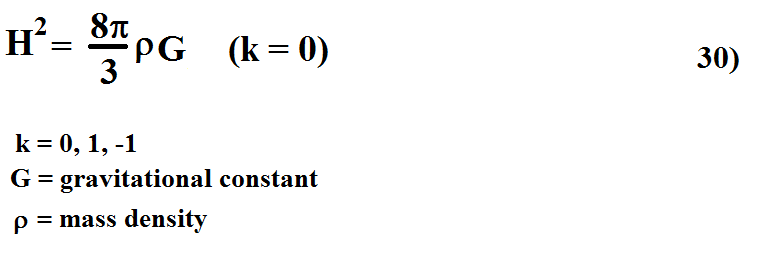
Let's assume a gravitational field has a limited range of r = c/H. The diagram below shows a sphere with volume V divided into an alpha section and a beta section. The alpha section is within the c/H limit for observer O; the beta section is not. This creates an inequality at 31. If gravity depends on gravitons limited to light speed, the Friedmann equation is invalid if distance r is greater than c/H.

Next, lets assume the vacuum and gravitational fields both exist everywhere. The equality is restored and the Friedmann equation is always valid:

This seems inconsistent with GWs that cannot penetrate the c/H barrier. Let's examine GW equations and see if we can reconcile this apparent inconsistency.

At 33 above we begin with a GW power equation for two rotating black holes. With a little algebra we derive equation 37. At 37 we assume gravity has an unlimited range, so we multiply that part by Sv which equals 1. We further assume GWs that are more than c/H meters away from an observer cannot be detected. So we multiply P and the frequency by s, where s equals 0. Equation 37 confirms that gravity overcomes the c/H barrier and GWs may not. GWs do not carry gravitational information. If there was zero frequency, the black holes would still have gravity and there would be no GWs. The source of GWs is the kinetic energy needed to maintain the orbits of the black holes. Over time this energy is converted to massless waves that propagate no faster than light. Equation 38 below shows how gravity can exist in the absence of GWs (notice that the s's cancel):

<

class="separator" style="clear: both;">

Conclusion:

It appears that vacuum and gravitational fields extend to infinity unlike the electric field. Both gravity and dark energy have the potential for speed greater than light; yet, ironically, this does not violate the light-speed limit. In fact, the light speed limit itself depends on "spooky action at a distance"--i.e.--entanglement of frequency and wavelength. This entanglement is also essential to the velocity addition formula that ensures that two velocities never exceed light speed.

References:

1. Flanagan, Eanna. Hughes, Scott A. 2005. The Basics of Gravitational Wave Theory. New Journal of Physics.

2. Van Flandern, T. 1999. The Speed of Gravity What the Experiments Say. Meta Research University of Maryland Physics Army Research Lab.

3. Siegel, Ethan. August 30, 2018. Our Motion Through Space Isn't A Vortex, But Something Far More Interesting. Forbes

4. Tzortzakakis, Filippos, LIGO Analysis: Direct Detection of Gravitational Waves. Journal of Research Progress Vol. 1.

5. Roberts, Tom, Schleif, Siegmar. 2007. What is the experimental basis of Special Relativity?

6. Friedmann equations. Wikipedia

Friday, May 21, 2021

The Relativistic Nature of the Expanding Universe

Our expanding universe is not thought to be relativistic. Technically, the galaxies receding away from us are at rest. The space between them is expanding and creating the impression that the galaxies are in motion. However, each galaxy can be treated as a clock, and, it is not likely that any of these clocks tell time at the same rate.

Using the diagram below as a reference, consider Alice and Bob living in a static universe. Alice lives in galaxy A and Bob lives in galaxy B. Each has a photon gun and shoots one photon per second at the other. The vertical red arrows represent the photons fired from one galaxy to the other. When the first photon from Alice (after traveling light years) finally arrives at galaxy B, Bob intercepts it and records it as a unit of time. Since Alice fired photons at regular intervals, Bob only has to wait one second for the next photon and another second for the next one after that and so forth. He receives one photon per second from Alice, and, for similar reasons, Alice receives one photon per second from Bob. This is how Alice and Bob keep track of each other's time rate.

You will note there are some horizontal red arrows at the top of the above diagram. Also located at galaxy A is Gertrude. She also has a photon gun. She fires one photon per second at Alice. Alice therefore intercepts and records one photon per second from Gertrude. Bob also receives photons in the same manner from Norbert who is also lacated at galaxy B (see horizontal red arrows at the diagram's bottom). This is how Alice and Bob keep track of their own time rates.

When the universe is static, both Alice and Bob receive fired photons from all directions at a rate of one photon per second. All clocks seem to agree and equations 1 and 2 provide the relevant math. But suppose the galaxies move away from each other at velocity v due to expanding space. The next diagram represents this scenario:

The vertical red arrows show that the photons take longer to reach their respective destinations and fewer photons are received per second compared to photons represented by the horizontal arrows. Since each photon is counted as a unit of time, Alice and Bob have the impression that the other's time rate is slower. Since Gertrude is located in the same galaxy as Alice, she isn't receding from Alice the way Bob is, so Alice sees no change in her time rate, since she receives the same number of photons (time units) from Gertrude. Ditto for Bob and Norbert at galaxy B.

If we do a little algebra we can derive the Lorentz equation from equation 3 above. The final result is equation 10:

Equation 10 shows each galaxy's proper time (t') shrinking as they accelerate further apart. It does not matter if the galaxies are technically at rest, since the space inbetween and the photons are not at rest. If the space is at rest, here's the result after firing a photon gun for five seconds:

Notice the steady stream of photons. This is where t' = t. The next diagram shows what happens if space expands at a steady rate of v. The photons still have a steady rate but the interval between them has increased, so they are not counted as frequently. Time t' is less than t.

Finally, the next diagram is the most realistic, since the expansion of space is accelerating. Here the the interval between photons continues to grow and they are counted less and less frequently. Time t' is shrinking.

When Alice and Bob are far enough apart, neither will receive any photons from the other. Time t' will be zero. Thus the expanding universe is relativistic if one keeps track of the various time rates at different distances.

Monday, May 11, 2020

Uncertainty Principle for Black Holes

The above video discusses black-hole mathematical singularity problems. The current laws of physics seem to break down once a particle crosses a black hole's event horizon. One mathematical singularity occurs at the Schwarzschild radius; another occurs at the black hole's center. That being said, we will show if Heisenberg's uncertainty principle is employed, the singularity problems vanish and the laws of physics are restored. First, we define the variables we will use:

Before we examine a black hole, let's look at an electron orbiting a hydrogen nucleus. If we know the electron's mass and its approximate velocity (close to light speed c),i.e., its momentum, then we don't know its exact position. Its position could be anywhere within the Bohr radius. The product of its uncertain position and momentum gives us a number close to Planck's reduced constant:

We can imagine the electron being anywhere within a spherical cloud extending as far as the Bohr radius:

Now, let's take the mass of a black hole. Let's assume it is greater than the Planck mass. At the black hole's Schwarzschild radius, equation 3 is true:

Next, we add a pinch of algebra to get equation/inequality 5--an uncertainty principle for the black hole.

So far, so good, but we run into a problem when we reduce radius r to, say, the Planck length:

The inequality at 6 clearly violates the uncertainty principle. The left side is required to be greater or equal to the right side--not less! The problem is caused by the momentum term containing nothing but constants (the Planck mass, c, and m).

If we are more certain about the position or size of the black hole's physical singularity, we need to be more uncertain about its momentum, so we need a momentum uncertainty factor represented by the Greek letter eta:

At 8 we see the uncertainty principle is restored. When radius r shrinks to a Planck or even a zero limit, eta blows up as it should.

Below we do some more algebra and derive 14:

At 14 we see the total energy on the right side never exceeds the total finite energy on the left side. A large momentum uncertainty (eta) cancels position certainty due to a small or zero radius. The inequality/equation at 14 also implies the black hole's singularity position is uncertain if the momentum is known. It could be located anywhere within a sphere bounded by the Schwarzschild radius. The most probable location being the center.

We can take what we have developed so far and apply it to an energy conservation technique used within a previous post titled "High Energy Quantum Gravity." At 15 below we take the total energy between two orbiting bodies and subtract the strong, weak and electromagnetic energies.

The gravitational energy that remains will have a radius (ro) independent of radius r. The total gravitational energy remains constant no matter the distance r. However, we've factored in eta to conserve the Heisenberg uncertainty principle if r shrinks below the Scharzschild limit. Equation 15 reveals that a small force over a large area is equal to a large force over a small area.

Now, let's take what we now know and apply it to the singularity problems that crop up in the Schwarzshild metric below:

At 16, the right side's first term is infinity if r = rs. This implies the spacetime interval (ds) is infinite at the Schwarzschild radius--which is ridiculous. If r = 0, the last term, proper time, is infinite--also ridiculous. But of course, we have the tools to vanquish these mathematical singularities. We know the following Lorenz equations are true:

From 19 to 23 we make some substitutions and simplify the metric at 24:

At 25 we factor in eta:

Now, the only time we get infinity is when r is infinity and kappa is greater than zero. This makes sense if you stop and think about it (see results below).

When the radius is equal to the Schwarzschild radius, the spacetime interval is finite and the proper time is zero. When the radius is zero, the spacetime interval is only the outside observer's time, which makes sense, since nothing can move through zero space (a single point). The proper time is also zero, which makes sense, since it implies that time began after the universe expanded beyond a single point. Thus the current laws of physics that previously broke down are now at least partially fixed.

Special thanks to Cosmological {Prime} Causality for linking this post. Click here to read their blog.

Tuesday, December 10, 2019

Resolving the Black Hole Information Paradox: How Information is Lost and Conserved

According to the current paradigm, quantum information is conserved. With perfect knowledge of the current universe it should be possible to trace the universe backwards and forwards in time. This principle would be violated if information were lost. When information enters a black hole we might assume the information is inside, but then black holes evaporate due to Hawking radiation, and the black hole's temperature is as follows:

As the black hole evaporates, its mass shrinks and its temperature increases. Take note that equation 1 fails to tell us what information went into the black hole, so looking at the final information (remaining mass, momentum, charge) pursuant to the no-hair theorem we can't extrapolate that data backwards and determine what information went into the black hole. This is known as the Black Hole Information Paradox.

Many hypotheses have been set forth that attempt to resolve this paradox. One popular one is the holographic principle (T'Hooft and Susskind). Unfortunately, it is easy to punch holes in this one. You can read about it by clicking here.

Another common proposal is the information goes inside the black hole, then through a wormhole into another universe. Personally, I don't care for this one, since it requires the establishment of another universe (good luck!). Then there's the explanation that begins with a shrug and ends with a sigh: the information is lost.

Of course I'm not without a brainstorm of my own, which is why I'm now scribbling. It occurred to me that maybe there's at least two kinds of information: information that is conserved and information that is not. This random thought popped into my head when I was working on the following math proof:

The proof starts with the absurd claim that if 'a' doesn't equal 'b' then 'a' is equal to 'b.' Let's suppose 'a' is information. At equation 2 it is defined. However, by the time we get to equation 4, 'a' becomes undefined. Zero times infinity can equal any number, so the definite information we started with appears to be lost. Although, unlike black-hole information, by the time we get to equation 7, 'a' is defined again, but this time it is defined as 'b.'

What we can take away from the proof above is specific information is not conserved, but information overall is conserved. The information changed from 'a' to undefined to 'b.' Unfortunately, even though the information is conserved, we can't tell by looking at 'b,' that it was once 'a.'

Below is another example of what I'm scribbling about. Start with two distinct binary numbers. Let's pretend they enter a fictitious binary black hole and come out identical (zeros on the left, ones on the right). Now we put them into a cosmic hat. You reach in and pull one out. Can you tell whether it used to be 1010 or 0101? I don't see how. The information is conserved however--there's still the same number of ones and zeros.

Rather than say information is lost, perhaps it is more prudent to say it is undefined. In the case of a black hole, most of the information becomes undefined. Having perfect knowledge of it doesn't help us trace it back to its defined state prior to entering a black hole.

There are many examples in everyday life where we can observe information evolving from defined to undefined. Write a message on a blackboard. Erase the message. The chock that made up the message is now smeared onto the eraser. Give the eraser to a physicist and see if he/she can tell you what your unique message was. At this point, the chalk has mass, for instance, but chances are excellent that physicist won't be able to know your unique message. That information is lost. It was defined, now it is undefined (except for some basic properties like mass, etc.)

The no-hair theorem reminds me of brown paint. Imagine some masterpiece paintings, each with a unique set of information. The paint on each painting is scraped off the canvass and mixed in a bucket of paint thinner. At the end you have several buckets of brown paint. If they are mixed up and you choose one at random, can you tell which painting it came from? Probably not. It's another case where defined information becomes less defined--so it may also be true even at the quantum scale. For example, according to quantum field theory, particles and their unique, well-defined properties are excitations of fields where the information is kind of blurry or undefined.

Imagine an electron-positron pair popping into existence. The electron is spin up, the positron is spin down. They annihilate. Is it possible to look at the resulting photon and know it was previously a spin-up electron and a spin-down positron? For all you know the electron was spin-down and the positron was spin up. Yet another case of information evolving into something where you can't know its previous state. So why should we be surprised there's an information paradox if we believe perfect knowledge of the current state of information allows us to trace it backwards and forwards in time?

Saturday, December 1, 2018

Why Gravitational Waves Fail to Confirm Extra Dimensions

According to the holographic principle, our four-dimensional universe, consisting of three space dimensions and one time dimension, is a surface area of a five-dimensional spacetime called "the bulk." The remaining dimensions of string theory or M-theory are allegedly compacted and rendered insignificant.

Gravity, compared to the other fundamental interactions, is weak due to the graviton's unique ability to move between the surface area (our spacetime) and the bulk. Other particles remain fully in our spacetime and thus have more intensity. At least that's how the story goes. Unfortunately, the gravitational-wave test described in the above video failed to confirm the existence of "the bulk" or any extra dimensions beyond our four-dimensional spacetime. This does not surprise me, given the problems extra dimensions can cause (click here to read all about it).

So why did the gravitational-wave test fail? Do we really need "the bulk" to explain the nature of gravity? We will explore these questions. First, let's define the variables we will use:

According to general relativity, gravity is a function of energy density, so let's begin with the energy density of an atom. An atom is mostly space, so let's only consider the volume of space taken up my the average nucleus and the electrons. That approximate volume can be found in the denominator of equation 1 below:

Of course if we put that volume in the numerator, we get the energy (E):

If we put a larger volume (V) in the denominator (equation 3), we get a reduced energy (E'). Reduced energy is consistent with weak gravity, so we are on the right track.

We don't want Energy units, so at 5 and 6 we use meters and Newtons to adjust the units:

Now, coincidentally, 10^-45/N is approximately equal to G/c^4, so we make the substitution:

We use distance D and the alpha scale factor to make more substitutions at equation 9. From there we derive equation 12.

Equation 12 is Newton's equation. We were able to derive this equation because we started with the premise that the intensity of gravity is determined by the actual amount of space a particle interacts with. For baryonic matter, that actual amount of space corresponds with the gravitational constant G. Note that no extra dimensions are needed to get equation 12. Our 4D spacetime is sufficient. So why should we be surprised that the gravitational-wave test failed to confirm "the bulk"?

Caveat: the above mathematics may work just fine for ordinary matter such as atoms and molecules, but what about singularities such as black holes? Theoretically, a singularity takes up no space, so there shouldn't be any interaction between the matter and space, but there is! To resolve this conundrum, we first need to establish that light speed is truly the top speed in our universe. Consider the familiar Lorentz equation:

The main problem with this equation is time (t) is arbitrary. Let's make it precise. Let's make time (t) equal to the age of the universe. When I say universe I mean everything including the megaverse if such a thing exists. What we want is the longest time ever lapsed--so we set t accordingly and define the other variables we need:

Now we derive 21 below:

Line 21 shows that no velocity (v) can exceed light speed (c). So what does this have to do with gravity and black holes? Given the fact that light speed is the top speed, we can derive the following:

Take a look at 25 and 26 above. At 25, G stays constant as long as the change in time (delta-t) is equal to or less than the age of the universe. Note that delta-t increases as radius r decreases, so G remains constant. But delta-t has an upper limit of t. If r continues to shrink, G must also shrink. Thus it appears the intensity of gravity is determined by how much space interacts with matter. The smaller the radius r, the smaller the space the matter occupies. Equation 27 shows that the intensity of gravity never exceeds the speed of light squared no matter how much radius r shrinks.

In conclusion, "the bulk" and extra dimensions are completely unnecessary to describe gravity.