Featured Post

Breakdown of Navier-Stokes Equations

Find PDF version here. Abstract: Given limited energy and a small mass density or large kinematic viscosity, this work shows why...

Showing posts with label applied mathematics. Show all posts

Monday, September 9, 2024

N-body Problem Solutions

ABSTRACT:

This paper reveals a paradox within our current understanding of gravity that makes problems involving more than two bodies seemingly unsolvable. By introducing the alpha factor, the paradox is resolved and the solutions to various n-body problems become clear.

Imagine a skydiver falling to the earth's surface. Normally we can treat this as a 2-body problem--the two bodies being the skydiver and the earth. But suppose we didn't have the benefit of Newton's formula? Suppose we see this as an n-body problem because the earth is made up of n-1 particles, each with an individual mass and distance from the skydiver. The position and momentum of each particle, of course, is uncertain, so let's settle for the expectation values of the particles' positions, i.e., where the particles are most likely to be:

The diagram below is a representation of the distance vectors for each particle to the skydiver (green dot):

To simplify the problem, we determine the average position of the expected value positions of the particles (see blue dots below). Our n-body problem becomes a 5-body problem.

At equation 1 below we sum the individual masses to get the total mass M. At equations 2 through 4 we calculate the resultant vector R which shows us which way the skydiver will move. As it turns out, R is the distance between the skydiver and the earth's center of mass. Via observations we determine the constant G. This leads us to equation 5 which is Newton's formula.

Thus, we have solved an n-body problem along an x-y plane. We could have included the z-axis, but it wasn't necessary. It is often possible to rotate or orient the coordinate system so the problem can be solved in the simpler 2D format.

Note that the direction the skydiver falls is down, or along the y-axis. This is because the x directions cancel each other. The skydiver's movement along x is always zero. This presents a paradox, however! The diagrams below demonstrate that the skydiver will always fall at the same rate no matter how far apart along x the red and blue masses are from each other. The distance to the mass center is always the same.

Here's a 3-body problem: Imagine the red and blue bodies above are an infinite distance apart. The center of mass between them is the same as when the two bodies are both located at the center of mass. In fact, all the earth's particles gravitationally behave as if they are all located at the center of mass, no matter how close or far away they are from the sky diver. Yet, the inverse square law tells us that distance matters. Paradoxically, if distance matters, then Newton's formula, as it is normally applied, wouldn't give us the right answer. It would make more sense to simply sum up each particle's gravitational impact on the skydiver.

Unfortunately, in earth's case, Newton's formula gives us the right answer if we pretend that all the earth's particles are located at the center of mass. It is also unfortunate that it won't enable us to solve the 3-body problem suggested in the above diagrams. Newton's method predicts gravitational acceleration is the same whether the red and blue bodies are close to the green body or far away. Albeit, perhaps there's a way to solve the paradox. Here is my proposed solution:

Equations 6 and 7 above show how the skydiver's position changes along x (delta-x) and along y (delta-y). At the right side of equation 6, dt is the increment of time; X/|X| is the direction along the x-axis; X^2/R^2 is the fraction of acceleration along x; then there's the summation of alpha factors, body masses, and r distances each body is from the skydiver. Ditto for the y-axis at equation 7.

Now, I've introduced something new: the alphas. So what exactly are the alphas and what is their purpose? Examine equations 9 and 10 below:

If each alpha has the value suggested at 10, then the inner product yields the familiar Newton's equation. If each alpha equals one, we get a different outcome:

At equation 11 above we have a solution that makes sense for our paradoxical 3-body problem. So when is it appropriate to use equation 11 instead of equation 10? Both the earth and the 3-body problem appear similar, but there is a difference. This difference becomes more obvious if we think of the earth as accelerating towards the skydiver rather than vice versa. Earth's particles, for the most part, move as one towards the skydiver, so they all move along the same vector instead of individual vectors. If, for example, one or more of the earth's particles are perturbed by an outside force, the remaining particles will also very likely accelerate along the same vector as the perturbed particles. By contrast, if, say, an outside force perturbed the red body in our 3-body problem, the blue body need not move in lockstep with the red body. The two bodies are more independent. The value we assign to each alpha is determined by how independently the bodies move.

Equations 6 and 7 seem fine for falling skydivers, but what about orbiting satellites? Equations 12 through 17 below provide the relevant math for orbiting bodies:

Now, that an n-body solution has been proposed, let's see if we can prove it mathematically. At 18 below we start with what we know: Newton's equaton, then go from there. The final result is equation 24.

Below we use our new formula to solve the seemingly unsolvable 3-body problem. All the alphas are set to 1. The distance between the skydiver and the center of mass is still the same, but the red and blue bodies don't have to move in lockstep, so their distance apart now matters.

Equations 29 and 30 above tell us how much the skydiver moves along x and y during time interval dt. To see some animated simulations of 3-body and 6-body solutions, visit https://garmichaels.pythonanywhere.com/n_body_index/.

References: ChatGPT4 and Wikipedia.com

Tuesday, May 23, 2023

Why Entanglement and Faster Than Light Speed Are Consistent with Relativity

ABSTRACT:

This paper shows why entanglement is not limited to the quantum realm, and shows how entanglement and superluminal speed is not only possible, but consistent with special and general relativity.

Imagine two photons. Photon A and photon B are propagating in opposite directions. According to the velocity addition formula, their combined velocity v is as follows:

Now, imagine two observers, Alice and Bob. Alice looks at each photon individually and notices that they each propagate at c. Bob looks at both photons at once and notes that their combined velocity is c. At this point, you probably have some questions: How does photon A seem to know that photon B is propagating in the opposite direction? It's not like photon B can send a signal to photon A (a signal that would have to be faster than light) to let photon A know that it needs to cut its velocity in half along with photon B so their combined velocity will be no faster than light. Further, how do A and B seem to know that Bob is watching them both? They also seem to know that Alice is watching only one of them. The one she's watching seems to adjust its velocity to c just for her benefit. It's as if the photons are entangled with each other and also entangled with all observers.

Einstein described quantum entanglement as "spooky action at a distance"--yet, where would the velocity addition formula be without "spooky action at a distance"? Below is a mathematical derivation of the entanglement of two particles with velocities v1 and v2:

Equation 7 above shows that, at any distance r (the distance between the two particles), any change of velocities (v1, v2) must lead to an instantaneous change in velocity v; otherwise, light speed c would not be constant in a vacuum. Note that the terms on the right side are in units of frequency and wavelength. To maintain a constant light speed requires any change of frequency to be instantly offset by a change of wavelength. Additionally, this entangled relationship between frequency and wavelength is shown by equation 9 below:

At 11 above is a scalar version of Einstein's field equations. Equation 10 shows that velocity v can be infinite if distance r drops to zero. How is this possible given that infinite energy is required to accelerate mass m to light speed? Equation 9 provides the answer: the infinite velocity is achieved with just the rest-mass energy (E). No force acts on mass m. If a force acts on mass m, then momentum p will be greater than zero. It is this momentum that requires infinite energy to reach light speed. Since infinite energy is not available, mass m cannot reach light speed in this way--and--here is the ironic part: to reach a speed faster than light requires no outside force or energy--just the rest-mass! Albeit, equation 9 shows that superluminal speed is offset by extreme curvature of spacetime. This offset happens instantaneously (yes, more "spooky action at a distance") to ensure that the rest-mass energy is conserved.

Below is a proof that shows the absurdity of assuming it takes a time of r/c seconds for a change of frequency (a change of velocity or mass density) to update a change of wavelength (velocity or curved spacetime), where r is distance and c is the speed of a graviton:

Ironically, the very speed of light itself depends on instantaneous "spooky action at a distance." We can conserve the energy of our two-particle system in the following manner:

The speed of light also depends on the speed of our expanding universe--even if that speed is faster than light:

Equation 19 above shows that velocity Hr could be faster than light; yet the right side of the equation never exceeds c or light speed.

So far, it appears that gravity and dark energy have infinite velocity potential and that spacetime and matter are entangled--which enables "spooky action at a distance" beyond the quantum realm. So ... are there any experiments or observations that lend support to such weirdness? At the time of this writing, I know of no direct observation of superluminal speed. However, black holes lead to the inference that light speed is not enough to escape a black hole's gravity that has a potential meeting or exceeding light speed (see equation 10 above). Additionally, no light can reach us from galaxies that are beyond the cosmological horizon. The "spooky action ..." on a cosmological scale is consistent with astronomical observations cited by Laplace and Van Flandern.

At equation 21 below we define the frequency (f) of an electric field. Albeit, there is a problem. It is assumed that the electric field extends to infinity! At any distance r, an observer allegedly experiences an electric field. If the electric charge q is beyond the cosmological horizon, i.e., r > c/H, an observer at that distance never observes q's electric field nor its frequency f. So at 22 we create a new variable s that equals zero if r > c/H. Equation 23 shows that the observer observes zero evidence of frequency f. Equations 24 through 26 show that variable s should also be applied to gravitational waves (GWs) (and their frequencies), since they are limited to light speed and can't reach an observer if they originate beyond the cosmological horizon.

It is clear that an electric field and GWs have a limited observable range. There is one field, however, that truly has an unlimited range: the vacuum field or "dark energy" if you prefer. An observer at any distance r would never claim there is no evidence of such a field. Thus our new variable s is inapplicable. Velocity v at equation 27 below never equals zero unless r equals zero. At 28 we create a new variable Sv that is always equal to one. As a result equation 29 can be substituted for equation 27.

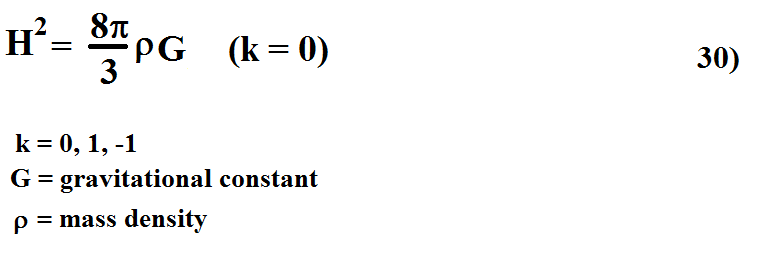
We bring back the Friedmann equation at 30 below. According to the WMAP spacecraft, space is nearly flat, so we set k to zero.

Let's assume a gravitational field has a limited range of r = c/H. The diagram below shows a sphere with volume V divided into an alpha section and a beta section. The alpha section is within the c/H limit for observer O; the beta section is not. This creates an inequality at 31. If gravity depends on gravitons limited to light speed, the Friedmann equation is invalid if distance r is greater than c/H.

Next, lets assume the vacuum and gravitational fields both exist everywhere. The equality is restored and the Friedmann equation is always valid:

This seems inconsistent with GWs that cannot penetrate the c/H barrier. Let's examine GW equations and see if we can reconcile this apparent inconsistency.

At 33 above we begin with a GW power equation for two rotating black holes. With a little algebra we derive equation 37. At 37 we assume gravity has an unlimited range, so we multiply that part by Sv which equals 1. We further assume GWs that are more than c/H meters away from an observer cannot be detected. So we multiply P and the frequency by s, where s equals 0. Equation 37 confirms that gravity overcomes the c/H barrier and GWs may not. GWs do not carry gravitational information. If there was zero frequency, the black holes would still have gravity and there would be no GWs. The source of GWs is the kinetic energy needed to maintain the orbits of the black holes. Over time this energy is converted to massless waves that propagate no faster than light. Equation 38 below shows how gravity can exist in the absence of GWs (notice that the s's cancel):

<

class="separator" style="clear: both;">

Conclusion:

It appears that vacuum and gravitational fields extend to infinity unlike the electric field. Both gravity and dark energy have the potential for speed greater than light; yet, ironically, this does not violate the light-speed limit. In fact, the light speed limit itself depends on "spooky action at a distance"--i.e.--entanglement of frequency and wavelength. This entanglement is also essential to the velocity addition formula that ensures that two velocities never exceed light speed.

References:

1. Flanagan, Eanna. Hughes, Scott A. 2005. The Basics of Gravitational Wave Theory. New Journal of Physics.

2. Van Flandern, T. 1999. The Speed of Gravity What the Experiments Say. Meta Research University of Maryland Physics Army Research Lab.

3. Siegel, Ethan. August 30, 2018. Our Motion Through Space Isn't A Vortex, But Something Far More Interesting. Forbes

4. Tzortzakakis, Filippos, LIGO Analysis: Direct Detection of Gravitational Waves. Journal of Research Progress Vol. 1.

5. Roberts, Tom, Schleif, Siegmar. 2007. What is the experimental basis of Special Relativity?

6. Friedmann equations. Wikipedia

Tuesday, June 11, 2019

A Perturbation Theory Proof

To prove the validity of the perturbation expansion, let's start with a simple and obvious statement:

It seems intuitive that a variable x can be the sum of two terms containing two new variables. In fact, the same can be said of variable a1:

And, a2 can be the sum of two terms containing two new variables. We can repeat this exercise as many times as we like until we reach a(sub-n):

Using equations 2 through 5 we make a series of substitutions which transform equation 1 into the familiar perturbation expansion:

However, equation 6 is an exact solution which can't be had unless we know the value of a(sub-n). Let's assume we don't. Let's eliminate a(sub-n). If we do, we get an approximate solution:

Now, how do we apply this approximate series known as a perturbation series? Consider a function of x:

Let's assume this function of x is too hard to solve. So we re-write f(x) above to show the easy, solvable part and the seemingly unsolvable part:

Let's suppose the hard part is g(x). Wouldn't it be great if we could just get rid of it? Not permanently. Just for the time being. We do away with g(x) by multiplying it by epsilon, and epsilon has a zero limit.

We end up with equation 12 which is easy to solve. The solution can be found at 13. However, we didn't solve variable x--we solved what is called an unperturbed x or x0. We can now plug that solution into equation 7 and equation 8. Because x is approximately equal to x0 plus the rest of the series, we can make a substitution at equation 11 to get the following:

At 15 we set the equation to zero. The idea here is to solve the xi coefficients. This is often done by grouping terms on the basis of their epsilon powers. The equation is broken up into smaller, simpler equations that are easy to solve. At 18 below, the solved coefficients are plugged into the series and epsilon is set back to 1 (giving us back the equivalent to the missing hard part of the original equation). At 19 and 20 we simply add up the coefficients to get a close approximation of the true value of x.

Since the intent of this post was to do a general proof of perturbation theory, no specific problem-solving examples were provided. Click here to see an example of a specific problem solved using perturbation theory.