Featured Post

Breakdown of Navier-Stokes Equations

Find PDF version here. Abstract: Given limited energy and a small mass density or large kinematic viscosity, this work shows why...

Showing posts with label dark energy. Show all posts

Monday, February 7, 2022

Quantizing Gravity without the Graviton

Abstract:

This paper shows the connection between "dark energy" and gravity, the equivalence between matter and space, and how gravity works without the graviton or gravitational waves. It also suggests an alternate way to quantize gravity using smaller units--of mass, space and time--than the Planck units.

The same force acting on different masses will cause each mass to move at a different rate: F = ma, where m is mass and a is acceleration. However, the same "gravitational force" causes different masses to fall at the same rate. How can this be? Einstein proposed that when a body appears to be falling to earth, it is really at rest, and the earth is accelerating towards the body at a given rate. Thus the body's mass is irrelevant.

Below is a diagram of Alice who is surrounded by four bodies, including Bob. Bob and the others appear to be either moving away from Alice or towards her, depending on how you follow the arrows. But if we go from left to right, we can think of Alice as the one who is moving away from the surrounding bodies. If we go from right to left, we can think of Alice as the one who is moving towards the surrounding bodies. As a consequence, the surrounding bodies can have any mass and the rate at which Alice and the surrounding bodies diverge or converge will be the same.

Equations 1 and 2 below were derived from Einstein's field equations. Equation 3 was derived from a Friedmann equation where k is set to zero due to spacetime being flat at a large scale where the mass density (rho) is a small number and so is the curvature which is represented by the cosmological constant.

At 4 and 5 we set up a couple of substitutions to be made at 7 and 8 below. Equation 6 shows how mass and space are equivalent. Divide any mass by the vacuum-mass density to get the equivalent volume. Equation 7 shows the universe must expand faster than light as the radius r tends to infinity; otherwise, light speed in a vacuum is not conserved! If both sides of the equation are multiplied by the universe's mass, then the universe's energy is conserved no matter how big or small the universe becomes.

Also, the vacuum-mass density rho correlates with outward pressure, and that pressure is not diminished by an increase in distance r, so the outward pressure continues and so does the universe's expansion. At equation 8 we see that gravity looks similar to equation 7. As the speed of gravity increases, it is offset by the increase in spacetime curvature. As a result, the constant c and energy are conserved.

Equation 9 below shows that gravitational waves are caused by gravity and angular frequency, so they cannot be the cause of gravity. In fact, if angular frequency is zero, there is still gravity but no gravitational waves.

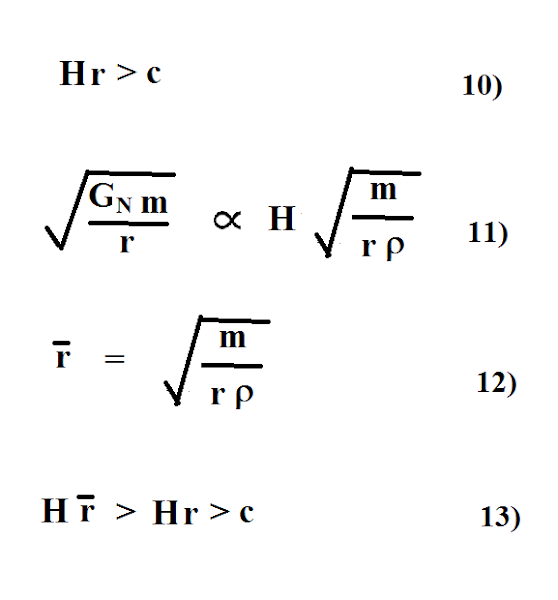
Now, let's imagine Alice and Bob are so far apart that Bob is moving away from Alice faster than light (see 10 below). Alice starts out with very little mass, but decides to go off her diet. As a result, she gains an enormous amount of mass. So much so that she becomes a black hole (see equation 11). The distance between her and Bob is the same but it is now less than Alice's Scharzschild radius. So are Alice and Bob still diverging or are they now converging?

We know that no signal, limited to light speed, ever reached Bob. This includes gravitons, gravitational waves, light, etc. At 12, Alice's mass is converted to it's equivalent space. Finally, the inequality at 13 shows that Bob is still moving faster than light if Alice is at rest, but Alice is no longer at rest--she's moving faster than Bob towards Bob. Thus Alice and Bob are converging as if a "gravitational force" is present.
Take a proton and electron. Equation 14 below shows acceleration depends on both their respective charges, their masses and distance r. Clearly there is an information exchange between them. At equation 15 it's a different story: acceleration only depends on the mass of the proton and distance r. It is clear the two masses don't exchange information. It's as if the proton simply accelerates towards the electron.

Now, let's consider Alice, Bob and Carl below. How fast Alice accelerates depends on the distance of the targets, the targets being Bob and Carl. Surely Alice needs to know the distance of each target so she can adjust her rate of acceleration accordingly?

Consider the diagram below. The numbers in each section add up to the total volume of the 3X3X3 cube. At 17 the volume of each cube is divided by its square. If we multiply each term by the square of Hubble's parameter it becomes apparent that Alice is accelerating less than Bob and Bob is accelerating less than Carl. These three are diverging as if they are in an expanding universe.

Now, let's add mass to the red section. Let's convert it to its equivalent volume which is 100 units. That brings the total to 101 units. Notice that the state of Bob's section (blue) and the state of Carl's section (green) do not change. Each have their previous volume. Also notice that the square areas do not change. This implies no information exchange between Alice, Bob and Carl. But now Alice is accelerating more than Bob and Bob is accelerating more than Carl. The three are converging is if they are in a gravitational field.

The rate of acceleration depends on distance but, as demonstrated above, this does not imply an information exchange between the parties. To drive this point home, imagine we divide up our universe into volume cells, each cell expands at a given rate independently of every other cell. More cells cause a greater rate of expansion, but each cell has no clue how many cells an observer is looking at or what the other cells are doing. The cells exchange no information. Thus the rate of expansion is really up to the observer. Now, suppose you add more volume (cells) to the system without increasing the space. This was done when mass was added to Alice's section (red). Mass's equivalent volume doesn't change the distances between Alice, Bob, and Carl. The result is what we call gravitational acceleration (see equation 20 below). Again, each cell need not know the state of the others. The rate of acceleration depends on the distance the observer chooses to consider.

Now let's turn to quantizing gravity. The popular choice is, of course, the graviton, but the graviton causes a major setback. If we assume the graviton is a real thing, surely we can come up with a reasonable estimate of how many gravitons are in the universe. For example, we could figure the total gravitational energy of the universe and divide that by the average energy of the graviton. At 21 below we plug in the entire mass of the universe to get the gravitational energy, but we don't get units of energy. Instead, we get velocity squared. One could argue that there is no gravitational energy, so there are no gravitons. Equation 22 is an attempt to counter this argument. It uses two masses which give an energy term, but how much gravitational energy there is depends on how much of the universe's total mass we assign to m and m'. Also, whatever gravitational-energy total we arrive at will be exceeded by a single black hole singularity and a single particle that have virtually zero distance between them.

At equation 23 we switch to a smaller scale. We assume the gravitational energy produced by an electron and proton is nEg, where Eg is the energy of one graviton and n is the number of gravitons. Therefore two electron-proton pairs produce 2nEg or 2n gravitons? Not so fast. Since gravitons have energy, they also produce gravitons. At 24 they produce up to an infinite number of gravitons if the distance r limit is zero! So how many gravitons are in the universe? It depends on how you crunch the numbers.

By contrast, it is much easier to estimate how many photons are in the universe, since photons don't produce photons. Electromagnetic energy is a function of charge and not energy or mass. So as long as photons don't have charge, they don't infinitely reproduce themselves. We can take the total luminous energy of the universe and divide it by a photon's average energy to get a reasonable estimate of how many photons there are.

For the above reasons, the graviton is untenable. So then how should we quantize gravity? Gravity is a function of mass (defined as energy divided by light speed squared), space and time. Thus it would make sense to quantize these fundamental dimensions. We could ask, what is the shortest length or time, and, what is the smallest mass? The popular response is, the Planck length, the Planck time and the Planck mass, respectively. But are these really the smallest units? The Planck mass clearly is not the smallest mass. An electron mass is smaller. Also, the Scharzschild radius of an electron is much shorter than a Planck length. The time it takes for a photon to travel the shorter distance is less than the Planck time. So what are the smallest units? Here are the smallest units I have found so far. I call them the Hubble units:

We could take the Hubble length, for example, and quantize equation 13 as follows:

At equation 29 the first term has alpha Hubble lengths; the second term has beta Hubble lengths. The smallest rate of expansion is Hubble's parameter times one Hubble's length. Now, one probable objection to this scheme is space is chaotic and stochastic on the quantum scale, so how can we have such nice, neat units? The Hubble length, for example, could be an expectation value (average) of all the chaotic activity that may make up space. We can think of the Hubble units as perhaps the smallest average units that can be derived from fundamental constants and Hubble's parameter.

In conclusion, unlike the other fundamental interactions, gravity does not appear to have any means for bodies to communicate with each other, nor is communication necessary. Thus the graviton is unnecessary. Further, the graviton fails to conserve energy like its electromagnetic counterpart the photon. A better way to quantize gravity is to quantize space, time and/or mass.

Acknowledgments:

Amber Strunk. Education and Outreach Lead. LIGO Hanford Observatory.

Peter Laursen, Astrophysicist and science communicator at the Cosmic Dawn Center, University of Copenhagen.

References:

1. Parikh, Wilczek, Zahariade. 2020. The Noise of Gravitons. arxiv.org.

2. Feynman, R.P. 07/03/1963. Quantum Theory of Gravitation. Acta Physica Polonica. Vol. XXIV.

3. Graviton. Wikipedia.

4. Carlip, S. 12/1999. Aberration and the Speed of Gravity. arxiv.org.

5. Van Raamsdonk, M. 05/17/2010. Building up spacetime with quantum entanglement. arxiv.org.

6. Hanson, R.; Twitchen, D. J.; Markham, M.; Schouten, R. N.; Tiggelman, M. J.; Taminiau, T. H.; Blok, M. S.; Dam, S. B. van; Bernien, H. (2014-08-01). Unconditional quantum teleportation between distant solid-state quantum bits. Science. 345 (6196): 532–535.

7. Gravitational Wave. Wikipedia.

8. de Rham, C., Tolley, A.J. 03/17/2020. Speed of Gravity. arxiv.org.

9. Carroll, S.M. 12/1997. Lecture Notes on General Relativity. Enrico Fermi Institute.

10. Marsh G.E., Nissim-Sabat. 3/18/1999. Comment on an article by Van Flandern on the speed of gravity. Physics Letters A Vol. 262, pp. 257-260 (1999)

11. Suede M. 11/29/2012. The Speed of Gravity: Why Einstein Was Wrong and Newton Was Right. Blog commentary re: Tom Van Flandern.

12. Cornish N., Blas D., and Nardini, G. 10/18/2017. Bounding the Speed of Gravity with Gravitational Wave Observations. Phys. Rev. Lett. 119, 161102

13. Van Flandern, T. 1999. The Speed of Gravity What the Experiments Say. Meta Research University of Maryland Physics Army Research Lab.

14. Nix, E. 08/22/2018. Who Determined the Speed of Light. History.com.

15. Speed of Gravity. Wikipedia.

16. Tests of General Relativity. Wikipedia.

17. Decross, M. et al. Gravitational Waves. Brilliant.com.

18. Lawden, D.F. 1982. Introduction to Tensor Calculus, Relativity and Cosmology. Dover Publications, Inc.

19. Stefanovich, E. V. 09/16/2018. A relativistic quantum theory of gravity. arxiv.org.

20. Light-time correction. Wikipedia.

21. LiĆ©nard–Wiechert potential Wikipedia.

22. Kopeikin, S. M. Fomalont, E. B. 03/27/2006. Aberration and the Fundamental Speed of Gravity in the Jovian Deflection Experiment. arxiv.org.

23. Faber, J. A. 11/24/2018. The Speed of Gravity Has Not Been Measured From Time Delays. arxiv.org.

24. Yin Zhu. 08/18/2011. Measurement of the Speed of Gravity. arxiv.org.

25. Perihelion of Mercury’s Orbit. macmillanlearning.com.

26. Belenchia A, Wald, R.M., Giacomini, F., Castro-Ruiz, E., Brukner, C., Aspelmeyer, M., 03/22/2019. Information Content of the Gravitational Field of a Quantum Superposition. Gravity Research Foundation.

Friday, May 21, 2021

The Relativistic Nature of the Expanding Universe

Our expanding universe is not thought to be relativistic. Technically, the galaxies receding away from us are at rest. The space between them is expanding and creating the impression that the galaxies are in motion. However, each galaxy can be treated as a clock, and, it is not likely that any of these clocks tell time at the same rate.

Using the diagram below as a reference, consider Alice and Bob living in a static universe. Alice lives in galaxy A and Bob lives in galaxy B. Each has a photon gun and shoots one photon per second at the other. The vertical red arrows represent the photons fired from one galaxy to the other. When the first photon from Alice (after traveling light years) finally arrives at galaxy B, Bob intercepts it and records it as a unit of time. Since Alice fired photons at regular intervals, Bob only has to wait one second for the next photon and another second for the next one after that and so forth. He receives one photon per second from Alice, and, for similar reasons, Alice receives one photon per second from Bob. This is how Alice and Bob keep track of each other's time rate.

You will note there are some horizontal red arrows at the top of the above diagram. Also located at galaxy A is Gertrude. She also has a photon gun. She fires one photon per second at Alice. Alice therefore intercepts and records one photon per second from Gertrude. Bob also receives photons in the same manner from Norbert who is also lacated at galaxy B (see horizontal red arrows at the diagram's bottom). This is how Alice and Bob keep track of their own time rates.

When the universe is static, both Alice and Bob receive fired photons from all directions at a rate of one photon per second. All clocks seem to agree and equations 1 and 2 provide the relevant math. But suppose the galaxies move away from each other at velocity v due to expanding space. The next diagram represents this scenario:

The vertical red arrows show that the photons take longer to reach their respective destinations and fewer photons are received per second compared to photons represented by the horizontal arrows. Since each photon is counted as a unit of time, Alice and Bob have the impression that the other's time rate is slower. Since Gertrude is located in the same galaxy as Alice, she isn't receding from Alice the way Bob is, so Alice sees no change in her time rate, since she receives the same number of photons (time units) from Gertrude. Ditto for Bob and Norbert at galaxy B.

If we do a little algebra we can derive the Lorentz equation from equation 3 above. The final result is equation 10:

Equation 10 shows each galaxy's proper time (t') shrinking as they accelerate further apart. It does not matter if the galaxies are technically at rest, since the space inbetween and the photons are not at rest. If the space is at rest, here's the result after firing a photon gun for five seconds:

Notice the steady stream of photons. This is where t' = t. The next diagram shows what happens if space expands at a steady rate of v. The photons still have a steady rate but the interval between them has increased, so they are not counted as frequently. Time t' is less than t.

Finally, the next diagram is the most realistic, since the expansion of space is accelerating. Here the the interval between photons continues to grow and they are counted less and less frequently. Time t' is shrinking.

When Alice and Bob are far enough apart, neither will receive any photons from the other. Time t' will be zero. Thus the expanding universe is relativistic if one keeps track of the various time rates at different distances.

Wednesday, May 16, 2018

Warp Drive Mathematics and Physics

"Scotty!" barked Captain Kirk, "we need more power!"

"I don' know, Cap'n!" replied Scotty, "we're on impulse engines alone!"

This classic exchange comes from the Star Trek series. It takes place in the 23'rd century, a time when there is warp-drive technology. In this post we work out the mathematics and describe the physics behind warp drive.

What exactly is warp drive? According to the series, it is powered by dilithium crystals. Warp drive pulls the starship's destination closer and pushes the ship's starting coordinates further back. Essentially, the spacetime shrinks in front of the starship and stretches out behind it. This implies shorter spacetime wavelengths in front and longer spacetime wavelengths in back. It is possible to derive an equation that models this. Let's begin with the classic Hamiltonian:

Why the Hamiltonian? It is the sum of kinetic and potential energy. We can think of kinetic energy as energy needed to move a particle through space. Potential energy is, of course, stored energy, or, time energy, since a particle moves through time when it is at rest.

Energy conservation suggests that when there is more kinetic energy (more movement through space), there is less potential energy (less movement through time), and vice versa. At equations 4 and 5 below, we show the equivalency of time and potential energy; and, space and kinetic energy:

We can also create a Minkowski diagram:

From the Minkowski diagram we can derive the Lorentz factor (see equation 11 below):

If we start with the Planck mass squared, we can derive and define the spacetime wavelength (lambda) as well as proper time (lambda/c). (See equations 16 and 17):

Using a scale factor (alpha) we can build a second energy equation equal to the one we derived from the Minkowski diagram.

At equation 20 we set the kinetic energy equal to the gravitational energy. Gravitational energy is the warped spacetime that allows the starship to stay at rest, yet, seemingly move through space. It actually moves with space rather than through it. This enables the starship to reach destinations at super-light speeds.

At 21 and 22 we equate the classical Hamiltonian with the energy's quantum representation. The alpha scale factor makes this possible. Also, notice energy would not be conserved without it. When gravitational energy increases, the wavelength (lambda) decreases. This conserves energy on the right side of equation 22, but the left side can become infinite. Dividing the left side by alpha fixes this problem.

Using a bit of algebra we derive equation 29 below:

Equation 29 is the warp-drive equation. We know that massive galaxies move away from us faster than light if they are far enough away. Equation 29's first term contains Hubble's constant and bar-lambda. This is a velocity with long wavelengths or vast distance. The second term contains a velocity with short wavelengths or distance. The greater the difference, the faster the starship moves with space. It's like dark energy pushing from behind and gravity pulling in front. We can use an integral to sum every point in space along the path between the longest wavelength to the shortest:

At 30 and 31 we show how energy is conserved in spite of the fact that gravitational energy seems to have no upper limit. Shorter wavelengths (lambda) offset the longer wavelengths (bar-lambda):

Below we restate equation 26 at 32. From there we show how Einstein's field equations can be derived.

The fact we can derive the field equations confirms that the warp-drive equation is a solution. Caveat: Unfortunately there is still that pesky second postulate of special relativity and the apparent fact that the photons within any system can't ever be observed going faster than light.

Update: "Alcubierre drive shifts space around an object so that the object would arrive at its destination faster than light would in normal space without breaking any physical laws."--Wikipedia.

OK, so how long does it take the Alcubierre drive to shift space around? Let's say the goal is to bring point B closer to point A. If no physical laws are broken, then the minimum time (t) needed is t = (B-A)/c, where c is light speed. Distance B-A = ct, the shortest distance possible. So if a spaceship goes light speed, it will cover the distance just as fast or faster than if you take the time to shift point B closer to point A and then pretend you covered the distance faster than light.

Tuesday, April 24, 2018

Does Gravity Really Exist?--Dark Energy's Equivalence Principle

According to the equivalence principle, when you drop a pen to the floor, the pen can be considered at rest while the floor moves to the pen. Because the pen is allegedly at rest, no force is needed to act on it and it can be any mass. Now here's the tricky part, because the pen has mass, it has a tiny bit of gravity of its own. It attracts the earth, or rather, the earth is at rest and the pen moves to the earth, so the earth can be any mass and no force needs to act on it. So one has to wonder: Is the earth moving to the pen or vice versa? How can they both be at rest and be moving? Is gravity really a force? It has been argued that it is not. As we shall see, one could also argue that gravity does not exist, especially when one takes a closer look at dark energy.

Galaxies are accelerating apart as the universe expands. Allegedly they are not moving through space, but rather, they are moving with space--and because they are moving with space, they can be any mass. No force is needed to push them apart? Kind of reminds you of gravity and the equivalence principle, doesn't it? It seems that dark energy is a kind of negative gravity, or, maybe gravity is positive dark energy? So many questions! But these questions will be addressed in this post. First, we define the variables we need:

Both gravity and dark energy have something in common: spacetime. To understand why galaxies move apart and why pens fall to the floor, we need to examine spacetime. What is it exactly? On the surface, it's a vacuum with dimensions of space and time. If we were put in charge of building a universe, how would we go about creating this thing called spacetime?

We could start by taking all forces (strong, weak, Higgs, EM, and unkown), add them together to get an energy field (see equation 1 below). We use that energy to derive equation 5: the Planck length.

At equation 4, notice how the energy field cancels itself. It could be any magnitude and any type of energy or combination of energies. It doesn't matter. In any case we get the Planck length unit. We can use this unit to create an arbitrary length (r) at equation 6.

Normally when we think of dimensions of space we think of fixed Cartesian coordinates (x,y,z), but our universe is not static; it is expanding--so how fast does our coordinate system move? We derive the answer to this question below (see equation 12).

According to equation 12, our universe's coordinate system is expanding at light speed, but this seems to contradict equation 13 below, which shows the expansion velocity (vd) depends on the distance r. Then again, the following equations show the velocity depends on which clock you use. If you use Hubble's constant, you get a velocity of Hr. If you use time t, you get light speed.

At equation 15, note that velocity Hct can go to infinity. This does not violate the light-speed limit if we assume galaxies are moving with space instead of through space. Moving with space means they are at rest. If they are at rest then no force or pressure is moving them. The math below demonstrates that the galaxies move the way they do regardless of how much or how little pressure vacuum energy has. The implication is "dark energy" isn't energy or vacuum pressure.

At equations 20 and 21 we see that mass (m) cancels itself no matter how big or small it is. Whether spacetime has a little or a lot of energy (mass), it moves at the rate of Hr or light speed (c), depending on the clock used.

To prove that dark energy and gravity are the same phenomenon we set up a series of Minkowski diagrams. The first one below breaks velocity Hr into a time component (Hrt) and a space component (Hrs).

At 23 we integrate over all the varying velocities at each point in spacetime to get the Pythagorean relation between Hr and it's components.

In the next diagram we express the distances (r's) in terms of spacetime (ct) and make some substitutions:

In the next diagram we measure velocity using time (1/t) instead of Hubble's constant:

Time t cancels itself and that brings us to the familiar Minkowski diagram that can be used to calculate gravitational velocity (vo):

At 28 we once again integrate over all velocities at all points in spacetime and get the Pythagorean relation between time velocity (u), space velocity (vo) and light speed (c).

We extract dark-energy equation 29 below from equation 23. From 29 we derive Newton's gravity (see equation 32).

Taking a few more steps and making a few more substitutions we derive Einstein's gravity (see equation 39):

We can also take equation 31 (restated at 40 below) and derive the Lorentz factor (equation 45):

Bottom line? We can start with dark energy and derive gravity! Or vice versa!

Now, the following 1D diagrams show how the equivalence principle works in terms of dark-energy. We use time t rather than Hubble's constant. That means all masses are coupled with c^2--hence the famous equation: E = mc^2. However, our first diagram is a universe with pure spacetime, no masses, so we just have c^2 in all directions:

Notice points A and B. They are static, i.e., going nowhere. At equation 46 we see why. The c^2's are equal and opposite and sum to zero.

Suppose we add a mass at point B. Doing so causes time to slow at that point. As a result, velocity c is reduced to velocity u. Equation 47 confirms this causes point A to move to point B.

Let's add a mass (m') at point A. Time is reduced, reducing c to w. We can see from the equations and diagram below that point B moves to point A and vice versa. The masses, no matter how large or small, located at those points move at the same rates as those points. When we add masses m' and m to points A and B, c^2 becomes m'c^2 and mc^2 respectively.

Now, it is commonly believed that gravity and dark energy are two opposing forces. One pulls everything together and the other pushes them apart. The following diagrams show this is not the case. The universe will expand at the rate of c or Hr no matter how much mass there is. For comparison, let's start with a universe with no mass and measure its expansion rate:

In the above diagram we interpret one direction as positive and the opposite direction as negative, so the universe expands at +/- c or +/- Hr (taking the square root of equation 54). (If we used a 3D diagram, each velocity would have an equal and opposite velocity; however, we only need 1D to illustrate the point.)

In the next diagram we introduce a mass and this appears to reduce the overall expansion rate, but the following math suggests this is relative, it depends on where the observer is located. An observer some distance from the mass will sum up a total value of c^2. According to the above Minkowski diagram, if space expands less, time expands more or vice versa. The total expansion rate is always Hr.

Note that equation 57 agrees with the corresponding Minkowski diagram.

The final diagram shows how the thing we call "dark energy" causes the thing we call "gravity" when matter is present. The red arrows are pens falling on opposite sides (pens moving with spacetime). the blue and red curves are satellites or photons moving along geodesic paths. Objects not moving through space move with space at the same rate, since they are technically at rest (mc^2).

Now you might wonder why mc^2 is rest mass energy and not light-speed energy. Well, you might think you are at rest, but to an observer a cosmological-horizon distance away, you are moving away at light speed! In fact, every point in the universe is moving at light speed relative to such an observer. So "at rest" really means you are moving with space and not through it. Oddly enough, if time is measured in units of r/c instead of Hubble's constant's reciprocal (1/H), points near and far (and their respective masses) are always moving at the speed of light! So rest-mass energy truly is E = mc^2.

Below we derive the dark-energy Lagrangian and equations of motion:

At 64 we recognize that the Ricci tensor and scalar have the same units as quantum wave numbers (k). As we shall see, it doesn't seem to matter what kind of wave numbers we use.

At 72 we have the Lagrangian (L). At 73 we have the speed of mass-less particles in a gravitational field (light speed c or Hr at the cosmological horizon). At 74 we have the speed of mass particles in a gravitational field--or is it a dark-energy field?

Final thoughts: Assuming objects can move with space and need no force to act on them, does this imply that no force-carrying particle is needed? The above math and diagrams show that there is no attractive force, per se. Gravity appears to be a by-product of expanding spacetime in different reference frames. Could this be the reason the "graviton" has eluded particle physicists?