Featured Post

Breakdown of Navier-Stokes Equations

Find PDF version here. Abstract: Given limited energy and a small mass density or large kinematic viscosity, this work shows why...

Showing posts with label gravity. Show all posts

Monday, September 9, 2024

N-body Problem Solutions

ABSTRACT:

This paper reveals a paradox within our current understanding of gravity that makes problems involving more than two bodies seemingly unsolvable. By introducing the alpha factor, the paradox is resolved and the solutions to various n-body problems become clear.

Imagine a skydiver falling to the earth's surface. Normally we can treat this as a 2-body problem--the two bodies being the skydiver and the earth. But suppose we didn't have the benefit of Newton's formula? Suppose we see this as an n-body problem because the earth is made up of n-1 particles, each with an individual mass and distance from the skydiver. The position and momentum of each particle, of course, is uncertain, so let's settle for the expectation values of the particles' positions, i.e., where the particles are most likely to be:

The diagram below is a representation of the distance vectors for each particle to the skydiver (green dot):

To simplify the problem, we determine the average position of the expected value positions of the particles (see blue dots below). Our n-body problem becomes a 5-body problem.

At equation 1 below we sum the individual masses to get the total mass M. At equations 2 through 4 we calculate the resultant vector R which shows us which way the skydiver will move. As it turns out, R is the distance between the skydiver and the earth's center of mass. Via observations we determine the constant G. This leads us to equation 5 which is Newton's formula.

Thus, we have solved an n-body problem along an x-y plane. We could have included the z-axis, but it wasn't necessary. It is often possible to rotate or orient the coordinate system so the problem can be solved in the simpler 2D format.

Note that the direction the skydiver falls is down, or along the y-axis. This is because the x directions cancel each other. The skydiver's movement along x is always zero. This presents a paradox, however! The diagrams below demonstrate that the skydiver will always fall at the same rate no matter how far apart along x the red and blue masses are from each other. The distance to the mass center is always the same.

Here's a 3-body problem: Imagine the red and blue bodies above are an infinite distance apart. The center of mass between them is the same as when the two bodies are both located at the center of mass. In fact, all the earth's particles gravitationally behave as if they are all located at the center of mass, no matter how close or far away they are from the sky diver. Yet, the inverse square law tells us that distance matters. Paradoxically, if distance matters, then Newton's formula, as it is normally applied, wouldn't give us the right answer. It would make more sense to simply sum up each particle's gravitational impact on the skydiver.

Unfortunately, in earth's case, Newton's formula gives us the right answer if we pretend that all the earth's particles are located at the center of mass. It is also unfortunate that it won't enable us to solve the 3-body problem suggested in the above diagrams. Newton's method predicts gravitational acceleration is the same whether the red and blue bodies are close to the green body or far away. Albeit, perhaps there's a way to solve the paradox. Here is my proposed solution:

Equations 6 and 7 above show how the skydiver's position changes along x (delta-x) and along y (delta-y). At the right side of equation 6, dt is the increment of time; X/|X| is the direction along the x-axis; X^2/R^2 is the fraction of acceleration along x; then there's the summation of alpha factors, body masses, and r distances each body is from the skydiver. Ditto for the y-axis at equation 7.

Now, I've introduced something new: the alphas. So what exactly are the alphas and what is their purpose? Examine equations 9 and 10 below:

If each alpha has the value suggested at 10, then the inner product yields the familiar Newton's equation. If each alpha equals one, we get a different outcome:

At equation 11 above we have a solution that makes sense for our paradoxical 3-body problem. So when is it appropriate to use equation 11 instead of equation 10? Both the earth and the 3-body problem appear similar, but there is a difference. This difference becomes more obvious if we think of the earth as accelerating towards the skydiver rather than vice versa. Earth's particles, for the most part, move as one towards the skydiver, so they all move along the same vector instead of individual vectors. If, for example, one or more of the earth's particles are perturbed by an outside force, the remaining particles will also very likely accelerate along the same vector as the perturbed particles. By contrast, if, say, an outside force perturbed the red body in our 3-body problem, the blue body need not move in lockstep with the red body. The two bodies are more independent. The value we assign to each alpha is determined by how independently the bodies move.

Equations 6 and 7 seem fine for falling skydivers, but what about orbiting satellites? Equations 12 through 17 below provide the relevant math for orbiting bodies:

Now, that an n-body solution has been proposed, let's see if we can prove it mathematically. At 18 below we start with what we know: Newton's equaton, then go from there. The final result is equation 24.

Below we use our new formula to solve the seemingly unsolvable 3-body problem. All the alphas are set to 1. The distance between the skydiver and the center of mass is still the same, but the red and blue bodies don't have to move in lockstep, so their distance apart now matters.

Equations 29 and 30 above tell us how much the skydiver moves along x and y during time interval dt. To see some animated simulations of 3-body and 6-body solutions, visit https://garmichaels.pythonanywhere.com/n_body_index/.

References: ChatGPT4 and Wikipedia.com

Saturday, May 25, 2024

Using Quantum Physics to Find the Best Model for Gravity, Gravitational Waves, and the Vacuum

ABSTRACT: According to Einstein's theories of relativity, nothing is faster than light; yet, observations made by Newton, Laplace and Van Flandern led them to believe gravitational information is much much faster than light, virtually instantaneous. To thicken the plot further, LIGO observed gravitational waves propagating within the light-speed limit. Then there's the vacuum energy problem where the vacuum seems to have up to infinite energy! By making use of quantum physics and changing an initial assumption about the vacuum energy, it is possible to connect the dots between quantum physics and General Relativity. By exposing a fundamental flaw in the rubber-sheet model for curved spacetime, it is possible to create a superior model that reconciles the speed of gravitational waves with the illusion of faster-than-light gravitational information.

Quantum physics is probabilistic as opposed to deterministic. Given a vacuum that is composed of numerous (omega) energies it only makes sense to multiply each energy by a probability. The alternative is to simply add all the energies and get up to infinity! Assuming each energy has a wave function, each probability can be determined by squaring each wave function. Each energy is represented by the Hubble energy (Hubble's parameter * Planck's constant) multiplied by n. At equation 1 below, we calculate the vacuum mass density (rho). At equation 2 we determine the cosmological constant:

Now, let's introduce a particle with mass m (or it could be massless: m = E/c^2). It could be located anywhere and everywhere. Its location (x,y,z coordinates) is uncertain at best. We could add m multiple times to cover all its possible locations, but that would lead to a rediculously big number. Or, as we did with the vacuum, we could multiply each m location by a probability (see equations 3 and 4) and that will give us the expectation value for m which is really just m. Thus, multiple m's at multiple locations don't amount to more than just m. The velocity of m is also uncertain, but we can calculate its expected value at equation 5. At 6 we determine the expectation value for the wavelength of m.

At equation 7 we see how multiple locations of m impact its gravity:

The gravity of m is also at multiple locations along with m, but probabilties cut it all down to size. The size being the left side of equation 7: the gravity of the expectation value: m.

At equation 8 below, we redefine m as one or more particles (expected values). At 9 and 10, we calculate the final velocity and the final wavelength, respectively.

At 10 we have the De Broglie wavelength formula. At 11 we below can see that if mass m or final velocity v changes, the final wavelength lambda must instantaneously change to keep Planck's constant a constant. After a few algebraic steps, we derive the Schwarzshild radius at 16.

Note that any change of mass m causes an instantaneous change of its wavelength (lambda prime). This means that when a black hole's singularity mass changes, its Schwarzschild radius instantaneously changes! Equation 17 below confirms this. The light-speed constant c on the left side is not a constant unless mass m and Schwarzschild radius changes are synchronized. Thus, we don't have to wonder how the singularity sends information out as far as the Schwarzschild radius, assuming such information is limited to light speed. It doesn't need to. Every mass simply has, and is defined by, a corresponding wavelength and Schwarzschild radius.

But wait! It gets even better! The diagram below shows the total radius r (in black), the Schwarzschild radius (in red) and the remaining distance (in blue). Let's assume the circle below contains the volume (V) of the entire universe (or any volume you like). If mass m owns the volume as far out as the Schwarzschild radius, then the vacuum's claim along the total distance r is reduced. The rest of the universe owns only the volume along the remaining distance.

One can infer that the remaining distance (in blue) must change instantaneously in response to a change in the Schwarzschild radius (in red) which in turn changes instantaneously to a change in the average wavelength which responds instantaneously to a change in mass m.

Equation 18 shows that proper time, out to radius r, is also reduced and is proportional to the square root of the remaining distance over r. The reader may recognize a variation of the Lorentz factor on the left side. One may also infer that proper time is reduced instantaneously given its dependency on the remaining distance.

Using the diagram above, we can set up equation 19 below. From there we can navigate to Einstein's field equations at 21. At 22, we can further verify the instantaneous relationship between matter, spacetime, and gravity. Again, the constant c is not constant unless spacetime curvature responds instantaneously to a change in the stress-energy tensor.

So far we have shown how matter interacts with spacetime. We should now take a look at how vacuum mass interacts with spacetime. All masses project a Schwarzshild radius regardless of how concentrated or diffuse they are. In each diagram below, the gray area represents the mass concentration. Note that each diagram has a mass of m and the same Schwarzschild radius.

Vacuum mass, like the star and black hole, also curves spacetime. The cosmological constant is that spacetime curvature caused by vacuum mass density. We add this to the field equations:

So a question arises: Why does vacuum mass density and its curvature cause the universe to expand? Below, term A implies term B, and, term C implies term D. Term B shows how matter (E) accelerates. When distance r is larger, the rate of acceleration is less. When r is smaller, the acceleration rate increases. This is because matter (E) is fixed. Contrast this with term D. At term D, the opposite happens: Acceleration increases as r increases and vice versa because vacuum mass is not fixed. It is proportional to volume. Both B and D contribute to spacetime curvature, but are seemingly opposite forces.

At equation 25 we set a scalar version of the Einstein tensor equal to the sum of the curvature caused by mass m and the curavature caused by vacuum mass. From there we derive equations 30 and 31 which show the tug of war between an expanding universe and gravity.

We can simulate the net acceleration rate at equation 31 with an accelerating rocket (see diagram A below). If we throw a shot put across, it will appear to fall along a curved path. Throwing the shot put gives it kinetic energy which may be lost and converted to gravitational waves (GWs, purple curved lines). At diagram B we have a fixed container with a magnetic field. Equations 31 and 32 demonstrate the time-delay difference between gravity and electromagnetism. Imagine t1 is the time it takes to initiate the rocket engine and the electromagnet. The magnetic field takes an additional r/c seconds to develop, since photons must propagate from the floor of B to the shot put (distance r) at speed c. After t1 + r/c seconds have passed, the shot put falls and takes time t2 to hit the floor. By contrast, the shot put at A immediately falls after t1 seconds.

Thus gravity's total time t is t1 + t2 seconds (equation 32). Electromagnetism's total time t is t1 + r/c + t2 (equation 33). Also note that the gravitational waves (GWs) do not cause the shot put to fall, but rather, it is the shot put's lost kinetic energy that causes the GWs.

Observations confirm that the GW strain (h) is consistent with 35 below and not 34. At 34 we have the curvature of the complete energy of the source; whereas, at 35, we just have the curvature of kinetic energy of the source. Notice at 36 and 37 electric and magnetic waves are proportionate and correlate with their respective fields. By contrast, GWs do not correlate with the full gravitational field.

The accelerating-rocket thought experiment above seems like a good approximation of gravity and gravitational waves; however, it seems to contradict the famous rubber-sheet model of gravity. Imagine placing the shot put on a rubber sheet. The shot put will depress the rubber sheet. Such depression, however, does not happen instantaneously. The depression curve takes time to form. As it's forming, one can imagine GWs propagating outward from the center of mass. But what happens if the shot put is moving fast (v > 0) and not at rest (v = 0)? One can imagine it not depressing the rubber sheet:

Imagine the earth is covered with a rubber sheet and the shot put has enough velocity v to orbit. It won't fall towards earth's center, so it won't depress the rubber sheet. We model this fact with equation 39:

One might erroneously conclude that if a mass moves fast enough, it won't curve spacetime! This could not be further from the truth. The truth is velocity enhances the curvature of space time:

Thus the rubber-sheet model has a fundamental flaw. The accelerating-rocket model is superior. It creates the illusion that gravity's speed is faster than light. This is consistent with observations made by Newton, Laplace and Van Flandern. I say "illusion" because nothing in the accelerating-rocket thought experiment exceeds the speed of light.

Given all the forgoing information, we can set up a timeline model for curved spacetime and gravitational waves (GW):

Equations 41 through 44 take into account the instantaneous interplay between matter and spacetime along with gravitational waves that don't exceed the light-speed limit. Equations 45 through 47 below confirm that 41 through 44 are correct; otherwise, the constant c would not be constant if the curvature of spacetime had to wait for gravitational waves or gravitons to propagate.

Acknowledgements:

Amber Strunk. Education and Outreach Lead. LIGO Hanford Observatory.

References:

1. Parikh, Wilczek, Zahariade. 2020. The Noise of Gravitons. arxiv.org.

2. Feynman, R.P. 07/03/1963. Quantum Theory of Gravitation. Acta Physica Polonica. Vol. XXIV.

3. Graviton. Wikipedia.

4. Carlip, S. 12/1999. Aberration and the Speed of Gravity. arxiv.org.

5. Van Raamsdonk, M. 05/17/2010. Building up spacetime with quantum entanglement. arxiv.org.

6. Hanson, R.; Twitchen, D. J.; Markham, M.; Schouten, R. N.; Tiggelman, M. J.; Taminiau, T. H.; Blok, M. S.; Dam, S. B. van; Bernien, H. (2014-08-01). Unconditional quantum teleportation between distant solid-state quantum bits. Science. 345 (6196): 532–535.

7. Gravitational Wave. Wikipedia.

8. de Rham, C., Tolley, A.J. 03/17/2020. Speed of Gravity. arxiv.org.

9. Carroll, S.M. 12/1997. Lecture Notes on General Relativity. Enrico Fermi Institute.

10. Marsh G.E., Nissim-Sabat. 3/18/1999. Comment on an article by Van Flandern on the speed of gravity. Physics Letters A Vol. 262, pp. 257-260 (1999)

11. Suede M. 11/29/2012. The Speed of Gravity: Why Einstein Was Wrong and Newton Was Right. Blog commentary re: Tom Van Flandern.

12. Cornish N., Blas D., and Nardini, G. 10/18/2017. Bounding the Speed of Gravity with Gravitational Wave Observations. Phys. Rev. Lett. 119, 161102

13. Van Flandern, T. 1999. The Speed of Gravity What the Experiments Say. Meta Research University of Maryland Physics Army Research Lab.

14. Nix, E. 08/22/2018. Who Determined the Speed of Light. History.com.

15. Speed of Gravity. Wikipedia.

16. Tests of General Relativity. Wikipedia.

17. Decross, M. et al. Gravitational Waves. Brilliant.com.

18. Lawden, D.F. 1982. Introduction to Tensor Calculus, Relativity and Cosmology. Dover Publications, Inc.

19. Stefanovich, E. V. 09/16/2018. A relativistic quantum theory of gravity. arxiv.org.

20. Light-time correction. Wikipedia.

21. LiĆ©nard–Wiechert potential Wikipedia.

22. Kopeikin, S. M. Fomalont, E. B. 03/27/2006. Aberration and the Fundamental Speed of Gravity in the Jovian Deflection Experiment. arxiv.org.

23. Faber, J. A. 11/24/2018. The Speed of Gravity Has Not Been Measured From Time Delays. arxiv.org.

24. Yin Zhu. 08/18/2011. Measurement of the Speed of Gravity. arxiv.org.

25. Perihelion of Mercury’s Orbit. macmillanlearning.com.

Saturday, April 29, 2023

Why the Speed of Gravity and the Speed of Gravitational Waves Are Not the Same

ABSTRACT:

According to Relativity Theory, everything propagates through spacetime at light speed. However, a mass at rest propagates solely through time and experiences zero velocity. A massless photon propagates solely through space and experiences no time. Other objects propagate through time and space, and, experience both time and subluminal velocities. This paper demonstrates that both gravity (the fundamental interaction) and gravitational waves propagate at light speed through spacetime, but with varying degrees through time and space, i.e., they each have different velocities through space.

The year was 1971. Via the Apollo 15 mission, David Scott performed the following experiment on the moon: With a hammer in one hand and a feather in the other, he held them the same distance from the moon's surface. He dropped them. They hit the ground simultaneously. This experiment might not seem like a big deal, but it confirms that Galileo was correct. More importantly, it shows that gravitational interactions (with the exception of gravitational waves) should never be modeled after the electromagnetic (EM) force.

The EM force, like Newtonian forces, conserves energy, momentum and itself in the following manner:

Equations 1 and 2 above show that different masses have different velocities and different rates of acceleration when acted on by the same magnitude of force. Since momentum is conserved, we can use equations 2 above and 3 below to predict the speed of the photons that mediate the force:

No surprises here. Photons propagate at c as expected. Gravity, unlike EM, is full of surprises. Let's model gravity after the EM force and see what happens. Let's assume there is a gravitational field of gravitons that mediate the "force" of gravity. Here is the math:

At 6 and 7 above, force and momentum are not conserved. If we assume momentum is conserved, at 8 the speed of gravitons depends on the mass of the falling object. We cannot count on their speed being c. What about gravitational waves? Why do they consistently propagate at or near the speed of light? Consider the following thought experiment:

You throw a baseball with enough force to place it into orbit around the earth. The force you use is independent of and counters gravity. It is also conserved and so is the ball's angular momentum. The ball's tangential velocity depends on its mass and vice versa. As the ball orbits earth its velocity changes, i.e., the ball accelerates. An accelerating mass emits gravitational waves (GWs). The energy converted to GWs is the same conserved energy you put into the ball when you threw it into orbit. We can predict the speed of these GWs the same way we predicted the speeds of photons and gravitons:

Equation 9 shows that the ball's velocity happens to equal the gravitational potential velocity at distance r. If the ball had more mass (m), its velocity would be less and its orbit would decay. If the ball had less mass, it would have more velocity and would rise out of orbit. Equation 10 shows how much power P is emitted. Over time velocity v will be reduced and the ball will spiral into the earth. At any time, momentum p equals mv. Equation 11 predicts the speed of GWs to be ~c, the speed of light. This is possible because the baseball was originally accelerated to v by you, not gravity. To predict the speed of gravity, absent the influence of another force (you throwing a baseball), requires a model that is different from the EM or force model. Over a century ago, Einstein realized this and had a big idea:

From an airplane flying 10,000 feet above the earth's surface, drop several items with different masses. If we assume they are falling to earth, they all fall at the same rate, so momentum at any instant is not conserved. But what if those items are at rest and it is the earth with mass M falling or accelerating to the items? Clearly, an independent force accelerating the earth would be conserved. With more mass, the earth would accelerate less. The problem is, with more mass the earth really accelerates more. This fact implies that there is no independent force causing earth to accelerate. So there is apparently no independent force acting on the earth or the items that appear to be falling.

If the earth simply accelerates to the items, what need is there for a graviton? As shown at 6 through 8 above, gravitons, if they exist, fail to either conserve force, energy and momentum, or, they don't have a consistent speed if force, energy and momentum are conserved. David Scott's experiment showed us this is true. The feather and the hammer fell at the same rate, not different rates.

Laplace and Van Flandern, based on observations, concluded that the speed of gravity must be several orders of magnitude faster than light. Perhaps infinite! (Masses simply accelerating towards one another combined with independant forces causing angular momentum could certainly provide that impression.) Other physicists hate the idea of infinite speed and insist the speed of gravity is c. To accommodate the Laplace and Van Flandern observations, they point to a model of moving charges, where one charge's vector is lined up with the another charge's instant position rather than its retarded position, creating the illusion that there is no light-time delay, i.e., infinite photon speed when in reality photon speed is c. This model is then projected onto a cosmological scale, and thus moving planets and stars work in a similar fashion and create the illusion of infinite graviton speed when in reality graviton speed is allegedly c. The problem with this model is it completely ignores the Heisenberg Uncertainty Principle. For the model to work, one has to know the position and velocity of the charges with precision. And, as demonstrated above, charges (or EM) conserve force and momentum in a way that gravity does not.

Laplace, Van Flandern and the physicists who criticize them have one thing in common: they all think of gravity as a force consisting of bosons that either propagate at c or much faster than c. Because of General Relativity, it makes perfect sense that most physicists want to limit the speed of gravity to c; however, when two black holes collide and form a new more massive singularity, it is not clear how a boson propagating at c can escape that singularity and inform the rest of the universe of the event. Since nothing propagating at c can escape a black hole, how does this new black hole singularity reset the curvature of its surrounding spacetime?

Let's start with what we know. At 12 below we have the Compton wavelength equation. Note that when mass m changes, the wavelength must change instantaneously, since a mass and its wavelength are essentially the same entity. If we think of the wavelength as spacetime, then spacetime is updated the instant mass changes. At 14 we convert the equation to Planck units with an alpha scale factor. At 15 we derive a Scharzschild radius. Equation 16 shows that a change in alpha instantaneously causes a change in beta, since their sum times a Planck length make up distance r. (Distance r, of course, along with the mass, determines the rate of Newtonian acceleration.) Equation 17 is a scalar version of Einstein's field equations. On the right side we have curvature units.

When two black holes merge, alpha increases everywhere it appears at equation 17. This causes an instantaneous decrease of beta at any distance r from the new black hole's singularity. Thus the new black hole doesn't have to send information at light speed or any speed to update its surrounding spacetime. Mass and spacetime have an entangled relationship. Energy and momentum equations show this to be true. Where would energy and momentum be without mass entangled with velocity? Of course velocity is in units of space and time. Thus one can conclude that the only valid speed for gravity is how fast matter moves at an arbitrary distance from a falling observer:

Equation 18 above shows how fast gravity moves through space. Equation 19 shows how fast gravity moves through time. Finally, equation 20 shows how fast gravity moves through spacetime--the speed of light.

References:

1. Ibison, Michael, Puthoff, Harold E., Little, Scott. The Speed of Gravity Revisited.

2. Kopeikin, Sergei, Fomalont, Edward B. 27 Mar 2006. Aberration and the Fundamental Speed of Gravity in the Jovian Deflection Experiment.

3. Flanagan, Eanna. Hughes, Scott A. 2005. The Basics of Gravitational Wave Theory. New Journal of Physics.

4. Carlip, S. Aberration and the Speed of Gravity. December 1999.

5. Van Flandern, T. 1999. The Speed of Gravity What the Experiments Say. Meta Research University of Maryland Physics Army Research Lab.

6. Siegel, Ethan. August 30, 2018. Our Motion Through Space Isn't A Vortex, But Something Far More Interesting. Forbes

7. Galileo's Leaning Tower of Pisa experiment. Wikipedia.

8. David Scott does the feather hammer experiment on the moon | Science News. Youtube.com

9. Tzortzakakis, Filippos, LIGO Analysis: Direct Detection of Gravitational Waves. Journal of Research Progress Vol. 1.

Monday, February 7, 2022

Quantizing Gravity without the Graviton

Abstract:

This paper shows the connection between "dark energy" and gravity, the equivalence between matter and space, and how gravity works without the graviton or gravitational waves. It also suggests an alternate way to quantize gravity using smaller units--of mass, space and time--than the Planck units.

The same force acting on different masses will cause each mass to move at a different rate: F = ma, where m is mass and a is acceleration. However, the same "gravitational force" causes different masses to fall at the same rate. How can this be? Einstein proposed that when a body appears to be falling to earth, it is really at rest, and the earth is accelerating towards the body at a given rate. Thus the body's mass is irrelevant.

Below is a diagram of Alice who is surrounded by four bodies, including Bob. Bob and the others appear to be either moving away from Alice or towards her, depending on how you follow the arrows. But if we go from left to right, we can think of Alice as the one who is moving away from the surrounding bodies. If we go from right to left, we can think of Alice as the one who is moving towards the surrounding bodies. As a consequence, the surrounding bodies can have any mass and the rate at which Alice and the surrounding bodies diverge or converge will be the same.

Equations 1 and 2 below were derived from Einstein's field equations. Equation 3 was derived from a Friedmann equation where k is set to zero due to spacetime being flat at a large scale where the mass density (rho) is a small number and so is the curvature which is represented by the cosmological constant.

At 4 and 5 we set up a couple of substitutions to be made at 7 and 8 below. Equation 6 shows how mass and space are equivalent. Divide any mass by the vacuum-mass density to get the equivalent volume. Equation 7 shows the universe must expand faster than light as the radius r tends to infinity; otherwise, light speed in a vacuum is not conserved! If both sides of the equation are multiplied by the universe's mass, then the universe's energy is conserved no matter how big or small the universe becomes.

Also, the vacuum-mass density rho correlates with outward pressure, and that pressure is not diminished by an increase in distance r, so the outward pressure continues and so does the universe's expansion. At equation 8 we see that gravity looks similar to equation 7. As the speed of gravity increases, it is offset by the increase in spacetime curvature. As a result, the constant c and energy are conserved.

Equation 9 below shows that gravitational waves are caused by gravity and angular frequency, so they cannot be the cause of gravity. In fact, if angular frequency is zero, there is still gravity but no gravitational waves.

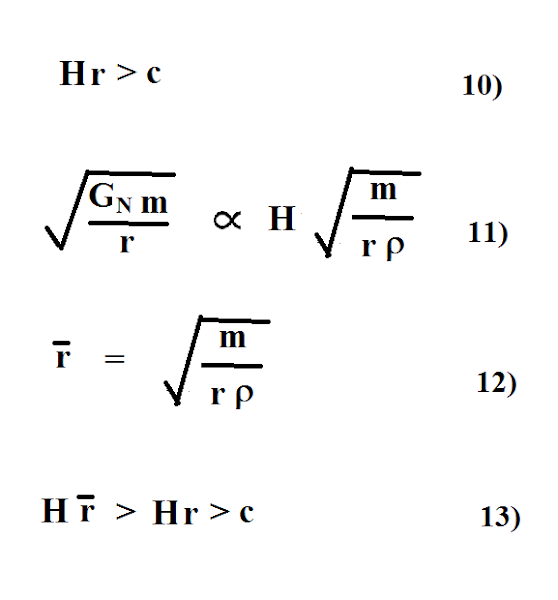
Now, let's imagine Alice and Bob are so far apart that Bob is moving away from Alice faster than light (see 10 below). Alice starts out with very little mass, but decides to go off her diet. As a result, she gains an enormous amount of mass. So much so that she becomes a black hole (see equation 11). The distance between her and Bob is the same but it is now less than Alice's Scharzschild radius. So are Alice and Bob still diverging or are they now converging?

We know that no signal, limited to light speed, ever reached Bob. This includes gravitons, gravitational waves, light, etc. At 12, Alice's mass is converted to it's equivalent space. Finally, the inequality at 13 shows that Bob is still moving faster than light if Alice is at rest, but Alice is no longer at rest--she's moving faster than Bob towards Bob. Thus Alice and Bob are converging as if a "gravitational force" is present.

Take a proton and electron. Equation 14 below shows acceleration depends on both their respective charges, their masses and distance r. Clearly there is an information exchange between them. At equation 15 it's a different story: acceleration only depends on the mass of the proton and distance r. It is clear the two masses don't exchange information. It's as if the proton simply accelerates towards the electron.

Now, let's consider Alice, Bob and Carl below. How fast Alice accelerates depends on the distance of the targets, the targets being Bob and Carl. Surely Alice needs to know the distance of each target so she can adjust her rate of acceleration accordingly?

Consider the diagram below. The numbers in each section add up to the total volume of the 3X3X3 cube. At 17 the volume of each cube is divided by its square. If we multiply each term by the square of Hubble's parameter it becomes apparent that Alice is accelerating less than Bob and Bob is accelerating less than Carl. These three are diverging as if they are in an expanding universe.

Now, let's add mass to the red section. Let's convert it to its equivalent volume which is 100 units. That brings the total to 101 units. Notice that the state of Bob's section (blue) and the state of Carl's section (green) do not change. Each have their previous volume. Also notice that the square areas do not change. This implies no information exchange between Alice, Bob and Carl. But now Alice is accelerating more than Bob and Bob is accelerating more than Carl. The three are converging is if they are in a gravitational field.

The rate of acceleration depends on distance but, as demonstrated above, this does not imply an information exchange between the parties. To drive this point home, imagine we divide up our universe into volume cells, each cell expands at a given rate independently of every other cell. More cells cause a greater rate of expansion, but each cell has no clue how many cells an observer is looking at or what the other cells are doing. The cells exchange no information. Thus the rate of expansion is really up to the observer. Now, suppose you add more volume (cells) to the system without increasing the space. This was done when mass was added to Alice's section (red). Mass's equivalent volume doesn't change the distances between Alice, Bob, and Carl. The result is what we call gravitational acceleration (see equation 20 below). Again, each cell need not know the state of the others. The rate of acceleration depends on the distance the observer chooses to consider.

Now let's turn to quantizing gravity. The popular choice is, of course, the graviton, but the graviton causes a major setback. If we assume the graviton is a real thing, surely we can come up with a reasonable estimate of how many gravitons are in the universe. For example, we could figure the total gravitational energy of the universe and divide that by the average energy of the graviton. At 21 below we plug in the entire mass of the universe to get the gravitational energy, but we don't get units of energy. Instead, we get velocity squared. One could argue that there is no gravitational energy, so there are no gravitons. Equation 22 is an attempt to counter this argument. It uses two masses which give an energy term, but how much gravitational energy there is depends on how much of the universe's total mass we assign to m and m'. Also, whatever gravitational-energy total we arrive at will be exceeded by a single black hole singularity and a single particle that have virtually zero distance between them.

At equation 23 we switch to a smaller scale. We assume the gravitational energy produced by an electron and proton is nEg, where Eg is the energy of one graviton and n is the number of gravitons. Therefore two electron-proton pairs produce 2nEg or 2n gravitons? Not so fast. Since gravitons have energy, they also produce gravitons. At 24 they produce up to an infinite number of gravitons if the distance r limit is zero! So how many gravitons are in the universe? It depends on how you crunch the numbers.

By contrast, it is much easier to estimate how many photons are in the universe, since photons don't produce photons. Electromagnetic energy is a function of charge and not energy or mass. So as long as photons don't have charge, they don't infinitely reproduce themselves. We can take the total luminous energy of the universe and divide it by a photon's average energy to get a reasonable estimate of how many photons there are.

For the above reasons, the graviton is untenable. So then how should we quantize gravity? Gravity is a function of mass (defined as energy divided by light speed squared), space and time. Thus it would make sense to quantize these fundamental dimensions. We could ask, what is the shortest length or time, and, what is the smallest mass? The popular response is, the Planck length, the Planck time and the Planck mass, respectively. But are these really the smallest units? The Planck mass clearly is not the smallest mass. An electron mass is smaller. Also, the Scharzschild radius of an electron is much shorter than a Planck length. The time it takes for a photon to travel the shorter distance is less than the Planck time. So what are the smallest units? Here are the smallest units I have found so far. I call them the Hubble units:

We could take the Hubble length, for example, and quantize equation 13 as follows:

At equation 29 the first term has alpha Hubble lengths; the second term has beta Hubble lengths. The smallest rate of expansion is Hubble's parameter times one Hubble's length. Now, one probable objection to this scheme is space is chaotic and stochastic on the quantum scale, so how can we have such nice, neat units? The Hubble length, for example, could be an expectation value (average) of all the chaotic activity that may make up space. We can think of the Hubble units as perhaps the smallest average units that can be derived from fundamental constants and Hubble's parameter.

In conclusion, unlike the other fundamental interactions, gravity does not appear to have any means for bodies to communicate with each other, nor is communication necessary. Thus the graviton is unnecessary. Further, the graviton fails to conserve energy like its electromagnetic counterpart the photon. A better way to quantize gravity is to quantize space, time and/or mass.

Acknowledgments:

Amber Strunk. Education and Outreach Lead. LIGO Hanford Observatory.

Peter Laursen, Astrophysicist and science communicator at the Cosmic Dawn Center, University of Copenhagen.

References:

1. Parikh, Wilczek, Zahariade. 2020. The Noise of Gravitons. arxiv.org.

2. Feynman, R.P. 07/03/1963. Quantum Theory of Gravitation. Acta Physica Polonica. Vol. XXIV.

3. Graviton. Wikipedia.

4. Carlip, S. 12/1999. Aberration and the Speed of Gravity. arxiv.org.

5. Van Raamsdonk, M. 05/17/2010. Building up spacetime with quantum entanglement. arxiv.org.

6. Hanson, R.; Twitchen, D. J.; Markham, M.; Schouten, R. N.; Tiggelman, M. J.; Taminiau, T. H.; Blok, M. S.; Dam, S. B. van; Bernien, H. (2014-08-01). Unconditional quantum teleportation between distant solid-state quantum bits. Science. 345 (6196): 532–535.

7. Gravitational Wave. Wikipedia.

8. de Rham, C., Tolley, A.J. 03/17/2020. Speed of Gravity. arxiv.org.

9. Carroll, S.M. 12/1997. Lecture Notes on General Relativity. Enrico Fermi Institute.

10. Marsh G.E., Nissim-Sabat. 3/18/1999. Comment on an article by Van Flandern on the speed of gravity. Physics Letters A Vol. 262, pp. 257-260 (1999)

11. Suede M. 11/29/2012. The Speed of Gravity: Why Einstein Was Wrong and Newton Was Right. Blog commentary re: Tom Van Flandern.

12. Cornish N., Blas D., and Nardini, G. 10/18/2017. Bounding the Speed of Gravity with Gravitational Wave Observations. Phys. Rev. Lett. 119, 161102

13. Van Flandern, T. 1999. The Speed of Gravity What the Experiments Say. Meta Research University of Maryland Physics Army Research Lab.

14. Nix, E. 08/22/2018. Who Determined the Speed of Light. History.com.

15. Speed of Gravity. Wikipedia.

16. Tests of General Relativity. Wikipedia.

17. Decross, M. et al. Gravitational Waves. Brilliant.com.

18. Lawden, D.F. 1982. Introduction to Tensor Calculus, Relativity and Cosmology. Dover Publications, Inc.

19. Stefanovich, E. V. 09/16/2018. A relativistic quantum theory of gravity. arxiv.org.

20. Light-time correction. Wikipedia.

21. LiĆ©nard–Wiechert potential Wikipedia.

22. Kopeikin, S. M. Fomalont, E. B. 03/27/2006. Aberration and the Fundamental Speed of Gravity in the Jovian Deflection Experiment. arxiv.org.

23. Faber, J. A. 11/24/2018. The Speed of Gravity Has Not Been Measured From Time Delays. arxiv.org.

24. Yin Zhu. 08/18/2011. Measurement of the Speed of Gravity. arxiv.org.

25. Perihelion of Mercury’s Orbit. macmillanlearning.com.

26. Belenchia A, Wald, R.M., Giacomini, F., Castro-Ruiz, E., Brukner, C., Aspelmeyer, M., 03/22/2019. Information Content of the Gravitational Field of a Quantum Superposition. Gravity Research Foundation.