Featured Post

Breakdown of Navier-Stokes Equations

Find PDF version here. Abstract: Given limited energy and a small mass density or large kinematic viscosity, this work shows why...

Showing posts with label faster than light. Show all posts

Tuesday, May 23, 2023

Why Entanglement and Faster Than Light Speed Are Consistent with Relativity

ABSTRACT:

This paper shows why entanglement is not limited to the quantum realm, and shows how entanglement and superluminal speed is not only possible, but consistent with special and general relativity.

Imagine two photons. Photon A and photon B are propagating in opposite directions. According to the velocity addition formula, their combined velocity v is as follows:

Now, imagine two observers, Alice and Bob. Alice looks at each photon individually and notices that they each propagate at c. Bob looks at both photons at once and notes that their combined velocity is c. At this point, you probably have some questions: How does photon A seem to know that photon B is propagating in the opposite direction? It's not like photon B can send a signal to photon A (a signal that would have to be faster than light) to let photon A know that it needs to cut its velocity in half along with photon B so their combined velocity will be no faster than light. Further, how do A and B seem to know that Bob is watching them both? They also seem to know that Alice is watching only one of them. The one she's watching seems to adjust its velocity to c just for her benefit. It's as if the photons are entangled with each other and also entangled with all observers.

Einstein described quantum entanglement as "spooky action at a distance"--yet, where would the velocity addition formula be without "spooky action at a distance"? Below is a mathematical derivation of the entanglement of two particles with velocities v1 and v2:

Equation 7 above shows that, at any distance r (the distance between the two particles), any change of velocities (v1, v2) must lead to an instantaneous change in velocity v; otherwise, light speed c would not be constant in a vacuum. Note that the terms on the right side are in units of frequency and wavelength. To maintain a constant light speed requires any change of frequency to be instantly offset by a change of wavelength. Additionally, this entangled relationship between frequency and wavelength is shown by equation 9 below:

At 11 above is a scalar version of Einstein's field equations. Equation 10 shows that velocity v can be infinite if distance r drops to zero. How is this possible given that infinite energy is required to accelerate mass m to light speed? Equation 9 provides the answer: the infinite velocity is achieved with just the rest-mass energy (E). No force acts on mass m. If a force acts on mass m, then momentum p will be greater than zero. It is this momentum that requires infinite energy to reach light speed. Since infinite energy is not available, mass m cannot reach light speed in this way--and--here is the ironic part: to reach a speed faster than light requires no outside force or energy--just the rest-mass! Albeit, equation 9 shows that superluminal speed is offset by extreme curvature of spacetime. This offset happens instantaneously (yes, more "spooky action at a distance") to ensure that the rest-mass energy is conserved.

Below is a proof that shows the absurdity of assuming it takes a time of r/c seconds for a change of frequency (a change of velocity or mass density) to update a change of wavelength (velocity or curved spacetime), where r is distance and c is the speed of a graviton:

Ironically, the very speed of light itself depends on instantaneous "spooky action at a distance." We can conserve the energy of our two-particle system in the following manner:

The speed of light also depends on the speed of our expanding universe--even if that speed is faster than light:

Equation 19 above shows that velocity Hr could be faster than light; yet the right side of the equation never exceeds c or light speed.

So far, it appears that gravity and dark energy have infinite velocity potential and that spacetime and matter are entangled--which enables "spooky action at a distance" beyond the quantum realm. So ... are there any experiments or observations that lend support to such weirdness? At the time of this writing, I know of no direct observation of superluminal speed. However, black holes lead to the inference that light speed is not enough to escape a black hole's gravity that has a potential meeting or exceeding light speed (see equation 10 above). Additionally, no light can reach us from galaxies that are beyond the cosmological horizon. The "spooky action ..." on a cosmological scale is consistent with astronomical observations cited by Laplace and Van Flandern.

At equation 21 below we define the frequency (f) of an electric field. Albeit, there is a problem. It is assumed that the electric field extends to infinity! At any distance r, an observer allegedly experiences an electric field. If the electric charge q is beyond the cosmological horizon, i.e., r > c/H, an observer at that distance never observes q's electric field nor its frequency f. So at 22 we create a new variable s that equals zero if r > c/H. Equation 23 shows that the observer observes zero evidence of frequency f. Equations 24 through 26 show that variable s should also be applied to gravitational waves (GWs) (and their frequencies), since they are limited to light speed and can't reach an observer if they originate beyond the cosmological horizon.

It is clear that an electric field and GWs have a limited observable range. There is one field, however, that truly has an unlimited range: the vacuum field or "dark energy" if you prefer. An observer at any distance r would never claim there is no evidence of such a field. Thus our new variable s is inapplicable. Velocity v at equation 27 below never equals zero unless r equals zero. At 28 we create a new variable Sv that is always equal to one. As a result equation 29 can be substituted for equation 27.

We bring back the Friedmann equation at 30 below. According to the WMAP spacecraft, space is nearly flat, so we set k to zero.
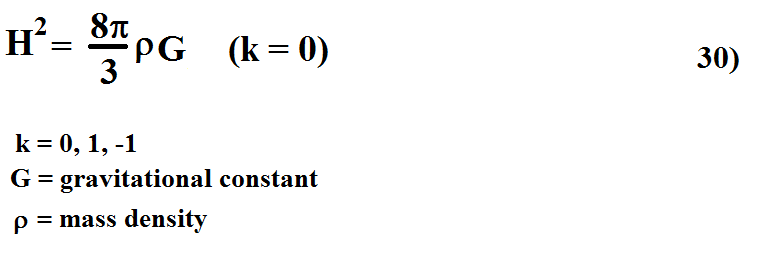
Let's assume a gravitational field has a limited range of r = c/H. The diagram below shows a sphere with volume V divided into an alpha section and a beta section. The alpha section is within the c/H limit for observer O; the beta section is not. This creates an inequality at 31. If gravity depends on gravitons limited to light speed, the Friedmann equation is invalid if distance r is greater than c/H.

Next, lets assume the vacuum and gravitational fields both exist everywhere. The equality is restored and the Friedmann equation is always valid:

This seems inconsistent with GWs that cannot penetrate the c/H barrier. Let's examine GW equations and see if we can reconcile this apparent inconsistency.

At 33 above we begin with a GW power equation for two rotating black holes. With a little algebra we derive equation 37. At 37 we assume gravity has an unlimited range, so we multiply that part by Sv which equals 1. We further assume GWs that are more than c/H meters away from an observer cannot be detected. So we multiply P and the frequency by s, where s equals 0. Equation 37 confirms that gravity overcomes the c/H barrier and GWs may not. GWs do not carry gravitational information. If there was zero frequency, the black holes would still have gravity and there would be no GWs. The source of GWs is the kinetic energy needed to maintain the orbits of the black holes. Over time this energy is converted to massless waves that propagate no faster than light. Equation 38 below shows how gravity can exist in the absence of GWs (notice that the s's cancel):

<

class="separator" style="clear: both;">

Conclusion:

It appears that vacuum and gravitational fields extend to infinity unlike the electric field. Both gravity and dark energy have the potential for speed greater than light; yet, ironically, this does not violate the light-speed limit. In fact, the light speed limit itself depends on "spooky action at a distance"--i.e.--entanglement of frequency and wavelength. This entanglement is also essential to the velocity addition formula that ensures that two velocities never exceed light speed.

References:

1. Flanagan, Eanna. Hughes, Scott A. 2005. The Basics of Gravitational Wave Theory. New Journal of Physics.

2. Van Flandern, T. 1999. The Speed of Gravity What the Experiments Say. Meta Research University of Maryland Physics Army Research Lab.

3. Siegel, Ethan. August 30, 2018. Our Motion Through Space Isn't A Vortex, But Something Far More Interesting. Forbes

4. Tzortzakakis, Filippos, LIGO Analysis: Direct Detection of Gravitational Waves. Journal of Research Progress Vol. 1.

5. Roberts, Tom, Schleif, Siegmar. 2007. What is the experimental basis of Special Relativity?

6. Friedmann equations. Wikipedia

Monday, April 30, 2018

How to Beat the Light-Speed Barrier--or Not

Is faster-than-light speed or warp drive possible? If Scotty were here to explain how warp drive works, he'd probably say, "Sorry, Capt'n, we don't 'ave enough power!" But assuming we have enough power, warp drive shrinks the spacetime in front of the Enterprise while it stretches the spacetime behind it. That way the Enterprise is closer to its destination and further from its starting coordinates without having moved through space. According to Scotty, this prevents time dilation, so the time on the Enterprise stays in sync with the time on earth.

You may be familiar with the twin paradox where one twin stays on earth and the other travels through space at high speed. According to special relativity, time on the spacecraft passes more slowly than the time on earth. When the space-twin returns home, he finds his brother has aged considerably while he has aged hardly at all. Warp drive allegedly solves this problem by not requiring the Enterprise to move through space. However, notice spacetime must be altered for warp drive to happen. This implies time as well as space is being altered, since, according Einstein, space and time are intrinsically connected.

Einstein also insisted that nothing goes faster than light, but as we shall see, the light-speed barrier can be beaten under the right circumstances. First, let's define the variables we are going to use:

Equation 1 below contains the famous Lorentz factor. At equation 2 we can see why Einstein believed nothing goes faster than light. Any particle with mass would be infinitely massive at light speed, which implies that an infinite amount of energy is needed to get the particle up to that speed. Since energy is limited, the logical conclusion is light speed for anything with mass is out of the question.

What Einstein insisted, is true if velocity (v) is not a function of mass. But suppose velocity is a function of mass, like in a gravitational field, for instance. What happens then? We know our earth orbits our sun. We know each is affected by the other's gravity. The equations below assume the sun's mass (M) and the earth's mass (m) increase as the Lorentz factor says they should.

So now the velocities are a function of mass, but this creates a runaway positive feedback loop!

The red arrows above show that an increase in the earth's mass causes an increase in the sun's mass which in turn causes another increase in the earth's mass and so on. According to NASA's database, the masses of the earth and sun do not need to be continually updated. Those masses stay reasonably constant. The same is true for other celestial bodies within our solar system. Also, at equation 8, notice how the sun and earth start out with less energy than they end up with. This violates energy conservation. That can only mean one thing: equations 6 and 7 are wrong.

We know equation 1 is right, however. So let's sort out this conundrum. We can derive equation 1 if we assume momentum is conserved. At equation 9, mc is constant and m' increases when velocity u decreases. Velocity u is defined at equation 10:

Using a little elementary algebra we derive equation 1 and restate it at 13 below:

So why doesn't equation 13 work for a gravitational field? Gravity is truly something special. Momentum is not conserved (see inequality at 13b). Different masses fall at the same rate. When a falling mass accelerates, the instant velocity (v) at a given point along the path is the same no matter how big or small the mass (m). Using this fact, we derive equations 20 and 21 below:

At equation 20 and 21, notice how the masses of the earth and sun don't change. No more positive- feedback loop and energy is now conserved.

Now, let's see what happens when a mass (m) moves at light speed in a gravitational field:

Mass m does not change! It remains the same no matter how fast it moves! This implies that infinite energy is no longer needed to achieve light speed. Higher speeds are possible when you consider that mass M has no upper limit and radius r has a zero-limit ( see equation 20). The only energy needed is GMm/r.

We know that time is slower where gravity is stronger and faster where gravity is weaker. If we replace mass (M) with time (t) at equation 21 we can derive equation 26:

Equation 26 confirms that time dilates in a gravitational field. This makes total sense when you consider gravity is a function of warped spacetime. This also explains why the Enterprise's warp drive must somehow place the ship in a protective spacetime bubble where the spacetime within is not warped, so time can be the same on the ship as it is on earth. Only the spacetime surrounding the bubble is warped.

Now, if mass m goes no faster than light speed, energy conservation is not a problem, but faster than light speed suggests a problem. If there are speeds faster than light then E does not necessarily equal mc^2. You would start out with that amount of energy but end up with more energy. Faster-than-light velocity might yield E = m(greater than c)^2. But if we begin with Einstein's complete energy equation (equation 27), we can derive equation 34 below:

At equation 34 we see that energy E is conserved no matter how fast mass m moves. At equation 37 we see why. Any increase in gravitational velocity is offset by a decrease in time velocity (u). When you add the square of those velocities you get c^2. NICE!

OK, another question: does time run backwards during faster-than-light spacetime travel? We work out the math below:

The variable u is time velocity. If it is negative, then proper time (t') is running backwards (see equation 41). However it appears earth time (t) is still running forward. At equation 44 we see that negative u cancels itself.

Imagine a spaceship (not protected by a warp-drive bubble) moving faster than light. Let's plug in some specific numbers and see what happens:

At equation 47 above, we see that two solutions are possible: positive and negative proper time (t') and imaginary numbers to boot. We factored out i to make the number real, but even then we have two possible solutions: proper time is running forward or backward. Forward time is more probable. To see why, click here. In either case, equation 53 confirms that earth time is not altered. It is still moving forward at a rate of t:

Apparently Hollywood and sci-fi novels failed to consider that a person going back in time is not exempt. If you went back in time, you would grow younger and younger. You would only be able to go back as far as your conception. Before that, you didn't exist. This might explain why we don't get tourists from the future.

Additionally, you are only going back in time in your reference frame. The rest of the universe is moving forward in time. So, if you are a space-twin, when you return to earth, your brother will still be years older than when you left, and, you will be much younger than when you left--perhaps just an embryo! The math below confirms this:

Thus the warp-drive bubble that protects the star ship Enterprise is an absolute necessity! We need to control time. Once we have this technology, we need the finite energy of a black hole to hurl across the universe faster than light!

Update: If a spaceship can go faster than light in a gravitational field, does light also go faster than light? Let's see what the math says. Here are the variables we will need:

Equation 58 is velocity according to special relativity (see derivation below). As the velocity v grows, so does the mass, creating an upper speed limit of c or light speed.

Equation 59 is velocity in a gravitational field. As we demonstrated above, mass m does not grow as velocity increases. There doesn't seem to be any upper limit to this type of velocity.

Equation 60 is light speed. If energy is added, the frequency increases, but the wavelength shortens. No matter how much energy is added, the increase in frequency is offset by the decrease in wavelength. As a result, a photon can't go faster than c.

At 61 below, we compare the momentum of a falling body to a photon's. The falling body's velocity will increase in a gravitational field with no apparent upper limit. The photon, on the other hand, will experience a frequency increase, but no apparent velocity increase.

"Captain," Scotty might say, "we have a problem!" If fermions in a system go faster than light, then the system's photons must also go faster than light or be left behind. If they are left behind, there's an energy loss that might reduce the fermions' speed, keeping it within the light-speed limit, and/or, the fermions could lose mass. No doubt Einstein is smiling in his grave. Anyway, as promised, here is the derivation of equation 58:

Update: What about galaxies beyond the cosmological horizon? Aren't they hurling away from us faster than light? Perhaps, but our galaxy's photons can't reach them and their's can't reach us, but said photons can reach galaxies that are closer. Locally, each galaxy is moving well under light speed. The relative velocity (v) of a galaxy is determined by Hubble's constant (H) and distance (D). Where v = HD. If HD < c, a system's photons can come, go, or stay. Within any galaxy, HD is less than c.

Update: Below is further proof that c is the top speed in our universe: