Featured Post

Breakdown of Navier-Stokes Equations

Find PDF version here. Abstract: Given limited energy and a small mass density or large kinematic viscosity, this work shows why...

Showing posts with label gravitational waves. Show all posts

Saturday, April 29, 2023

Why the Speed of Gravity and the Speed of Gravitational Waves Are Not the Same

ABSTRACT:

According to Relativity Theory, everything propagates through spacetime at light speed. However, a mass at rest propagates solely through time and experiences zero velocity. A massless photon propagates solely through space and experiences no time. Other objects propagate through time and space, and, experience both time and subluminal velocities. This paper demonstrates that both gravity (the fundamental interaction) and gravitational waves propagate at light speed through spacetime, but with varying degrees through time and space, i.e., they each have different velocities through space.

The year was 1971. Via the Apollo 15 mission, David Scott performed the following experiment on the moon: With a hammer in one hand and a feather in the other, he held them the same distance from the moon's surface. He dropped them. They hit the ground simultaneously. This experiment might not seem like a big deal, but it confirms that Galileo was correct. More importantly, it shows that gravitational interactions (with the exception of gravitational waves) should never be modeled after the electromagnetic (EM) force.

The EM force, like Newtonian forces, conserves energy, momentum and itself in the following manner:

Equations 1 and 2 above show that different masses have different velocities and different rates of acceleration when acted on by the same magnitude of force. Since momentum is conserved, we can use equations 2 above and 3 below to predict the speed of the photons that mediate the force:

No surprises here. Photons propagate at c as expected. Gravity, unlike EM, is full of surprises. Let's model gravity after the EM force and see what happens. Let's assume there is a gravitational field of gravitons that mediate the "force" of gravity. Here is the math:

At 6 and 7 above, force and momentum are not conserved. If we assume momentum is conserved, at 8 the speed of gravitons depends on the mass of the falling object. We cannot count on their speed being c. What about gravitational waves? Why do they consistently propagate at or near the speed of light? Consider the following thought experiment:

You throw a baseball with enough force to place it into orbit around the earth. The force you use is independent of and counters gravity. It is also conserved and so is the ball's angular momentum. The ball's tangential velocity depends on its mass and vice versa. As the ball orbits earth its velocity changes, i.e., the ball accelerates. An accelerating mass emits gravitational waves (GWs). The energy converted to GWs is the same conserved energy you put into the ball when you threw it into orbit. We can predict the speed of these GWs the same way we predicted the speeds of photons and gravitons:

Equation 9 shows that the ball's velocity happens to equal the gravitational potential velocity at distance r. If the ball had more mass (m), its velocity would be less and its orbit would decay. If the ball had less mass, it would have more velocity and would rise out of orbit. Equation 10 shows how much power P is emitted. Over time velocity v will be reduced and the ball will spiral into the earth. At any time, momentum p equals mv. Equation 11 predicts the speed of GWs to be ~c, the speed of light. This is possible because the baseball was originally accelerated to v by you, not gravity. To predict the speed of gravity, absent the influence of another force (you throwing a baseball), requires a model that is different from the EM or force model. Over a century ago, Einstein realized this and had a big idea:

From an airplane flying 10,000 feet above the earth's surface, drop several items with different masses. If we assume they are falling to earth, they all fall at the same rate, so momentum at any instant is not conserved. But what if those items are at rest and it is the earth with mass M falling or accelerating to the items? Clearly, an independent force accelerating the earth would be conserved. With more mass, the earth would accelerate less. The problem is, with more mass the earth really accelerates more. This fact implies that there is no independent force causing earth to accelerate. So there is apparently no independent force acting on the earth or the items that appear to be falling.

If the earth simply accelerates to the items, what need is there for a graviton? As shown at 6 through 8 above, gravitons, if they exist, fail to either conserve force, energy and momentum, or, they don't have a consistent speed if force, energy and momentum are conserved. David Scott's experiment showed us this is true. The feather and the hammer fell at the same rate, not different rates.

Laplace and Van Flandern, based on observations, concluded that the speed of gravity must be several orders of magnitude faster than light. Perhaps infinite! (Masses simply accelerating towards one another combined with independant forces causing angular momentum could certainly provide that impression.) Other physicists hate the idea of infinite speed and insist the speed of gravity is c. To accommodate the Laplace and Van Flandern observations, they point to a model of moving charges, where one charge's vector is lined up with the another charge's instant position rather than its retarded position, creating the illusion that there is no light-time delay, i.e., infinite photon speed when in reality photon speed is c. This model is then projected onto a cosmological scale, and thus moving planets and stars work in a similar fashion and create the illusion of infinite graviton speed when in reality graviton speed is allegedly c. The problem with this model is it completely ignores the Heisenberg Uncertainty Principle. For the model to work, one has to know the position and velocity of the charges with precision. And, as demonstrated above, charges (or EM) conserve force and momentum in a way that gravity does not.

Laplace, Van Flandern and the physicists who criticize them have one thing in common: they all think of gravity as a force consisting of bosons that either propagate at c or much faster than c. Because of General Relativity, it makes perfect sense that most physicists want to limit the speed of gravity to c; however, when two black holes collide and form a new more massive singularity, it is not clear how a boson propagating at c can escape that singularity and inform the rest of the universe of the event. Since nothing propagating at c can escape a black hole, how does this new black hole singularity reset the curvature of its surrounding spacetime?

Let's start with what we know. At 12 below we have the Compton wavelength equation. Note that when mass m changes, the wavelength must change instantaneously, since a mass and its wavelength are essentially the same entity. If we think of the wavelength as spacetime, then spacetime is updated the instant mass changes. At 14 we convert the equation to Planck units with an alpha scale factor. At 15 we derive a Scharzschild radius. Equation 16 shows that a change in alpha instantaneously causes a change in beta, since their sum times a Planck length make up distance r. (Distance r, of course, along with the mass, determines the rate of Newtonian acceleration.) Equation 17 is a scalar version of Einstein's field equations. On the right side we have curvature units.

When two black holes merge, alpha increases everywhere it appears at equation 17. This causes an instantaneous decrease of beta at any distance r from the new black hole's singularity. Thus the new black hole doesn't have to send information at light speed or any speed to update its surrounding spacetime. Mass and spacetime have an entangled relationship. Energy and momentum equations show this to be true. Where would energy and momentum be without mass entangled with velocity? Of course velocity is in units of space and time. Thus one can conclude that the only valid speed for gravity is how fast matter moves at an arbitrary distance from a falling observer:

Equation 18 above shows how fast gravity moves through space. Equation 19 shows how fast gravity moves through time. Finally, equation 20 shows how fast gravity moves through spacetime--the speed of light.

References:

1. Ibison, Michael, Puthoff, Harold E., Little, Scott. The Speed of Gravity Revisited.

2. Kopeikin, Sergei, Fomalont, Edward B. 27 Mar 2006. Aberration and the Fundamental Speed of Gravity in the Jovian Deflection Experiment.

3. Flanagan, Eanna. Hughes, Scott A. 2005. The Basics of Gravitational Wave Theory. New Journal of Physics.

4. Carlip, S. Aberration and the Speed of Gravity. December 1999.

5. Van Flandern, T. 1999. The Speed of Gravity What the Experiments Say. Meta Research University of Maryland Physics Army Research Lab.

6. Siegel, Ethan. August 30, 2018. Our Motion Through Space Isn't A Vortex, But Something Far More Interesting. Forbes

7. Galileo's Leaning Tower of Pisa experiment. Wikipedia.

8. David Scott does the feather hammer experiment on the moon | Science News. Youtube.com

9. Tzortzakakis, Filippos, LIGO Analysis: Direct Detection of Gravitational Waves. Journal of Research Progress Vol. 1.

Friday, August 14, 2020

The Beautiful Destruction of the Graviton


ABSTRACT:

In his paper titled "Aberration and the Speed of Gravity," S. Carlip argues that gravity propagates at light speed, and, its "action at a distance" and the lack of observed aberration is canceled by velocity dependent interactions. However, the underlying assumption of his thesis is that gravity is caused by gravitational radiation propagating at light speed. Another assumption held by much of the physics community is the quantization of gravitational waves will lead to a spin-2 massless particle known as the graviton. In this paper, I show why gravitational waves and gravitons are not the root cause of gravity. Gravity emerges from an entangled relationship between spacetime and matter.

Modern physics has two conflicting ideas: 1. gravity propagates at light speed, and 2. the equivalence principle. Why are these two ideas in conflict? The first proposes that gravity works in the following manner: a person holds a pen in his hand and drops it. Before it hits the floor, however, the floor must emit gravitons that propagate at c to create a field of gravity, so the pen can receive the gravitational information; otherwise, the pen won't fall.

The second idea is often set forth using a thought experiment where the person holding the pen is in a spaceship. The thrust of the engines cause the floor to accelerate toward the pen when the pen is dropped; otherwise, the pen would float freely in space and never make contact with the floor. In this scenario, no gravitons or gravitational field are needed. The floor is on a collision course with the pen and does not need to send a signal to the pen to let it know it's coming. According to Einstein, this is indistinguishable from gravity.  Therefore, this great idea and the one that precedes it create a paradox: the first idea implies a force is causing the pen to fall, so a force-carrying particle is necessary.  The second idea implies there is no force. 

That begs the question: does gravity require gravitons? Let's examine what may be a source of gravitons and strong evidence that gravity's velocity is c: gravitational waves. Equation 2 below is a gravitational-wave equation:

From equation 2 we derive equation 3 which emphasizes that c is a component of rest-mass energy and not propagation speed.

Does gravity exist if there are no gravitational waves? To find out, we take angular frequency to zero. The time (t') it takes for no waves to propagate a distance r is also zero. The final result is equation 5:

Where there are no gravitational waves there is zero angular frequency and zero strain measured at distance r, but on the left side of equation 5 we see Newtonian gravity is not zero. Thus, the magnitude of gravitational acceleration does not depend on the magnitude of gravitational waves nor their quanta. Further, a zero time delay (t') implies action at a distance.

A comparison between electric waves and gravitational waves reveals why photons are observable and gravitons are not. The wave equation i below represents an electric field (photons) propagating at c. Equations ii through iv demonstrate how the removal of the electric field (photons) leads to no electromagnetic force:

By contrast, if the gravitational field (gravitons) is removed, Newtonian gravity still exists:

What's been shown so far is not surprising when you consider problems surrounding the hypothetical graviton:

1. Since electromagnetic force is around 1037 times greater than gravity, one might imagine a graviton with 1037 times the Compton wavelength of an electron. The graviton's wavelength would span much of the known universe! Not exactly quantum scale.

2. Or, one could imagine one graviton (with the same Compton wavelength as an electron and same speed as a photon) per 1037 photons. If it takes 1037 photons one second to interact with X number of atoms, the graviton would take 1037 seconds to interact with X number of atoms--many orders of magnitude longer than the age of the universe! Further, each graviton interaction would have the same strength as a photon interaction or electromagnetic force.

3. One expects gravitons to spread out to form a field. It is not clear how the gravitons of a black hole can escape each other (if they have a light-speed limit) and not clump together due to mutual attraction (caused by their spin, angular momentum, mass-energy equivalence, etc.).

4. Gravitational wave wavelengths are inconsistent with hypothetical graviton wavelengths.

5. There's a renormalization problem.

6. The graviton has never been observed.

Assuming gravitons are not the root cause of gravity, what exactly is? If we begin with the spacetime metric (equation 6), we can derive equations 9 and 10 below:

Imagine, for the sake of argument, there is a graviton propagating at velocity c. Equation 9 shows if the graviton's energy (E) changes, the spacetime must also change instantaneously; otherwise the constant c would have a different value during the time it takes the graviton to emit another graviton which then transports information to surrounding spacetime. In other words, if the speed of gravity is limited to c, there would be a time lag where c is no longer c! The same holds for Planck's reduced constant at equation 10. The very constants physics relies on would fail to be constant if gravity is required to propagate an information-carrying particle no faster than c.

A careful examination of equation 9 reveals the graviton's energy, when divided by Planck's constant, has the same dimension as frequency, and the spacetime has the same dimension as wavelength. Frequency and wavelength have an entangled relationship. If you measure the value of one, you instantaneously know the value of the other.


In the case of our graviton, a change in its energy instantaneously updates its surrounding spacetime. Our graviton does not need to emit a graviton--and neither does any particle, planet, star, or black hole.

Thus, if the graviton is ever discovered, it is not the root cause of gravity. Gravity is the result of an entangled relationship between matter and spacetime. Matter has a certain energy and moves in certain ways because of a certain configuration of spacetime, and spacetime has a certain configuration because matter has a certain energy and moves in certain ways. Like frequency and wavelength, one does not exist without the other. This new hypothesis is consistent with "action at a distance" observations but inconsistent with the highly contraversial Jovian deflection experiment (see endnote 22).

Acknowledgements:

Amber Strunk. Education and Outreach Lead. LIGO Hanford Observatory.

References:

1. Parikh, Wilczek, Zahariade. 2020. The Noise of Gravitons. arxiv.org.

2. Feynman, R.P. 07/03/1963. Quantum Theory of Gravitation. Acta Physica Polonica. Vol. XXIV.

3. Graviton. Wikipedia.

4. Carlip, S. 12/1999. Aberration and the Speed of Gravity. arxiv.org.

5. Van Raamsdonk, M. 05/17/2010. Building up spacetime with quantum entanglement. arxiv.org.

6. Hanson, R.; Twitchen, D. J.; Markham, M.; Schouten, R. N.; Tiggelman, M. J.; Taminiau, T. H.; Blok, M. S.; Dam, S. B. van; Bernien, H. (2014-08-01). Unconditional quantum teleportation between distant solid-state quantum bits. Science. 345 (6196): 532–535.

7. Gravitational Wave. Wikipedia.

8. de Rham, C., Tolley, A.J. 03/17/2020. Speed of Gravity. arxiv.org.

9. Carroll, S.M. 12/1997. Lecture Notes on General Relativity. Enrico Fermi Institute.

10. Marsh G.E., Nissim-Sabat. 3/18/1999. Comment on an article by Van Flandern on the speed of gravity. Physics Letters A Vol. 262, pp. 257-260 (1999)

11. Suede M. 11/29/2012. The Speed of Gravity: Why Einstein Was Wrong and Newton Was Right. Blog commentary re: Tom Van Flandern.

12. Cornish N., Blas D., and Nardini, G. 10/18/2017. Bounding the Speed of Gravity with Gravitational Wave Observations. Phys. Rev. Lett. 119, 161102

13. Van Flandern, T. 1999. The Speed of Gravity What the Experiments Say. Meta Research University of Maryland Physics Army Research Lab.

14. Nix, E. 08/22/2018. Who Determined the Speed of Light. History.com.

15. Speed of Gravity. Wikipedia.

16. Tests of General Relativity. Wikipedia.

17. Decross, M. et al. Gravitational Waves. Brilliant.com.

18. Lawden, D.F. 1982. Introduction to Tensor Calculus, Relativity and Cosmology. Dover Publications, Inc.

19. Stefanovich, E. V. 09/16/2018. A relativistic quantum theory of gravity. arxiv.org.

20. Light-time correction. Wikipedia.

21. Liénard–Wiechert potential Wikipedia.

22. Kopeikin, S. M. Fomalont, E. B. 03/27/2006. Aberration and the Fundamental Speed of Gravity in the Jovian Deflection Experiment. arxiv.org.

23. Faber, J. A. 11/24/2018. The Speed of Gravity Has Not Been Measured From Time Delays. arxiv.org.

24. Yin Zhu. 08/18/2011. Measurement of the Speed of Gravity. arxiv.org.

25. Perihelion of Mercury’s Orbit. macmillanlearning.com.

26. Belenchia A, Wald, R.M., Giacomini, F., Castro-Ruiz, E., Brukner, C., Aspelmeyer, M., 03/22/2019. Information Content of the Gravitational Field of a Quantum Superposition. Gravity Research Foundation.

Saturday, December 1, 2018

Why Gravitational Waves Fail to Confirm Extra Dimensions

According to the holographic principle, our four-dimensional universe, consisting of three space dimensions and one time dimension, is a surface area of a five-dimensional spacetime called "the bulk." The remaining dimensions of string theory or M-theory are allegedly compacted and rendered insignificant.

Gravity, compared to the other fundamental interactions, is weak due to the graviton's unique ability to move between the surface area (our spacetime) and the bulk. Other particles remain fully in our spacetime and thus have more intensity. At least that's how the story goes. Unfortunately, the gravitational-wave test described in the above video failed to confirm the existence of "the bulk" or any extra dimensions beyond our four-dimensional spacetime. This does not surprise me, given the problems extra dimensions can cause (click here to read all about it).

So why did the gravitational-wave test fail? Do we really need "the bulk" to explain the nature of gravity? We will explore these questions. First, let's define the variables we will use:

According to general relativity, gravity is a function of energy density, so let's begin with the energy density of an atom. An atom is mostly space, so let's only consider the volume of space taken up my the average nucleus and the electrons. That approximate volume can be found in the denominator of equation 1 below:

Of course if we put that volume in the numerator, we get the energy (E):

If we put a larger volume (V) in the denominator (equation 3), we get a reduced energy (E'). Reduced energy is consistent with weak gravity, so we are on the right track.

We don't want Energy units, so at 5 and 6 we use meters and Newtons to adjust the units:

Now, coincidentally, 10^-45/N is approximately equal to G/c^4, so we make the substitution:

We use distance D and the alpha scale factor to make more substitutions at equation 9. From there we derive equation 12.

Equation 12 is Newton's equation. We were able to derive this equation because we started with the premise that the intensity of gravity is determined by the actual amount of space a particle interacts with. For baryonic matter, that actual amount of space corresponds with the gravitational constant G. Note that no extra dimensions are needed to get equation 12. Our 4D spacetime is sufficient. So why should we be surprised that the gravitational-wave test failed to confirm "the bulk"?

Caveat: the above mathematics may work just fine for ordinary matter such as atoms and molecules, but what about singularities such as black holes? Theoretically, a singularity takes up no space, so there shouldn't be any interaction between the matter and space, but there is! To resolve this conundrum, we first need to establish that light speed is truly the top speed in our universe. Consider the familiar Lorentz equation:

The main problem with this equation is time (t) is arbitrary. Let's make it precise. Let's make time (t) equal to the age of the universe. When I say universe I mean everything including the megaverse if such a thing exists. What we want is the longest time ever lapsed--so we set t accordingly and define the other variables we need:

Now we derive 21 below:

Line 21 shows that no velocity (v) can exceed light speed (c). So what does this have to do with gravity and black holes? Given the fact that light speed is the top speed, we can derive the following:

Take a look at 25 and 26 above. At 25, G stays constant as long as the change in time (delta-t) is equal to or less than the age of the universe. Note that delta-t increases as radius r decreases, so G remains constant. But delta-t has an upper limit of t. If r continues to shrink, G must also shrink. Thus it appears the intensity of gravity is determined by how much space interacts with matter. The smaller the radius r, the smaller the space the matter occupies. Equation 27 shows that the intensity of gravity never exceeds the speed of light squared no matter how much radius r shrinks.

In conclusion, "the bulk" and extra dimensions are completely unnecessary to describe gravity.

Thursday, July 14, 2016

The Quantum Mechanics of Gravitional Waves

Today we are going to work out the quantum mechanics of gravitational waves using my relativity wave function. If you have no clue what I'm talking about, check out my post entitled "The New Relativity Particle Wave Function." The following video provides some basic information on g-waves:

Of course there are always naysayers. Here is a skeptic's video:

I didn't find the magnet demonstration very convincing. Magnets do a great job accelerating iron filings, but not wood chips. If the guy in the above video got those magnets to accelerate something non-metallic, I'd be impressed, but all he did was show magnetic field interactions under a bright light. Thus it seems like a safe bet to build a theory of quantum gravity based on the gravitational wave discoveries.

Below are some gravitational-wave equations we can work with. The first one is the chirp mass (Mc). It depends on two very big masses: m1 and m2. They could be a double-star system or a couple of black holes.

Next we have the scaling amplitude (q)--the size of the wave's stretching and squeezing (here is a link to an animation). Normally, the variable h is used, but later we are going to use h for Planck's constant along with h-bar. G is Newton's constant; c is light speed; distance is d; frequency is f, and there's pi.

Then there is the chirp (dot f). (For a demonstration of the chirp, see the video below .)

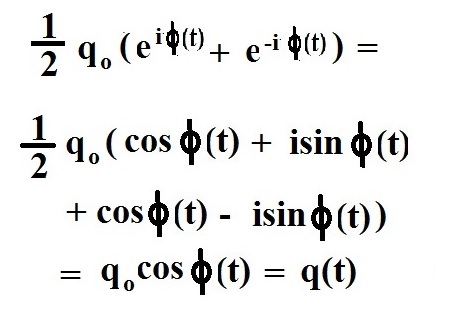
Next, we have the gravity-wave phase angle represented by the Greek letter phi. As you can see it depends on time (t). Below it is the chirp waveform amplitude q(t).

We can take q(t) and convert it into a wave-function expression:

As you can see, if we use Euler's identity and add the exponent to its complex conjugate, multiply by 1/2q, we get q(t). We now have a quantum expression we can use.

Since phi is time-dependent, and since the goal is to equate it with the relativity wave function, it is imperative that we make the relativity wave function time-dependent as well:

Note how position variables x, y, z were converted to time variables t1, t2, t3. We add these with t4 and multiply by coefficient a to get the observed time t. The four time dimensions may or may not add up to t which is why we multiply by a. We also multiply kct by A, B and C to make them equal to each expression in the phi function. We add those to get the final result: Dkct=phi(t). We use these equated expressions in the equated wave functions and their complex conjugates below:

Now we have the tools we need to calculate the gravitational waves' energy (E), the entropy (S), the temperature (T), the momentum (p), the velocity (c) and the acceleration due to gravity (g). Let's plug these wave functions into Schrodinger's time-dependant derivative expression and see what happens (but first we need to multiply both sides of the equation above by 2/q and subtract the complex conjugates):

Multiply both sides by a complex conjugate to get the expectation value:

At last! We get the energy (E). With a little algebra we can determine the entropy (S), the temperature (T), the momentum (p). We also get the velocity, which happens to be the speed of light (c). If we divide the velocity by t, we get an acceleration (g).

So there you have it!--a theory of quantum gravity based on something scientists claim they have observed and measured: gravitational waves.