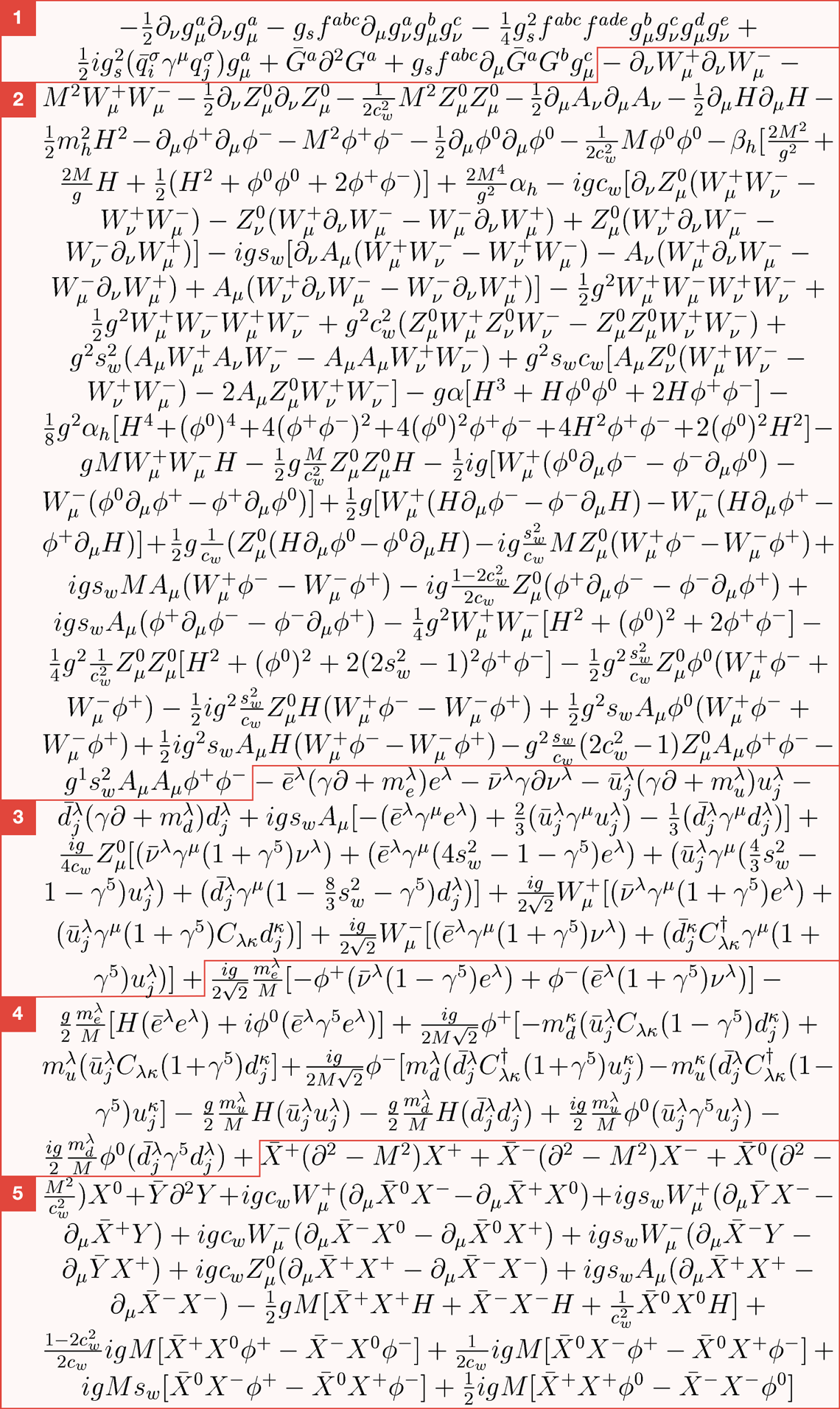
According to Einstein, mass, momentum and energy cause spacetime to curve and curved spacetime tells matter how to move. Since gravity is considered one of the five fundamental forces (interactions), it ought to have its own boson--the graviton.
Unfortunately, particle physicists have had no luck finding this very elusive particle. Is it possible the graviton does not exist? If so, how does gravity work? That's what we will explore today. First, we define some variables:

Imagine a universe devoid of gravitons. Such a universe has mostly photons (radiation), and a little bit of matter here and there. The vacuum of space isn't much of a vacuum. We use Einstein's energy equation (equation 2) to describe the mass, energy and momentum in this universe.

Equation 2's first term represents the photon radiation; the second term is matter. Let's assume this universe is not entirely homogeneous and isotropic. There are places where there is more or less mass, more or less radiation. We compare two such places at equation 3:

Using a bit of algebra, we derive equation 7 below:

Equation 7 reveals an increase in net mass causes the second term's wave-number ratio to shrink. This correlates nicely with the slowing of time and with spacetime curvature. From 7 we can derive Newton's gravitational constant:

Wait! We derived Newton's constant? How is that possible without gravitons? Note the wave numbers we used to derive G are from photons, not gravitons. Doing some more algebra leads to the Lagrangian (L) below:

Equation 17 is the gravity Lagrangian for our universe filled with photons and a little matter thrown in. Still no graviton in sight. When we take partial derivatives with respect to momenta, here's what we get:

Equation 18 shows the photon radiation velocity in a gravitational field. Equation 19 shows the velocity of fermions (mass particles) and satellites in a gravitational field. These results are consistent with our current understanding of gravity. However, we arrived at these results without using gravitons, gravitinos, strings, d-branes, extra dimensions, sparticles and all the fairy dust modern-theoretical physics has to offer.