Featured Post

Breakdown of Navier-Stokes Equations

Find PDF version here. Abstract: Given limited energy and a small mass density or large kinematic viscosity, this work shows why...

Saturday, May 25, 2024

Using Quantum Physics to Find the Best Model for Gravity, Gravitational Waves, and the Vacuum

ABSTRACT: According to Einstein's theories of relativity, nothing is faster than light; yet, observations made by Newton, Laplace and Van Flandern led them to believe gravitational information is much much faster than light, virtually instantaneous. To thicken the plot further, LIGO observed gravitational waves propagating within the light-speed limit. Then there's the vacuum energy problem where the vacuum seems to have up to infinite energy! By making use of quantum physics and changing an initial assumption about the vacuum energy, it is possible to connect the dots between quantum physics and General Relativity. By exposing a fundamental flaw in the rubber-sheet model for curved spacetime, it is possible to create a superior model that reconciles the speed of gravitational waves with the illusion of faster-than-light gravitational information.

Quantum physics is probabilistic as opposed to deterministic. Given a vacuum that is composed of numerous (omega) energies it only makes sense to multiply each energy by a probability. The alternative is to simply add all the energies and get up to infinity! Assuming each energy has a wave function, each probability can be determined by squaring each wave function. Each energy is represented by the Hubble energy (Hubble's parameter * Planck's constant) multiplied by n. At equation 1 below, we calculate the vacuum mass density (rho). At equation 2 we determine the cosmological constant:

Now, let's introduce a particle with mass m (or it could be massless: m = E/c^2). It could be located anywhere and everywhere. Its location (x,y,z coordinates) is uncertain at best. We could add m multiple times to cover all its possible locations, but that would lead to a rediculously big number. Or, as we did with the vacuum, we could multiply each m location by a probability (see equations 3 and 4) and that will give us the expectation value for m which is really just m. Thus, multiple m's at multiple locations don't amount to more than just m. The velocity of m is also uncertain, but we can calculate its expected value at equation 5. At 6 we determine the expectation value for the wavelength of m.

At equation 7 we see how multiple locations of m impact its gravity:

The gravity of m is also at multiple locations along with m, but probabilties cut it all down to size. The size being the left side of equation 7: the gravity of the expectation value: m.

At equation 8 below, we redefine m as one or more particles (expected values). At 9 and 10, we calculate the final velocity and the final wavelength, respectively.

At 10 we have the De Broglie wavelength formula. At 11 we below can see that if mass m or final velocity v changes, the final wavelength lambda must instantaneously change to keep Planck's constant a constant. After a few algebraic steps, we derive the Schwarzshild radius at 16.

Note that any change of mass m causes an instantaneous change of its wavelength (lambda prime). This means that when a black hole's singularity mass changes, its Schwarzschild radius instantaneously changes! Equation 17 below confirms this. The light-speed constant c on the left side is not a constant unless mass m and Schwarzschild radius changes are synchronized. Thus, we don't have to wonder how the singularity sends information out as far as the Schwarzschild radius, assuming such information is limited to light speed. It doesn't need to. Every mass simply has, and is defined by, a corresponding wavelength and Schwarzschild radius.

But wait! It gets even better! The diagram below shows the total radius r (in black), the Schwarzschild radius (in red) and the remaining distance (in blue). Let's assume the circle below contains the volume (V) of the entire universe (or any volume you like). If mass m owns the volume as far out as the Schwarzschild radius, then the vacuum's claim along the total distance r is reduced. The rest of the universe owns only the volume along the remaining distance.

One can infer that the remaining distance (in blue) must change instantaneously in response to a change in the Schwarzschild radius (in red) which in turn changes instantaneously to a change in the average wavelength which responds instantaneously to a change in mass m.

Equation 18 shows that proper time, out to radius r, is also reduced and is proportional to the square root of the remaining distance over r. The reader may recognize a variation of the Lorentz factor on the left side. One may also infer that proper time is reduced instantaneously given its dependency on the remaining distance.

Using the diagram above, we can set up equation 19 below. From there we can navigate to Einstein's field equations at 21. At 22, we can further verify the instantaneous relationship between matter, spacetime, and gravity. Again, the constant c is not constant unless spacetime curvature responds instantaneously to a change in the stress-energy tensor.

So far we have shown how matter interacts with spacetime. We should now take a look at how vacuum mass interacts with spacetime. All masses project a Schwarzshild radius regardless of how concentrated or diffuse they are. In each diagram below, the gray area represents the mass concentration. Note that each diagram has a mass of m and the same Schwarzschild radius.

Vacuum mass, like the star and black hole, also curves spacetime. The cosmological constant is that spacetime curvature caused by vacuum mass density. We add this to the field equations:

So a question arises: Why does vacuum mass density and its curvature cause the universe to expand? Below, term A implies term B, and, term C implies term D. Term B shows how matter (E) accelerates. When distance r is larger, the rate of acceleration is less. When r is smaller, the acceleration rate increases. This is because matter (E) is fixed. Contrast this with term D. At term D, the opposite happens: Acceleration increases as r increases and vice versa because vacuum mass is not fixed. It is proportional to volume. Both B and D contribute to spacetime curvature, but are seemingly opposite forces.

At equation 25 we set a scalar version of the Einstein tensor equal to the sum of the curvature caused by mass m and the curavature caused by vacuum mass. From there we derive equations 30 and 31 which show the tug of war between an expanding universe and gravity.

We can simulate the net acceleration rate at equation 31 with an accelerating rocket (see diagram A below). If we throw a shot put across, it will appear to fall along a curved path. Throwing the shot put gives it kinetic energy which may be lost and converted to gravitational waves (GWs, purple curved lines). At diagram B we have a fixed container with a magnetic field. Equations 31 and 32 demonstrate the time-delay difference between gravity and electromagnetism. Imagine t1 is the time it takes to initiate the rocket engine and the electromagnet. The magnetic field takes an additional r/c seconds to develop, since photons must propagate from the floor of B to the shot put (distance r) at speed c. After t1 + r/c seconds have passed, the shot put falls and takes time t2 to hit the floor. By contrast, the shot put at A immediately falls after t1 seconds.

Thus gravity's total time t is t1 + t2 seconds (equation 32). Electromagnetism's total time t is t1 + r/c + t2 (equation 33). Also note that the gravitational waves (GWs) do not cause the shot put to fall, but rather, it is the shot put's lost kinetic energy that causes the GWs.

Observations confirm that the GW strain (h) is consistent with 35 below and not 34. At 34 we have the curvature of the complete energy of the source; whereas, at 35, we just have the curvature of kinetic energy of the source. Notice at 36 and 37 electric and magnetic waves are proportionate and correlate with their respective fields. By contrast, GWs do not correlate with the full gravitational field.

The accelerating-rocket thought experiment above seems like a good approximation of gravity and gravitational waves; however, it seems to contradict the famous rubber-sheet model of gravity. Imagine placing the shot put on a rubber sheet. The shot put will depress the rubber sheet. Such depression, however, does not happen instantaneously. The depression curve takes time to form. As it's forming, one can imagine GWs propagating outward from the center of mass. But what happens if the shot put is moving fast (v > 0) and not at rest (v = 0)? One can imagine it not depressing the rubber sheet:

Imagine the earth is covered with a rubber sheet and the shot put has enough velocity v to orbit. It won't fall towards earth's center, so it won't depress the rubber sheet. We model this fact with equation 39:

One might erroneously conclude that if a mass moves fast enough, it won't curve spacetime! This could not be further from the truth. The truth is velocity enhances the curvature of space time:

Thus the rubber-sheet model has a fundamental flaw. The accelerating-rocket model is superior. It creates the illusion that gravity's speed is faster than light. This is consistent with observations made by Newton, Laplace and Van Flandern. I say "illusion" because nothing in the accelerating-rocket thought experiment exceeds the speed of light.

Given all the forgoing information, we can set up a timeline model for curved spacetime and gravitational waves (GW):

Equations 41 through 44 take into account the instantaneous interplay between matter and spacetime along with gravitational waves that don't exceed the light-speed limit. Equations 45 through 47 below confirm that 41 through 44 are correct; otherwise, the constant c would not be constant if the curvature of spacetime had to wait for gravitational waves or gravitons to propagate.

Acknowledgements:

Amber Strunk. Education and Outreach Lead. LIGO Hanford Observatory.

References:

1. Parikh, Wilczek, Zahariade. 2020. The Noise of Gravitons. arxiv.org.

2. Feynman, R.P. 07/03/1963. Quantum Theory of Gravitation. Acta Physica Polonica. Vol. XXIV.

3. Graviton. Wikipedia.

4. Carlip, S. 12/1999. Aberration and the Speed of Gravity. arxiv.org.

5. Van Raamsdonk, M. 05/17/2010. Building up spacetime with quantum entanglement. arxiv.org.

6. Hanson, R.; Twitchen, D. J.; Markham, M.; Schouten, R. N.; Tiggelman, M. J.; Taminiau, T. H.; Blok, M. S.; Dam, S. B. van; Bernien, H. (2014-08-01). Unconditional quantum teleportation between distant solid-state quantum bits. Science. 345 (6196): 532–535.

7. Gravitational Wave. Wikipedia.

8. de Rham, C., Tolley, A.J. 03/17/2020. Speed of Gravity. arxiv.org.

9. Carroll, S.M. 12/1997. Lecture Notes on General Relativity. Enrico Fermi Institute.

10. Marsh G.E., Nissim-Sabat. 3/18/1999. Comment on an article by Van Flandern on the speed of gravity. Physics Letters A Vol. 262, pp. 257-260 (1999)

11. Suede M. 11/29/2012. The Speed of Gravity: Why Einstein Was Wrong and Newton Was Right. Blog commentary re: Tom Van Flandern.

12. Cornish N., Blas D., and Nardini, G. 10/18/2017. Bounding the Speed of Gravity with Gravitational Wave Observations. Phys. Rev. Lett. 119, 161102

13. Van Flandern, T. 1999. The Speed of Gravity What the Experiments Say. Meta Research University of Maryland Physics Army Research Lab.

14. Nix, E. 08/22/2018. Who Determined the Speed of Light. History.com.

15. Speed of Gravity. Wikipedia.

16. Tests of General Relativity. Wikipedia.

17. Decross, M. et al. Gravitational Waves. Brilliant.com.

18. Lawden, D.F. 1982. Introduction to Tensor Calculus, Relativity and Cosmology. Dover Publications, Inc.

19. Stefanovich, E. V. 09/16/2018. A relativistic quantum theory of gravity. arxiv.org.

20. Light-time correction. Wikipedia.

21. LiĆ©nard–Wiechert potential Wikipedia.

22. Kopeikin, S. M. Fomalont, E. B. 03/27/2006. Aberration and the Fundamental Speed of Gravity in the Jovian Deflection Experiment. arxiv.org.

23. Faber, J. A. 11/24/2018. The Speed of Gravity Has Not Been Measured From Time Delays. arxiv.org.

24. Yin Zhu. 08/18/2011. Measurement of the Speed of Gravity. arxiv.org.

25. Perihelion of Mercury’s Orbit. macmillanlearning.com.

Saturday, January 6, 2024

Was the Speed of Gravity Successfully Measured?

ABSTRACT: This paper shows mathematically and experimentally why it is highly unlikely that the speed of gravity was successfully measured.

Consider the rubber-sheet analogy. If you place an iron ball on a rubber sheet, you will see the ball depress and curve the rubber sheet. If you roll the ball accross the sheet, you will see the sheet flatten out at the ball's previous position and the sheet will begin to curve at the ball's current position. Over a given distance, it takes time for the curve to flatten and reform. We can calculate the speed of this process by dividing the distance by the time. One might assume we can calculate the speed of gravity in an analogous manner. In fact, I had an email exchange with Sergei Kopeikin who claimed that during the Jovian Deflection Experiment he observed Jupiter's gravity fading and reforming as Jupiter moved through space. The speed of this process turned out to be the speed of light or close to it. He also informed me that the gravity was stronger at Jupiter's previous (retarded) position and weaker at Jupiter's current position due to the light-time delay.

That got me thinking. If Jupiter moved at light speed, there would be zero gravity at its instant position, since if takes time for the spacetime to curve and when it does, Jupiter has moved to its next position. Its maximum gravity would be at a previous position. This is true even if Jupiter moves much slower than light speed. And so ... Houstin, we have a problem: Newton and Einstein created equations that assume Jupiter's maximum gravity is located at Jupiter's current position, not its previous position. If we plug in zero (or minimum gravity) at Jupiter's current position, or, plug in maximum gravity where there is no Jupiter (mass Mj), the equations break down and become inequalities:

Additionally, the Jovian observations are inconsistent with observations of the solar system orbiting the center of the Milky Way galaxy. According to Ethan Siegel (see reference below), the sun and the planets orbit the galaxy's center on the same plane. This implies that the solar system's curved spacetime moves in sync with the sun and planets. If the sun were to get ahead of its gravity (like Jupiter), the planets would lag behind the sun and form what looks like a vortex.

There is also a physical and thought experiment that can verify whether or not curved spacetime lags behind a planet's motion: Imagine two sky divers (Alice and Bob) jumping from a jet. Alice holds a target and Bob holds and aims a paintball gun. Bob has perfect aim and takes aim and fires along the horizontal axis (x). The paintball accelerates and hits the bullseye. This would not be possible if Alice, Bob, the target and the paintball were not falling at the same rate. Here is a crude illustration of what has happened so far:

If the paintball's acceleration vector lagged behind, it would have followed the path of the dotted line. It didn't; it followed the path of Earth's spacetime curvature along with Alice and Bob. Not only does gravity pull down matter, it also pulls down acceleration vectors. Additionally, the fact the paintball hit the bullseye implies that Earth's curved spacetime vector, along with everything else, follows the sun's curved spacetime as the Earth orbits the sun. Imagine the sun's gravity pulling everything forward along the z axis:

From this experiment we can infer that the solar system orbits the galaxy center on the same plane because the solar system's curved spacetime vectors follow the galaxy's curved spacetime. Or, another way to put it, the solar system's gravity falls at the same rate as the solar system. This means where there is mass, there is gravity and vice versa. Gravity does not lag behind a mass's movement. This is consistent with gravity equations, but not consistent with the rubber-sheet analogy or the Jovian experiment.

OK, so the Jovian experiment is called into question. So what? Surely LIGO's discovery of gravitational waves clinches the notion that scientists have successfully measured the speed of gravity. There's even a nice quadrupole-moment equation that gives the strain or amplitude (h) of such waves:

As the black holes' orbits decay, gravitational waves carry away energy and momentum. Unfortunately, these quantities are conserved. Why is this unfortunate? It is the hope of many physicists that gravitons make up gravitational waves. It is believed that when gravitons interact with matter, this interaction will be indistinguishable from gravity, but gravity does not appear to conserve force and momentum. For example, if you consider falling objects at rest and the earth accelerating to them, the earth accelerates more if it gains mass and accelerates less if it loses mass. Or, consider the earth at rest and drop any two objects with different masses in a vacuum chamber and they will appear to have virtually the same velocity at any point in spacetime:

Notice at equations 6 and 6a there's squared momentums in the numerators and they are not conserved because the velocity c is constant. By contrast, if gravitational waves interact with masses M and M', we have the following:

Since the momentum is conserved, we can expect the strain h to change when the waves interact with different masses. If the strain is gravitational, it should not change at all. Gravitational waves behave somewhat like a Newtonian force. If there is just enough lost energy to move a feather, that energy will not move a mack truck. Gravity has no problem moving both the feather and the truck.

Additionally, any quadrupole-moment force can cause gravitational waves! Let me demonstrate. Take equation 4 and make some substitutions:

Equation 16 shows that any force with a quadrupole moment can cause gravitational waves. An example would be a rotating dumbbell powered by an electric motor. Perhaps such waves should be relabeled "vacuum waves." It is highly doubtful they are made up of gravitons. If they were, there would be a strong correlation between gravitational waves and the strength of gravity. Earth is the strongest source of gravity we experience; yet, its gravitational waves are nil. By contrast, the gravity we experience from black holes lightyears away is nil, but their gravitational waves are significant. It is also highly doubtful the speed of gravity was successfully measured. However, we can sate with confidence that vacuum waves propagate at or close to the speed of light.

References:

1. Ibison, Michael, Puthoff, Harold E., Little, Scott. The Speed of Gravity Revisited.

2. Kopeikin, Sergei, Fomalont, Edward B. 27 Mar 2006. Aberration and the Fundamental Speed of Gravity in the Jovian Deflection Experiment.

3. Flanagan, Eanna. Hughes, Scott A. 2005. The Basics of Gravitational Wave Theory. New Journal of Physics.

4. Carlip, S. Aberration and the Speed of Gravity. December 1999.

5. Van Flandern, T. 1999. The Speed of Gravity What the Experiments Say. Meta Research University of Maryland Physics Army Research Lab.

6. Siegel, Ethan. August 30, 2018. Our Motion Through Space Isn't A Vortex, But Something Far More Interesting. Forbes

7. Galileo's Leaning Tower of Pisa experiment. Wikipedia.

8. David Scott does the feather hammer experiment on the moon | Science News. Youtube.com

9. Tzortzakakis, Filippos, LIGO Analysis: Direct Detection of Gravitational Waves. Journal of Research Progress Vol. 1.

Tuesday, May 23, 2023

Why Entanglement and Faster Than Light Speed Are Consistent with Relativity

ABSTRACT:

This paper shows why entanglement is not limited to the quantum realm, and shows how entanglement and superluminal speed is not only possible, but consistent with special and general relativity.

Imagine two photons. Photon A and photon B are propagating in opposite directions. According to the velocity addition formula, their combined velocity v is as follows:

Now, imagine two observers, Alice and Bob. Alice looks at each photon individually and notices that they each propagate at c. Bob looks at both photons at once and notes that their combined velocity is c. At this point, you probably have some questions: How does photon A seem to know that photon B is propagating in the opposite direction? It's not like photon B can send a signal to photon A (a signal that would have to be faster than light) to let photon A know that it needs to cut its velocity in half along with photon B so their combined velocity will be no faster than light. Further, how do A and B seem to know that Bob is watching them both? They also seem to know that Alice is watching only one of them. The one she's watching seems to adjust its velocity to c just for her benefit. It's as if the photons are entangled with each other and also entangled with all observers.

Einstein described quantum entanglement as "spooky action at a distance"--yet, where would the velocity addition formula be without "spooky action at a distance"? Below is a mathematical derivation of the entanglement of two particles with velocities v1 and v2:

Equation 7 above shows that, at any distance r (the distance between the two particles), any change of velocities (v1, v2) must lead to an instantaneous change in velocity v; otherwise, light speed c would not be constant in a vacuum. Note that the terms on the right side are in units of frequency and wavelength. To maintain a constant light speed requires any change of frequency to be instantly offset by a change of wavelength. Additionally, this entangled relationship between frequency and wavelength is shown by equation 9 below:

At 11 above is a scalar version of Einstein's field equations. Equation 10 shows that velocity v can be infinite if distance r drops to zero. How is this possible given that infinite energy is required to accelerate mass m to light speed? Equation 9 provides the answer: the infinite velocity is achieved with just the rest-mass energy (E). No force acts on mass m. If a force acts on mass m, then momentum p will be greater than zero. It is this momentum that requires infinite energy to reach light speed. Since infinite energy is not available, mass m cannot reach light speed in this way--and--here is the ironic part: to reach a speed faster than light requires no outside force or energy--just the rest-mass! Albeit, equation 9 shows that superluminal speed is offset by extreme curvature of spacetime. This offset happens instantaneously (yes, more "spooky action at a distance") to ensure that the rest-mass energy is conserved.

Below is a proof that shows the absurdity of assuming it takes a time of r/c seconds for a change of frequency (a change of velocity or mass density) to update a change of wavelength (velocity or curved spacetime), where r is distance and c is the speed of a graviton:

Ironically, the very speed of light itself depends on instantaneous "spooky action at a distance." We can conserve the energy of our two-particle system in the following manner:

The speed of light also depends on the speed of our expanding universe--even if that speed is faster than light:

Equation 19 above shows that velocity Hr could be faster than light; yet the right side of the equation never exceeds c or light speed.

So far, it appears that gravity and dark energy have infinite velocity potential and that spacetime and matter are entangled--which enables "spooky action at a distance" beyond the quantum realm. So ... are there any experiments or observations that lend support to such weirdness? At the time of this writing, I know of no direct observation of superluminal speed. However, black holes lead to the inference that light speed is not enough to escape a black hole's gravity that has a potential meeting or exceeding light speed (see equation 10 above). Additionally, no light can reach us from galaxies that are beyond the cosmological horizon. The "spooky action ..." on a cosmological scale is consistent with astronomical observations cited by Laplace and Van Flandern.

At equation 21 below we define the frequency (f) of an electric field. Albeit, there is a problem. It is assumed that the electric field extends to infinity! At any distance r, an observer allegedly experiences an electric field. If the electric charge q is beyond the cosmological horizon, i.e., r > c/H, an observer at that distance never observes q's electric field nor its frequency f. So at 22 we create a new variable s that equals zero if r > c/H. Equation 23 shows that the observer observes zero evidence of frequency f. Equations 24 through 26 show that variable s should also be applied to gravitational waves (GWs) (and their frequencies), since they are limited to light speed and can't reach an observer if they originate beyond the cosmological horizon.

It is clear that an electric field and GWs have a limited observable range. There is one field, however, that truly has an unlimited range: the vacuum field or "dark energy" if you prefer. An observer at any distance r would never claim there is no evidence of such a field. Thus our new variable s is inapplicable. Velocity v at equation 27 below never equals zero unless r equals zero. At 28 we create a new variable Sv that is always equal to one. As a result equation 29 can be substituted for equation 27.

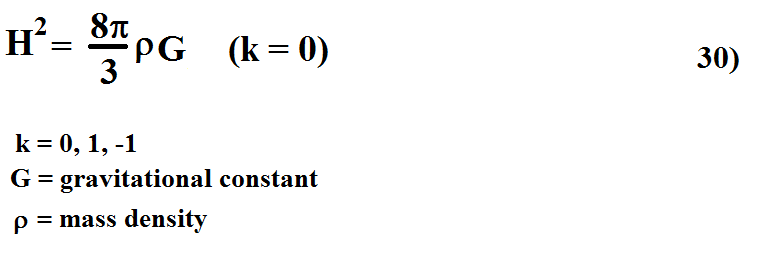
We bring back the Friedmann equation at 30 below. According to the WMAP spacecraft, space is nearly flat, so we set k to zero.

Let's assume a gravitational field has a limited range of r = c/H. The diagram below shows a sphere with volume V divided into an alpha section and a beta section. The alpha section is within the c/H limit for observer O; the beta section is not. This creates an inequality at 31. If gravity depends on gravitons limited to light speed, the Friedmann equation is invalid if distance r is greater than c/H.

Next, lets assume the vacuum and gravitational fields both exist everywhere. The equality is restored and the Friedmann equation is always valid:

This seems inconsistent with GWs that cannot penetrate the c/H barrier. Let's examine GW equations and see if we can reconcile this apparent inconsistency.

At 33 above we begin with a GW power equation for two rotating black holes. With a little algebra we derive equation 37. At 37 we assume gravity has an unlimited range, so we multiply that part by Sv which equals 1. We further assume GWs that are more than c/H meters away from an observer cannot be detected. So we multiply P and the frequency by s, where s equals 0. Equation 37 confirms that gravity overcomes the c/H barrier and GWs may not. GWs do not carry gravitational information. If there was zero frequency, the black holes would still have gravity and there would be no GWs. The source of GWs is the kinetic energy needed to maintain the orbits of the black holes. Over time this energy is converted to massless waves that propagate no faster than light. Equation 38 below shows how gravity can exist in the absence of GWs (notice that the s's cancel):

<

class="separator" style="clear: both;">

Conclusion:

It appears that vacuum and gravitational fields extend to infinity unlike the electric field. Both gravity and dark energy have the potential for speed greater than light; yet, ironically, this does not violate the light-speed limit. In fact, the light speed limit itself depends on "spooky action at a distance"--i.e.--entanglement of frequency and wavelength. This entanglement is also essential to the velocity addition formula that ensures that two velocities never exceed light speed.

References:

1. Flanagan, Eanna. Hughes, Scott A. 2005. The Basics of Gravitational Wave Theory. New Journal of Physics.

2. Van Flandern, T. 1999. The Speed of Gravity What the Experiments Say. Meta Research University of Maryland Physics Army Research Lab.

3. Siegel, Ethan. August 30, 2018. Our Motion Through Space Isn't A Vortex, But Something Far More Interesting. Forbes

4. Tzortzakakis, Filippos, LIGO Analysis: Direct Detection of Gravitational Waves. Journal of Research Progress Vol. 1.

5. Roberts, Tom, Schleif, Siegmar. 2007. What is the experimental basis of Special Relativity?

6. Friedmann equations. Wikipedia

Saturday, April 29, 2023

Why the Speed of Gravity and the Speed of Gravitational Waves Are Not the Same

ABSTRACT:

According to Relativity Theory, everything propagates through spacetime at light speed. However, a mass at rest propagates solely through time and experiences zero velocity. A massless photon propagates solely through space and experiences no time. Other objects propagate through time and space, and, experience both time and subluminal velocities. This paper demonstrates that both gravity (the fundamental interaction) and gravitational waves propagate at light speed through spacetime, but with varying degrees through time and space, i.e., they each have different velocities through space.

The year was 1971. Via the Apollo 15 mission, David Scott performed the following experiment on the moon: With a hammer in one hand and a feather in the other, he held them the same distance from the moon's surface. He dropped them. They hit the ground simultaneously. This experiment might not seem like a big deal, but it confirms that Galileo was correct. More importantly, it shows that gravitational interactions (with the exception of gravitational waves) should never be modeled after the electromagnetic (EM) force.

The EM force, like Newtonian forces, conserves energy, momentum and itself in the following manner:

Equations 1 and 2 above show that different masses have different velocities and different rates of acceleration when acted on by the same magnitude of force. Since momentum is conserved, we can use equations 2 above and 3 below to predict the speed of the photons that mediate the force:

No surprises here. Photons propagate at c as expected. Gravity, unlike EM, is full of surprises. Let's model gravity after the EM force and see what happens. Let's assume there is a gravitational field of gravitons that mediate the "force" of gravity. Here is the math:

At 6 and 7 above, force and momentum are not conserved. If we assume momentum is conserved, at 8 the speed of gravitons depends on the mass of the falling object. We cannot count on their speed being c. What about gravitational waves? Why do they consistently propagate at or near the speed of light? Consider the following thought experiment:

You throw a baseball with enough force to place it into orbit around the earth. The force you use is independent of and counters gravity. It is also conserved and so is the ball's angular momentum. The ball's tangential velocity depends on its mass and vice versa. As the ball orbits earth its velocity changes, i.e., the ball accelerates. An accelerating mass emits gravitational waves (GWs). The energy converted to GWs is the same conserved energy you put into the ball when you threw it into orbit. We can predict the speed of these GWs the same way we predicted the speeds of photons and gravitons:

Equation 9 shows that the ball's velocity happens to equal the gravitational potential velocity at distance r. If the ball had more mass (m), its velocity would be less and its orbit would decay. If the ball had less mass, it would have more velocity and would rise out of orbit. Equation 10 shows how much power P is emitted. Over time velocity v will be reduced and the ball will spiral into the earth. At any time, momentum p equals mv. Equation 11 predicts the speed of GWs to be ~c, the speed of light. This is possible because the baseball was originally accelerated to v by you, not gravity. To predict the speed of gravity, absent the influence of another force (you throwing a baseball), requires a model that is different from the EM or force model. Over a century ago, Einstein realized this and had a big idea:

From an airplane flying 10,000 feet above the earth's surface, drop several items with different masses. If we assume they are falling to earth, they all fall at the same rate, so momentum at any instant is not conserved. But what if those items are at rest and it is the earth with mass M falling or accelerating to the items? Clearly, an independent force accelerating the earth would be conserved. With more mass, the earth would accelerate less. The problem is, with more mass the earth really accelerates more. This fact implies that there is no independent force causing earth to accelerate. So there is apparently no independent force acting on the earth or the items that appear to be falling.

If the earth simply accelerates to the items, what need is there for a graviton? As shown at 6 through 8 above, gravitons, if they exist, fail to either conserve force, energy and momentum, or, they don't have a consistent speed if force, energy and momentum are conserved. David Scott's experiment showed us this is true. The feather and the hammer fell at the same rate, not different rates.

Laplace and Van Flandern, based on observations, concluded that the speed of gravity must be several orders of magnitude faster than light. Perhaps infinite! (Masses simply accelerating towards one another combined with independant forces causing angular momentum could certainly provide that impression.) Other physicists hate the idea of infinite speed and insist the speed of gravity is c. To accommodate the Laplace and Van Flandern observations, they point to a model of moving charges, where one charge's vector is lined up with the another charge's instant position rather than its retarded position, creating the illusion that there is no light-time delay, i.e., infinite photon speed when in reality photon speed is c. This model is then projected onto a cosmological scale, and thus moving planets and stars work in a similar fashion and create the illusion of infinite graviton speed when in reality graviton speed is allegedly c. The problem with this model is it completely ignores the Heisenberg Uncertainty Principle. For the model to work, one has to know the position and velocity of the charges with precision. And, as demonstrated above, charges (or EM) conserve force and momentum in a way that gravity does not.

Laplace, Van Flandern and the physicists who criticize them have one thing in common: they all think of gravity as a force consisting of bosons that either propagate at c or much faster than c. Because of General Relativity, it makes perfect sense that most physicists want to limit the speed of gravity to c; however, when two black holes collide and form a new more massive singularity, it is not clear how a boson propagating at c can escape that singularity and inform the rest of the universe of the event. Since nothing propagating at c can escape a black hole, how does this new black hole singularity reset the curvature of its surrounding spacetime?

Let's start with what we know. At 12 below we have the Compton wavelength equation. Note that when mass m changes, the wavelength must change instantaneously, since a mass and its wavelength are essentially the same entity. If we think of the wavelength as spacetime, then spacetime is updated the instant mass changes. At 14 we convert the equation to Planck units with an alpha scale factor. At 15 we derive a Scharzschild radius. Equation 16 shows that a change in alpha instantaneously causes a change in beta, since their sum times a Planck length make up distance r. (Distance r, of course, along with the mass, determines the rate of Newtonian acceleration.) Equation 17 is a scalar version of Einstein's field equations. On the right side we have curvature units.

When two black holes merge, alpha increases everywhere it appears at equation 17. This causes an instantaneous decrease of beta at any distance r from the new black hole's singularity. Thus the new black hole doesn't have to send information at light speed or any speed to update its surrounding spacetime. Mass and spacetime have an entangled relationship. Energy and momentum equations show this to be true. Where would energy and momentum be without mass entangled with velocity? Of course velocity is in units of space and time. Thus one can conclude that the only valid speed for gravity is how fast matter moves at an arbitrary distance from a falling observer:

Equation 18 above shows how fast gravity moves through space. Equation 19 shows how fast gravity moves through time. Finally, equation 20 shows how fast gravity moves through spacetime--the speed of light.

References:

1. Ibison, Michael, Puthoff, Harold E., Little, Scott. The Speed of Gravity Revisited.

2. Kopeikin, Sergei, Fomalont, Edward B. 27 Mar 2006. Aberration and the Fundamental Speed of Gravity in the Jovian Deflection Experiment.

3. Flanagan, Eanna. Hughes, Scott A. 2005. The Basics of Gravitational Wave Theory. New Journal of Physics.

4. Carlip, S. Aberration and the Speed of Gravity. December 1999.

5. Van Flandern, T. 1999. The Speed of Gravity What the Experiments Say. Meta Research University of Maryland Physics Army Research Lab.

6. Siegel, Ethan. August 30, 2018. Our Motion Through Space Isn't A Vortex, But Something Far More Interesting. Forbes

7. Galileo's Leaning Tower of Pisa experiment. Wikipedia.

8. David Scott does the feather hammer experiment on the moon | Science News. Youtube.com

9. Tzortzakakis, Filippos, LIGO Analysis: Direct Detection of Gravitational Waves. Journal of Research Progress Vol. 1.

Saturday, December 31, 2022

What Really Happens If the Sun Disappears?

To demonstrate that the speed of gravity is no faster than light, physicists love to point out that if the sun suddenly vanished, it would take approximately eight minutes for the information to reach earth, and over five hours for the information to reach Pluto. It is assumed that earth and Pluto would remain under the influence of the sun's gravity for eight minutes or over five hours respectively. After all, it is currently understood that information, including gravitational information cannot exceed light speed.

But here is the irony: to make the point that nothing is faster than light, the sun (poof!) disappears faster than light! Further, such a thought experiment only takes into account an observer on earth (or Pluto). Allegedly, both gravitational and electromagnetic information reach the observer simultaneously, so said observer (Alice) observes nothing out of the ordinary. She sees the sun vanish and notices that the sun's gravity has vanished along with it. However, another observer (Bob) has parked his spaceship telescope halfway between the sun and the orb where Alice is located (see drawing below).

The orb is distance r from the sun and Bob's telescope is distance r from the sun and the orb. Information from the sun and the orb reach Bob simultaneously within a time of r/c seconds, where c is light speed. Now, let's suspend disbelief and pretend the sun vanishes instantaneously (see drawing below).

Because information from the sun and the orb reach Bob simultaneously, Bob must wait another r/c seconds to observe what Alice observes. Suppose he doesn't wait. Suppose he plugs in the numbers he observes when he first receives information from the sun and the orb. Here is what Bob's math reveals:

At 1) we have Einstein's field equation. If the sun vanishes, the stress-energy tensor (T) value would be severely reduced, so at 2) T has a limit of zero. A little algebra gives us a value that is substantially greater than the gravitational constant. Both 2) and 3) reveal that Newton's constant is not constant, i.e., has a much greater value than expected for a time period of r/c, the time it takes for the information to reach Alice.

If we assume that gravitational information is necessary and that it propagates at light speed, then we must abandon the idea that Newton's constant is constant for all observers. Clearly it is not if gravitational information is necessary to cause gravity.

On the other hand, if we assume gravity is more analogous with the equivalence-principal thought experiment, where the dropped pen seems to fall to the spaceship's floor but the floor really accelerates to the pen, then gravitational information is not necessary to cause gravity. Further, the math shows that Newton's constant remains constant, because there is no r/c time delay--the spaceship does not send a signal to the pen--it simply accelerates to the pen, creating the "persistent illusion" of gravity, where reality, according to Einstein, is a "persistent illusion."

Of course nothing I have written here addresses gravitational waves or how gravity is supposed to work outside an equivalence-principle spaceship. I address those concerns in "The Beautiful Destruction of the Graviton" and "Quantizing Gravity without the Graviton."--which you can find at my profile page at Accademia.edu.

OK, then ... if the sun should magically disappear what really happens? If Newton's constant is really a constant, the impact on the solar system will be immediate but this will not violate the light-speed limit because no gravitational information needs to propagate from the sun.

Saturday, August 6, 2022

P = NP? A Solution to the Clay Mathematics Institute's Sample NP Problem

ABSTRACT:

This paper offers a solution to the sample NP problem that can be found at the Clay Mathematics Institute's website. A python program is included along with commentary on whether or not P = NP.

At their P vs. NP page, the Clay Mathematics Institute (CMI) provides the following NP problem example:

"Suppose that you are organizing housing accommodations for a group of four hundred university students. Space is limited and only one hundred of the students will receive places in the dormitory. To complicate matters, the Dean has provided you with a list of pairs of incompatible students, and requested that no pair from this list appear in your final choice. This is an example of what computer scientists call an NP-problem, since it is easy to check if a given choice of one hundred students proposed by a coworker is satisfactory (i.e., no pair taken from your coworker's list also appears on the list from the Dean's office), however the task of generating such a list from scratch seems to be so hard as to be completely impractical. Indeed, the total number of ways of choosing one hundred students from the four hundred applicants is greater than the number of atoms in the known universe! Thus no future civilization could ever hope to build a supercomputer capable of solving the problem by brute force; that is, by checking every possible combination of 100 students."

To make this problem even more difficult and more explicit, let's assume there is only one set of 100 students who qualify for places in the dormitory, and, let's assume we can randomly select any two students from this set--and the pair will not appear on the dean's list of pairs of incompatible students. Thus, no pair from this set will match any pair on the dean's list. The following math shows that this ideal set is buried in a haystack of approximately 10^96 (not 10^200) sets of 100 students!

Below we derive equation 4 which shows that not only k increases as n increases, but the exponent increases as well:

A brute-force algorithm will undoubtedly exceed polynomial time (P). However, we can convert this NP problem to a P problem if we replace student names with numbers ranging from 0 to 399, then pair with each student number an incompatibility score. We do this by examining how many times each student number appears on the dean's list of student pairs. For example, if the list shows [[1,2], [1,3] ...], student 1 appears twice and receives a score of 2. Students 2 and 3 only appear once, so they receive a score of 1. Having the lowest incompatibily scores, students 2 and 3 will appear on the final 100 list along with 98 other low-scoring students.

The final list of 100 students can be checked against the dean's list in polynomial time. The process of checking the dean's list to give each student a score can also be performed in polynomial time. This can be mathematically shown. Let's start by calculating the size of the dean's list of pairs:

The first term on the right side of equation 5 is the total number of student pairs possible with no repeats. We subtract from that the total possible pairs (with no repeats) from the final 100 list. Thus, the size and complexity of the problem has been reduced from approximately 10^96 arrangements of 100 students to less than 100,000 arrangements of student pairs. Below is the relevant math showing the problem is solved in polynomial time:

The term on the right side of equation 11 does not have the number of students (n) as an exponent. The variable k' increases as n increases but the exponent stays fixed at 2--unlike equation 4 where the exponent increases as n increases.

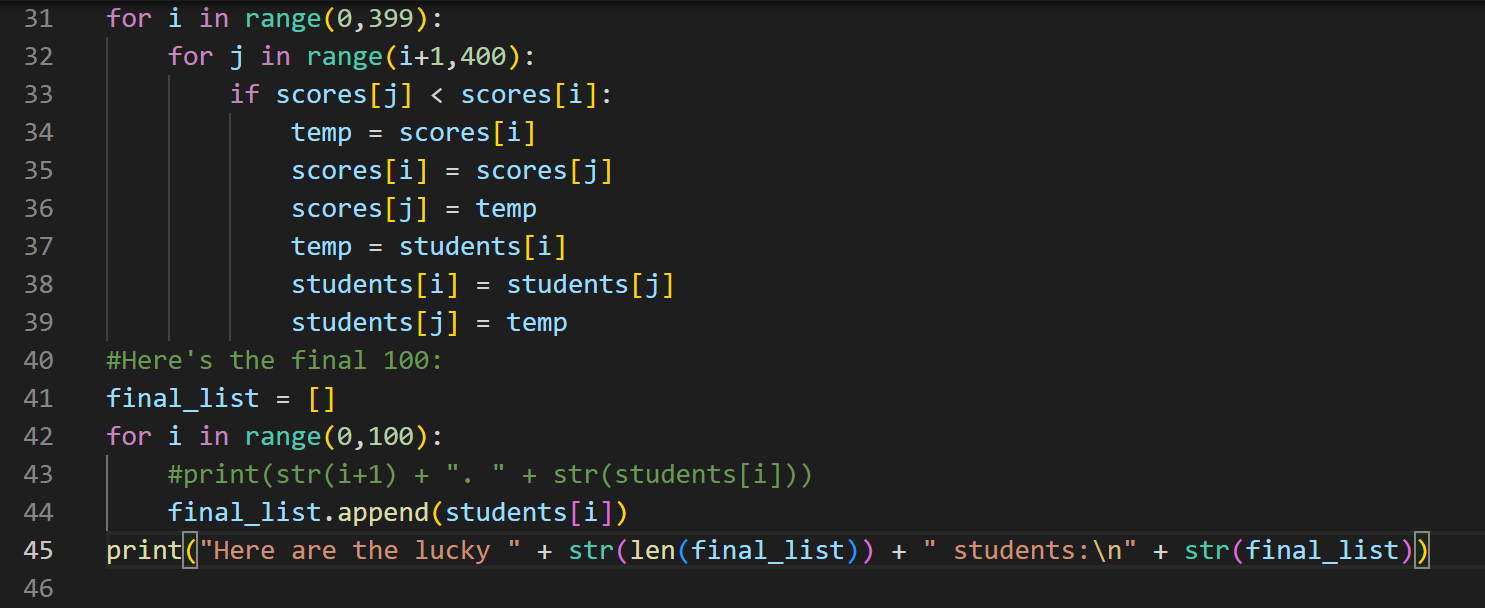
Now, on paper it looks as though the NP problem can be reduced to a P problem, but what about in practice? Below is a python program that solves the CMI's sample NP problem:

Here is the final output:

Lines 1 to 21 are devoted to creating a random dean's list. The remaining program solves the puzzle by giving each student number an incompatibility score. The 100 students with the lowest scores make the final cut. As you can see, there is only 45 lines of code, most of which are used merely to set up the problem. Only the final 22 lines of code are used to solve the problem. The total run time on my personal computer is about one minute. Now, does this mean that P = NP?

At the very least it can be shown that an NP problem can be reduced to a P problem. But is this always the case? One thing I have noticed is that some NP problems have more clues than others. The CMI's example has 74,850 clues, i.e., the student pairs on the dean's list. These clues tell which pairs don't belong to the set of pairs of students on the final 100 list. So there's no need to guess which of the approximately 10^200 sets of 100 students is the right answer. We can use the power of deduction.

Now, imagine this same NP problem without any dean's list, without any clues. The dean simply tells you whether or not you have the right answer. Even the great Sherlock Holmes would be forced to test up to approximately 10^96 sets of 100 students. His powers of deduction would be useless. So even if we can make NP equal to P, we can always make the NP problem harder--the hardest problem has no clues. Thus it seems reasonable to conclude that P doesn't equal NP where there are no clues. Where there are clues, there is opportunity!

References:

1. Cook, Stephen. The P Versus NP Problem. Clay Mathematics Institute

2. Stewart, Ian. Ian Stewart on MInesweeper. Clay Mathematics Institute

3. P vs NP Problem. Clay Mathematics Institute