Featured Post

Breakdown of Navier-Stokes Equations

Find PDF version here. Abstract: Given limited energy and a small mass density or large kinematic viscosity, this work shows why...

Friday, May 31, 2024

Hawking Radiation Doesn't Work the Way You Think

ABSTRACT:

Hawking radiation has not been directly observed. Maybe it exists, maybe it doesn't. Even it it exists, some very fundamental physical laws prevent black hole evaporation. At the quantum level, Hawking radiation can be turned on its head. It could just as easily add mass to a black hole.

Hawking radiation has not been observed for a very good reason: it does not work the way you think. The hypothesis seems sound at first blush: Two particles pop into existence. One outside the black-hole horizon, and the other trapped inside the black hole. The outside particle escapes, and, can be deemed positive energy, since it adds energy to the outside universe. The trapped particle can be deemed negative energy since, according to Hawking, will reduce the black hole's mass. Note that energy is always conserved, since positive energy and negative energy mathematically cancel each other. The bottom line is black holes allegedly evaporate due to Hawking radiation. I say "allegedly" because there is more to the story. The Hawking-radiation hypothesis is incomplete. Let's do a more complete thought experiment and see what happens.

Imagine a star that is virtually all matter, with next to no anti-matter. The star collapes into a black hole. Its mass is still composed of virtually all matter. The stuff that falls into this black hole is virtually all matter. In the black-hole diagram below, we represent a particle of this matter with the Greek letter mu preceded by a plus sign. Ellipses before and after the plus mu's represent multiple particles that may have been crushed into a singularity.

The above diagram represents the starting mass and the state prior to the appearance of a particle (plus mu) and an antiparticle (minus mu). The next state below is where a particle-antiparticle pair appears. The antiparticle escapes the black hole's gravity, but the particle is trapped.

In the next diagram the trapped particle has no anti-particle to interact with, so it adds mass to the black hole! This particle can be deemed the positive energy. The escaped anti-particle is then deemed negative energy and has the potential to interact with any particle it encounters. Such interaction will reduce the mass of the universe outside the black hole.

Of course there is only a 50% probability the black hole will gain mass and the remaining universe will lose mass. Below we see that there is a 50% probability that the particle will escape and the antiparticle is trapped.

The antiparticle has no problem finding particles to interact with:

The black hole loses the mass it previously gained:

The escaped particle and the escaped anti-particle may annihilate each other, or, if they are too far apart, will interact with other particles and antiparticles.

The space outside the black hole returns to nothing and the black hole returns to its starting mass:

The above thought experiment can also be performed with anti-matter black holes. The main problem with Hawking's hypothesis is it has the following implicit assumption: That all black holes have fairly equal amounts of matter and anti-matter. One might ponder whether a star that precedes a black hole can have fairly equal amounts of matter and anti-matter and still exist. Assuming the answer is a resounding no, then black holes don't evaporate via Hawking radiation.

For the sake of argument, let's assume Hawking was right. There is Hawking radiation and it causes black holes to evaporate. Why should black holes have all the fun? Imagine a particle-antiparticle pair appearing above the earth's surface. One escapes earth's gravity, the other does not. When they first appeared, they each had velocity v which is less than light speed. Velocity v was an escape velocity for one but not the other--the other being too close to earth's center of mass. If Hawking was right, the trapped particle should reduce the earth's mass. Over time the earth will completely evaporate. Thus, if Hawking was correct, all planets, stars, etc. should evaporate. The counter-argument is no such evaporation has been observed.

The equations below further demonstrate why black holes, in particular, refuse to evaporate:

Since light can't escape a black hole, a black hole's emissivity is zero. Even if it has an emissivity of one, power (P) according to the Stefan-Boltzmann equation above, is less than zero. This implies there is more radiation entering a black hole than randiation escaping. The minimum mass required to make a black hole is approximately three solar masses. So much mass causes the black hole's temperature to be less than its surrounding environment: deep space. The second law of thermodynamics would be violated if the net thermal transfer favors black-hole evaporation. Black hole entropy increases when a black hole's mass increases:

On the flip side, a compelling argument in favor of black-hole evaporation is the following thought experiment: Imagine a photon-antiphoton pair. Photons and antiphotons are indistinguishable from each other. So if the photon is trapped, it could behave like an antiphoton and annihilate matter inside the black hole, reducing the black-hole's mass. However, the escaped anti-photon can also behave like an antiphoton. If the escaped antiphoton finds another photon first, it becomes the negative-energy particle and reduces the energy of the universe outside the black hole. The trapped photon (or antiphoton) will add energy or mass to the black hole.

Photon-antiphoton Hawking radiation is more likely to cause the black-hole to lose mass if the black-hole's surrounding environment is empty space with a lower temperature. Albeit, this is an ideal and unrealistic condition. The cosmic microwave background raises the temperature of the surrounding environment to approximately 2.73 Kelvin, well above the temperature of the typical black hole. Thus, the following scenario is consistent with equations 1 through 6 above: The escaped photon is more likely to find another photon to interact with. When it does, the two photons vanish. The trapped photon adds mass to the black hole.

References:

1. Hossenfelder, Sabine (23 August 2019). "How do black holes destroy information and why is that a problem?". Back ReAction. Retrieved 23 November 2019.

2. Hawking, Stephen (1 August 1975). "Particle Creation by Black Holes" (PDF). Commun. Math. Phys. 43 (3): 199–220.

3. Susskind, Leonard (2008-07-07). The Black Hole War: My Battle with Stephen Hawking to Make the World Safe for Quantum Mechanics. Little, Brown and Company.

4. Black hole information paradox. Wikipedia.

5. Mathur, Samir D. 03/21/2021. The Elastic Vacuum. Gravity Research Foundation.

6. Chaisson, Eric. Astronomy Today. Englewood, NJ: Prentice Hall, 1993: 503

7. Severino, Paul. THe Black Hole Information Paradox: A Quantum Information Perspective. 03/24/2020

8. Wilkins, Alex. Ilands Poking Out of Black Holes May Solve the Information Paradox. 01/11/2024. UC Berkeley Physics.

Saturday, May 25, 2024

Using Quantum Physics to Find the Best Model for Gravity, Gravitational Waves, and the Vacuum

ABSTRACT: According to Einstein's theories of relativity, nothing is faster than light; yet, observations made by Newton, Laplace and Van Flandern led them to believe gravitational information is much much faster than light, virtually instantaneous. To thicken the plot further, LIGO observed gravitational waves propagating within the light-speed limit. Then there's the vacuum energy problem where the vacuum seems to have up to infinite energy! By making use of quantum physics and changing an initial assumption about the vacuum energy, it is possible to connect the dots between quantum physics and General Relativity. By exposing a fundamental flaw in the rubber-sheet model for curved spacetime, it is possible to create a superior model that reconciles the speed of gravitational waves with the illusion of faster-than-light gravitational information.

Quantum physics is probabilistic as opposed to deterministic. Given a vacuum that is composed of numerous (omega) energies it only makes sense to multiply each energy by a probability. The alternative is to simply add all the energies and get up to infinity! Assuming each energy has a wave function, each probability can be determined by squaring each wave function. Each energy is represented by the Hubble energy (Hubble's parameter * Planck's constant) multiplied by n. At equation 1 below, we calculate the vacuum mass density (rho). At equation 2 we determine the cosmological constant:

Now, let's introduce a particle with mass m (or it could be massless: m = E/c^2). It could be located anywhere and everywhere. Its location (x,y,z coordinates) is uncertain at best. We could add m multiple times to cover all its possible locations, but that would lead to a rediculously big number. Or, as we did with the vacuum, we could multiply each m location by a probability (see equations 3 and 4) and that will give us the expectation value for m which is really just m. Thus, multiple m's at multiple locations don't amount to more than just m. The velocity of m is also uncertain, but we can calculate its expected value at equation 5. At 6 we determine the expectation value for the wavelength of m.

At equation 7 we see how multiple locations of m impact its gravity:

The gravity of m is also at multiple locations along with m, but probabilties cut it all down to size. The size being the left side of equation 7: the gravity of the expectation value: m.

At equation 8 below, we redefine m as one or more particles (expected values). At 9 and 10, we calculate the final velocity and the final wavelength, respectively.

At 10 we have the De Broglie wavelength formula. At 11 we below can see that if mass m or final velocity v changes, the final wavelength lambda must instantaneously change to keep Planck's constant a constant. After a few algebraic steps, we derive the Schwarzshild radius at 16.

Note that any change of mass m causes an instantaneous change of its wavelength (lambda prime). This means that when a black hole's singularity mass changes, its Schwarzschild radius instantaneously changes! Equation 17 below confirms this. The light-speed constant c on the left side is not a constant unless mass m and Schwarzschild radius changes are synchronized. Thus, we don't have to wonder how the singularity sends information out as far as the Schwarzschild radius, assuming such information is limited to light speed. It doesn't need to. Every mass simply has, and is defined by, a corresponding wavelength and Schwarzschild radius.

But wait! It gets even better! The diagram below shows the total radius r (in black), the Schwarzschild radius (in red) and the remaining distance (in blue). Let's assume the circle below contains the volume (V) of the entire universe (or any volume you like). If mass m owns the volume as far out as the Schwarzschild radius, then the vacuum's claim along the total distance r is reduced. The rest of the universe owns only the volume along the remaining distance.

One can infer that the remaining distance (in blue) must change instantaneously in response to a change in the Schwarzschild radius (in red) which in turn changes instantaneously to a change in the average wavelength which responds instantaneously to a change in mass m.

Equation 18 shows that proper time, out to radius r, is also reduced and is proportional to the square root of the remaining distance over r. The reader may recognize a variation of the Lorentz factor on the left side. One may also infer that proper time is reduced instantaneously given its dependency on the remaining distance.

Using the diagram above, we can set up equation 19 below. From there we can navigate to Einstein's field equations at 21. At 22, we can further verify the instantaneous relationship between matter, spacetime, and gravity. Again, the constant c is not constant unless spacetime curvature responds instantaneously to a change in the stress-energy tensor.

So far we have shown how matter interacts with spacetime. We should now take a look at how vacuum mass interacts with spacetime. All masses project a Schwarzshild radius regardless of how concentrated or diffuse they are. In each diagram below, the gray area represents the mass concentration. Note that each diagram has a mass of m and the same Schwarzschild radius.

Vacuum mass, like the star and black hole, also curves spacetime. The cosmological constant is that spacetime curvature caused by vacuum mass density. We add this to the field equations:

So a question arises: Why does vacuum mass density and its curvature cause the universe to expand? Below, term A implies term B, and, term C implies term D. Term B shows how matter (E) accelerates. When distance r is larger, the rate of acceleration is less. When r is smaller, the acceleration rate increases. This is because matter (E) is fixed. Contrast this with term D. At term D, the opposite happens: Acceleration increases as r increases and vice versa because vacuum mass is not fixed. It is proportional to volume. Both B and D contribute to spacetime curvature, but are seemingly opposite forces.

At equation 25 we set a scalar version of the Einstein tensor equal to the sum of the curvature caused by mass m and the curavature caused by vacuum mass. From there we derive equations 30 and 31 which show the tug of war between an expanding universe and gravity.

We can simulate the net acceleration rate at equation 31 with an accelerating rocket (see diagram A below). If we throw a shot put across, it will appear to fall along a curved path. Throwing the shot put gives it kinetic energy which may be lost and converted to gravitational waves (GWs, purple curved lines). At diagram B we have a fixed container with a magnetic field. Equations 31 and 32 demonstrate the time-delay difference between gravity and electromagnetism. Imagine t1 is the time it takes to initiate the rocket engine and the electromagnet. The magnetic field takes an additional r/c seconds to develop, since photons must propagate from the floor of B to the shot put (distance r) at speed c. After t1 + r/c seconds have passed, the shot put falls and takes time t2 to hit the floor. By contrast, the shot put at A immediately falls after t1 seconds.

Thus gravity's total time t is t1 + t2 seconds (equation 32). Electromagnetism's total time t is t1 + r/c + t2 (equation 33). Also note that the gravitational waves (GWs) do not cause the shot put to fall, but rather, it is the shot put's lost kinetic energy that causes the GWs.

Observations confirm that the GW strain (h) is consistent with 35 below and not 34. At 34 we have the curvature of the complete energy of the source; whereas, at 35, we just have the curvature of kinetic energy of the source. Notice at 36 and 37 electric and magnetic waves are proportionate and correlate with their respective fields. By contrast, GWs do not correlate with the full gravitational field.

The accelerating-rocket thought experiment above seems like a good approximation of gravity and gravitational waves; however, it seems to contradict the famous rubber-sheet model of gravity. Imagine placing the shot put on a rubber sheet. The shot put will depress the rubber sheet. Such depression, however, does not happen instantaneously. The depression curve takes time to form. As it's forming, one can imagine GWs propagating outward from the center of mass. But what happens if the shot put is moving fast (v > 0) and not at rest (v = 0)? One can imagine it not depressing the rubber sheet:

Imagine the earth is covered with a rubber sheet and the shot put has enough velocity v to orbit. It won't fall towards earth's center, so it won't depress the rubber sheet. We model this fact with equation 39:

One might erroneously conclude that if a mass moves fast enough, it won't curve spacetime! This could not be further from the truth. The truth is velocity enhances the curvature of space time:

Thus the rubber-sheet model has a fundamental flaw. The accelerating-rocket model is superior. It creates the illusion that gravity's speed is faster than light. This is consistent with observations made by Newton, Laplace and Van Flandern. I say "illusion" because nothing in the accelerating-rocket thought experiment exceeds the speed of light.

Given all the forgoing information, we can set up a timeline model for curved spacetime and gravitational waves (GW):

Equations 41 through 44 take into account the instantaneous interplay between matter and spacetime along with gravitational waves that don't exceed the light-speed limit. Equations 45 through 47 below confirm that 41 through 44 are correct; otherwise, the constant c would not be constant if the curvature of spacetime had to wait for gravitational waves or gravitons to propagate.

Acknowledgements:

Amber Strunk. Education and Outreach Lead. LIGO Hanford Observatory.

References:

1. Parikh, Wilczek, Zahariade. 2020. The Noise of Gravitons. arxiv.org.

2. Feynman, R.P. 07/03/1963. Quantum Theory of Gravitation. Acta Physica Polonica. Vol. XXIV.

3. Graviton. Wikipedia.

4. Carlip, S. 12/1999. Aberration and the Speed of Gravity. arxiv.org.

5. Van Raamsdonk, M. 05/17/2010. Building up spacetime with quantum entanglement. arxiv.org.

6. Hanson, R.; Twitchen, D. J.; Markham, M.; Schouten, R. N.; Tiggelman, M. J.; Taminiau, T. H.; Blok, M. S.; Dam, S. B. van; Bernien, H. (2014-08-01). Unconditional quantum teleportation between distant solid-state quantum bits. Science. 345 (6196): 532–535.

7. Gravitational Wave. Wikipedia.

8. de Rham, C., Tolley, A.J. 03/17/2020. Speed of Gravity. arxiv.org.

9. Carroll, S.M. 12/1997. Lecture Notes on General Relativity. Enrico Fermi Institute.

10. Marsh G.E., Nissim-Sabat. 3/18/1999. Comment on an article by Van Flandern on the speed of gravity. Physics Letters A Vol. 262, pp. 257-260 (1999)

11. Suede M. 11/29/2012. The Speed of Gravity: Why Einstein Was Wrong and Newton Was Right. Blog commentary re: Tom Van Flandern.

12. Cornish N., Blas D., and Nardini, G. 10/18/2017. Bounding the Speed of Gravity with Gravitational Wave Observations. Phys. Rev. Lett. 119, 161102

13. Van Flandern, T. 1999. The Speed of Gravity What the Experiments Say. Meta Research University of Maryland Physics Army Research Lab.

14. Nix, E. 08/22/2018. Who Determined the Speed of Light. History.com.

15. Speed of Gravity. Wikipedia.

16. Tests of General Relativity. Wikipedia.

17. Decross, M. et al. Gravitational Waves. Brilliant.com.

18. Lawden, D.F. 1982. Introduction to Tensor Calculus, Relativity and Cosmology. Dover Publications, Inc.

19. Stefanovich, E. V. 09/16/2018. A relativistic quantum theory of gravity. arxiv.org.

20. Light-time correction. Wikipedia.

21. Liénard–Wiechert potential Wikipedia.

22. Kopeikin, S. M. Fomalont, E. B. 03/27/2006. Aberration and the Fundamental Speed of Gravity in the Jovian Deflection Experiment. arxiv.org.

23. Faber, J. A. 11/24/2018. The Speed of Gravity Has Not Been Measured From Time Delays. arxiv.org.

24. Yin Zhu. 08/18/2011. Measurement of the Speed of Gravity. arxiv.org.

25. Perihelion of Mercury’s Orbit. macmillanlearning.com.

Saturday, January 6, 2024

Was the Speed of Gravity Successfully Measured?

ABSTRACT: This paper shows mathematically and experimentally why it is highly unlikely that the speed of gravity was successfully measured.

Consider the rubber-sheet analogy. If you place an iron ball on a rubber sheet, you will see the ball depress and curve the rubber sheet. If you roll the ball accross the sheet, you will see the sheet flatten out at the ball's previous position and the sheet will begin to curve at the ball's current position. Over a given distance, it takes time for the curve to flatten and reform. We can calculate the speed of this process by dividing the distance by the time. One might assume we can calculate the speed of gravity in an analogous manner. In fact, I had an email exchange with Sergei Kopeikin who claimed that during the Jovian Deflection Experiment he observed Jupiter's gravity fading and reforming as Jupiter moved through space. The speed of this process turned out to be the speed of light or close to it. He also informed me that the gravity was stronger at Jupiter's previous (retarded) position and weaker at Jupiter's current position due to the light-time delay.

That got me thinking. If Jupiter moved at light speed, there would be zero gravity at its instant position, since if takes time for the spacetime to curve and when it does, Jupiter has moved to its next position. Its maximum gravity would be at a previous position. This is true even if Jupiter moves much slower than light speed. And so ... Houstin, we have a problem: Newton and Einstein created equations that assume Jupiter's maximum gravity is located at Jupiter's current position, not its previous position. If we plug in zero (or minimum gravity) at Jupiter's current position, or, plug in maximum gravity where there is no Jupiter (mass Mj), the equations break down and become inequalities:

Additionally, the Jovian observations are inconsistent with observations of the solar system orbiting the center of the Milky Way galaxy. According to Ethan Siegel (see reference below), the sun and the planets orbit the galaxy's center on the same plane. This implies that the solar system's curved spacetime moves in sync with the sun and planets. If the sun were to get ahead of its gravity (like Jupiter), the planets would lag behind the sun and form what looks like a vortex.

There is also a physical and thought experiment that can verify whether or not curved spacetime lags behind a planet's motion: Imagine two sky divers (Alice and Bob) jumping from a jet. Alice holds a target and Bob holds and aims a paintball gun. Bob has perfect aim and takes aim and fires along the horizontal axis (x). The paintball accelerates and hits the bullseye. This would not be possible if Alice, Bob, the target and the paintball were not falling at the same rate. Here is a crude illustration of what has happened so far:

If the paintball's acceleration vector lagged behind, it would have followed the path of the dotted line. It didn't; it followed the path of Earth's spacetime curvature along with Alice and Bob. Not only does gravity pull down matter, it also pulls down acceleration vectors. Additionally, the fact the paintball hit the bullseye implies that Earth's curved spacetime vector, along with everything else, follows the sun's curved spacetime as the Earth orbits the sun. Imagine the sun's gravity pulling everything forward along the z axis:

From this experiment we can infer that the solar system orbits the galaxy center on the same plane because the solar system's curved spacetime vectors follow the galaxy's curved spacetime. Or, another way to put it, the solar system's gravity falls at the same rate as the solar system. This means where there is mass, there is gravity and vice versa. Gravity does not lag behind a mass's movement. This is consistent with gravity equations, but not consistent with the rubber-sheet analogy or the Jovian experiment.

OK, so the Jovian experiment is called into question. So what? Surely LIGO's discovery of gravitational waves clinches the notion that scientists have successfully measured the speed of gravity. There's even a nice quadrupole-moment equation that gives the strain or amplitude (h) of such waves:

As the black holes' orbits decay, gravitational waves carry away energy and momentum. Unfortunately, these quantities are conserved. Why is this unfortunate? It is the hope of many physicists that gravitons make up gravitational waves. It is believed that when gravitons interact with matter, this interaction will be indistinguishable from gravity, but gravity does not appear to conserve force and momentum. For example, if you consider falling objects at rest and the earth accelerating to them, the earth accelerates more if it gains mass and accelerates less if it loses mass. Or, consider the earth at rest and drop any two objects with different masses in a vacuum chamber and they will appear to have virtually the same velocity at any point in spacetime:

Notice at equations 6 and 6a there's squared momentums in the numerators and they are not conserved because the velocity c is constant. By contrast, if gravitational waves interact with masses M and M', we have the following:

Since the momentum is conserved, we can expect the strain h to change when the waves interact with different masses. If the strain is gravitational, it should not change at all. Gravitational waves behave somewhat like a Newtonian force. If there is just enough lost energy to move a feather, that energy will not move a mack truck. Gravity has no problem moving both the feather and the truck.

Additionally, any quadrupole-moment force can cause gravitational waves! Let me demonstrate. Take equation 4 and make some substitutions:

Equation 16 shows that any force with a quadrupole moment can cause gravitational waves. An example would be a rotating dumbbell powered by an electric motor. Perhaps such waves should be relabeled "vacuum waves." It is highly doubtful they are made up of gravitons. If they were, there would be a strong correlation between gravitational waves and the strength of gravity. Earth is the strongest source of gravity we experience; yet, its gravitational waves are nil. By contrast, the gravity we experience from black holes lightyears away is nil, but their gravitational waves are significant. It is also highly doubtful the speed of gravity was successfully measured. However, we can sate with confidence that vacuum waves propagate at or close to the speed of light.

References:

1. Ibison, Michael, Puthoff, Harold E., Little, Scott. The Speed of Gravity Revisited.

2. Kopeikin, Sergei, Fomalont, Edward B. 27 Mar 2006. Aberration and the Fundamental Speed of Gravity in the Jovian Deflection Experiment.

3. Flanagan, Eanna. Hughes, Scott A. 2005. The Basics of Gravitational Wave Theory. New Journal of Physics.

4. Carlip, S. Aberration and the Speed of Gravity. December 1999.

5. Van Flandern, T. 1999. The Speed of Gravity What the Experiments Say. Meta Research University of Maryland Physics Army Research Lab.

6. Siegel, Ethan. August 30, 2018. Our Motion Through Space Isn't A Vortex, But Something Far More Interesting. Forbes

7. Galileo's Leaning Tower of Pisa experiment. Wikipedia.

8. David Scott does the feather hammer experiment on the moon | Science News. Youtube.com

9. Tzortzakakis, Filippos, LIGO Analysis: Direct Detection of Gravitational Waves. Journal of Research Progress Vol. 1.

Tuesday, May 23, 2023

Why Entanglement and Faster Than Light Speed Are Consistent with Relativity

ABSTRACT:

This paper shows why entanglement is not limited to the quantum realm, and shows how entanglement and superluminal speed is not only possible, but consistent with special and general relativity.

Imagine two photons. Photon A and photon B are propagating in opposite directions. According to the velocity addition formula, their combined velocity v is as follows:

Now, imagine two observers, Alice and Bob. Alice looks at each photon individually and notices that they each propagate at c. Bob looks at both photons at once and notes that their combined velocity is c. At this point, you probably have some questions: How does photon A seem to know that photon B is propagating in the opposite direction? It's not like photon B can send a signal to photon A (a signal that would have to be faster than light) to let photon A know that it needs to cut its velocity in half along with photon B so their combined velocity will be no faster than light. Further, how do A and B seem to know that Bob is watching them both? They also seem to know that Alice is watching only one of them. The one she's watching seems to adjust its velocity to c just for her benefit. It's as if the photons are entangled with each other and also entangled with all observers.

Einstein described quantum entanglement as "spooky action at a distance"--yet, where would the velocity addition formula be without "spooky action at a distance"? Below is a mathematical derivation of the entanglement of two particles with velocities v1 and v2:

Equation 7 above shows that, at any distance r (the distance between the two particles), any change of velocities (v1, v2) must lead to an instantaneous change in velocity v; otherwise, light speed c would not be constant in a vacuum. Note that the terms on the right side are in units of frequency and wavelength. To maintain a constant light speed requires any change of frequency to be instantly offset by a change of wavelength. Additionally, this entangled relationship between frequency and wavelength is shown by equation 9 below:

At 11 above is a scalar version of Einstein's field equations. Equation 10 shows that velocity v can be infinite if distance r drops to zero. How is this possible given that infinite energy is required to accelerate mass m to light speed? Equation 9 provides the answer: the infinite velocity is achieved with just the rest-mass energy (E). No force acts on mass m. If a force acts on mass m, then momentum p will be greater than zero. It is this momentum that requires infinite energy to reach light speed. Since infinite energy is not available, mass m cannot reach light speed in this way--and--here is the ironic part: to reach a speed faster than light requires no outside force or energy--just the rest-mass! Albeit, equation 9 shows that superluminal speed is offset by extreme curvature of spacetime. This offset happens instantaneously (yes, more "spooky action at a distance") to ensure that the rest-mass energy is conserved.

Below is a proof that shows the absurdity of assuming it takes a time of r/c seconds for a change of frequency (a change of velocity or mass density) to update a change of wavelength (velocity or curved spacetime), where r is distance and c is the speed of a graviton:

Ironically, the very speed of light itself depends on instantaneous "spooky action at a distance." We can conserve the energy of our two-particle system in the following manner:

The speed of light also depends on the speed of our expanding universe--even if that speed is faster than light:

Equation 19 above shows that velocity Hr could be faster than light; yet the right side of the equation never exceeds c or light speed.

So far, it appears that gravity and dark energy have infinite velocity potential and that spacetime and matter are entangled--which enables "spooky action at a distance" beyond the quantum realm. So ... are there any experiments or observations that lend support to such weirdness? At the time of this writing, I know of no direct observation of superluminal speed. However, black holes lead to the inference that light speed is not enough to escape a black hole's gravity that has a potential meeting or exceeding light speed (see equation 10 above). Additionally, no light can reach us from galaxies that are beyond the cosmological horizon. The "spooky action ..." on a cosmological scale is consistent with astronomical observations cited by Laplace and Van Flandern.

At equation 21 below we define the frequency (f) of an electric field. Albeit, there is a problem. It is assumed that the electric field extends to infinity! At any distance r, an observer allegedly experiences an electric field. If the electric charge q is beyond the cosmological horizon, i.e., r > c/H, an observer at that distance never observes q's electric field nor its frequency f. So at 22 we create a new variable s that equals zero if r > c/H. Equation 23 shows that the observer observes zero evidence of frequency f. Equations 24 through 26 show that variable s should also be applied to gravitational waves (GWs) (and their frequencies), since they are limited to light speed and can't reach an observer if they originate beyond the cosmological horizon.

It is clear that an electric field and GWs have a limited observable range. There is one field, however, that truly has an unlimited range: the vacuum field or "dark energy" if you prefer. An observer at any distance r would never claim there is no evidence of such a field. Thus our new variable s is inapplicable. Velocity v at equation 27 below never equals zero unless r equals zero. At 28 we create a new variable Sv that is always equal to one. As a result equation 29 can be substituted for equation 27.

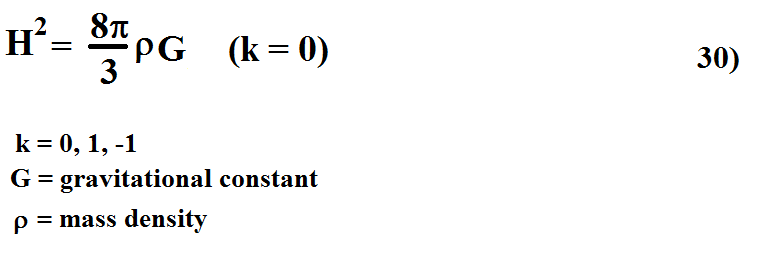
We bring back the Friedmann equation at 30 below. According to the WMAP spacecraft, space is nearly flat, so we set k to zero.

Let's assume a gravitational field has a limited range of r = c/H. The diagram below shows a sphere with volume V divided into an alpha section and a beta section. The alpha section is within the c/H limit for observer O; the beta section is not. This creates an inequality at 31. If gravity depends on gravitons limited to light speed, the Friedmann equation is invalid if distance r is greater than c/H.

Next, lets assume the vacuum and gravitational fields both exist everywhere. The equality is restored and the Friedmann equation is always valid:

This seems inconsistent with GWs that cannot penetrate the c/H barrier. Let's examine GW equations and see if we can reconcile this apparent inconsistency.

At 33 above we begin with a GW power equation for two rotating black holes. With a little algebra we derive equation 37. At 37 we assume gravity has an unlimited range, so we multiply that part by Sv which equals 1. We further assume GWs that are more than c/H meters away from an observer cannot be detected. So we multiply P and the frequency by s, where s equals 0. Equation 37 confirms that gravity overcomes the c/H barrier and GWs may not. GWs do not carry gravitational information. If there was zero frequency, the black holes would still have gravity and there would be no GWs. The source of GWs is the kinetic energy needed to maintain the orbits of the black holes. Over time this energy is converted to massless waves that propagate no faster than light. Equation 38 below shows how gravity can exist in the absence of GWs (notice that the s's cancel):

<

class="separator" style="clear: both;">

Conclusion:

It appears that vacuum and gravitational fields extend to infinity unlike the electric field. Both gravity and dark energy have the potential for speed greater than light; yet, ironically, this does not violate the light-speed limit. In fact, the light speed limit itself depends on "spooky action at a distance"--i.e.--entanglement of frequency and wavelength. This entanglement is also essential to the velocity addition formula that ensures that two velocities never exceed light speed.

References:

1. Flanagan, Eanna. Hughes, Scott A. 2005. The Basics of Gravitational Wave Theory. New Journal of Physics.

2. Van Flandern, T. 1999. The Speed of Gravity What the Experiments Say. Meta Research University of Maryland Physics Army Research Lab.

3. Siegel, Ethan. August 30, 2018. Our Motion Through Space Isn't A Vortex, But Something Far More Interesting. Forbes

4. Tzortzakakis, Filippos, LIGO Analysis: Direct Detection of Gravitational Waves. Journal of Research Progress Vol. 1.

5. Roberts, Tom, Schleif, Siegmar. 2007. What is the experimental basis of Special Relativity?

6. Friedmann equations. Wikipedia