Featured Post

Proof that Aleph Zero Equals Aleph One, Etc.

ABSTRACT: According to the current dogma, Aleph-0 is less than Aleph-1, but is there evidence to the contrary? Is it really true that ...

Showing posts with label momentum conservation. Show all posts

Sunday, March 12, 2017

The Essence of Time

What exactly is time? Is it just an abstract idea? Or does it exist independently of human imagination and perception? Atomic clocks reveal that the rate of time appears to run slower on the earth's surface than way out in space. Assuming time is a real entity, what is it made of? What is its essence? We start our investigation by defining some variables:

We know that nothing goes faster than light in a vacuum. If we add velocity (v) to velocity (c) we still get the speed of light (c).

Equation 1) above seems absurd. When we combine velocities, we should get a higher velocity than c ... unless ... the rate of time (t') shrinks. Equation 2) below works:

And from equation 2) we can derive the famous Lorentz equation:

When velocity (v) increases, time (t') shrinks, but something else happens that's also strange: mass (m') increases. We can verify this if we start with Einstein's energy equation below.

From equation 6) we can derive the relative mass equation:

Equation 13) confirms that when velocity (v) is increased, mass (m') increases. Now, let's take equation 10) and derive equation 14) below:

Equation 14) shows why increased velocity increases mass. When the velocity of a system increases, velocity (u) decreases. To conserve momentum, mass (m') must increase. We start with momentum (mc) and end up with (m'u). Of course m'u must always equal mc. But what exactly is this velocity u? I call it the velocity of time.

The rate of time is the relative speed (u) of a photon or (c^2-v^2)^.5. If a system is moving at velocity (v) and we assume that system is at rest, then the photons in that system may still appear to be moving at c, but relative to v they have slowed to velocity u. Since photons are bosons, their relative speed (how fast they carry force) will determine how fast or how slow the system evolves. If the system is your watch, your watch will noticeably slow down if it moves at a significant fraction of light speed. This suggests that time is real and not just a concept. After all, the original concept of time was that the rate of time is fixed.

Below is a Feynman diagram where velocity v is zero, so velocity u equals velocity c. At the beginning of time (t), two electrons colide. Next, a photon is emitted, then the electrons fly apart.

In the next diagram imagine that the entire diagram is moving through space at velocity v. If we assume the diagram is at rest, the emitted photon will be relatively slower and the measure of time will also be slower:

The electrons in the above diagram are moving faster, but photons can't increase their speed, so, relative to the electrons, the photon is slower. This seemingly slow moving photon is the time we measure or proportionate to the time we measure. Now, just for fun, what happens if the electrons go faster than light?

Time reverses! Your watch is now running backwards. In the diagram above, the particles fly apart, then comes the photon, and finally, the particles collide.

Before we conclude that time is (or is proportionate to) the speed of photons relative to the other particles in a system, let's look at how gravity impacts time, and take a closer look at light, i.e., electromagnetic waves. Once again we define some variables:

We include the variables for permittivity and permeability. Taken together, they determine the speed of an electromagnetic wave. A photon's relative speed (u) has its own corresponding permittivity and permeability. Free space is a vacuum. That is where light has a velocity of c. If the permittivity of free space, for example, had a lower value, light would go faster. Increasing velocity v causes permittivity and permeability to increase (so does additional mass/energy). As a result, EM waves (light) slow down or are relatively slower. The mathematical proof below provides further insight into the essence of time:

Equations 23) and 24) show that time is the reciprocal of frequency. Equations 24) and 26) define the rate of time (with variable t[sub o] set to 1) in one of two ways: The ratio of the relative speed (u) of a photon to light speed (c); or, the ratio of permittivities and permeabilities. Both ways are equivalent. To put it more simply, time (at the quantum level) is the measure of the rate bosons can carry force between particles. If that process is disrupted by high speeds or increased mass/energy, that process will slow down. Anything that is a function of that process will also slow down--including your watch.

Update: Quantum particle-waves are transverse waves: their oscillations are perpendicular to their propagation direction. The following is a mathematical proof that shows that the Lorentz equations above work for transverse waves.

Equation 37) is the formula used to calculate the velocity of a transverse wave. We were able to derive it from the Lorentz equation for relative mass. This shows that the two are intrinsically connected. Equation 39) predicts what we expect: increased mass (m') reduces the time rate (t').

Monday, February 27, 2017

Using Fluid Mechanics to Explain Expanding Spacetime and Gravity

The above video is an excellent demonstration of Bernoulli's principle. Notice how the current flows to the right and how the leaves get caught in the eddies. The current is slowed by the obstacles and this causes a back flow. Now imagine a current of expanding spacetime flowing in all directions, and matter swirling in eddies we call galaxies. The outward flow is slowed by the presence of matter--there is a back flow we call gravity.

Below is Bernoulli's equation along with a couple of diagrams. The top diagram shows a boat going merrily down an unimpeded stream. Pressure (P) is zero. This is analogous to an expanding universe devoid of matter. The second diagram shows a stream with a big black boulder in the way. It slows the stream down. The current pushes and brushes the boulder, so pressure (P) is greater than zero. There is a back flow indicated by the red arrow. The boat is pushed upstream to the boulder. This is analogous to matter in an expanding universe causing a gravitational effect.

Bernoulli's equation isn't very practical if applied to spacetime and gravity. Bernoulli didn't take into account relativity, for instance. However, we learn a very useful concept from Bernoulli: Mass causes pressure to rise and the current velocity (v) to slow. If pressure falls, velocity increases, but in this case, pressure can only fall if mass is reduced. Kind of sounds like momentum conservation, doesn't it?

In the diagram below we feature a momentum equation. If spacetime were devoid of all matter, the outflow velocity (v) would equal the back flow velocity (c) (see arrows). The mass pressure density (pm) would equal the vacuum mass density (ps). There would be no gravity--just expansion.

The next diagram shows a universe with a black hole. Expanding spacetime flows around and puts pressure on this black hole. To conserve momentum, the outflow velocity is reduced. The result is a back flow indicated by the arrows in red. We have gravity.

The momentum equation seems like a pretty good model for spacetime and gravity, but is it valid? Let's see if we can prove its validity. First let's define some variables:

And here's the proof:

Within the proof we derived another useful equation:

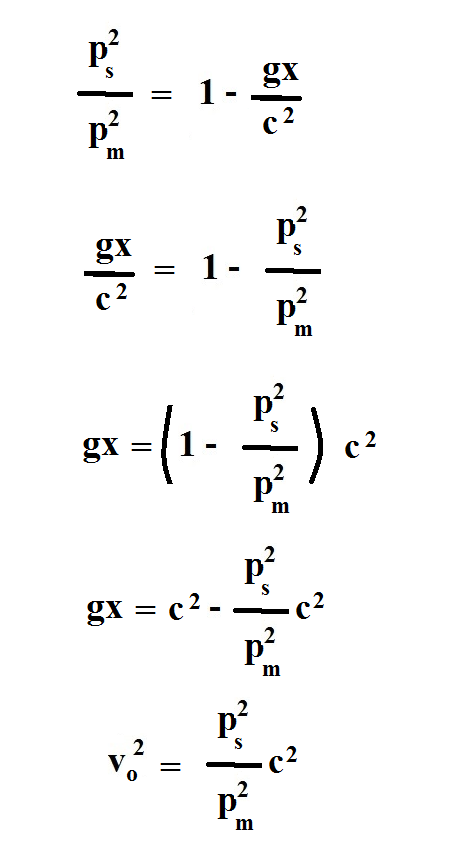
The above equation tells us the instant gravitational velocity squared (gx) at a given location (x)--or, fluid-mechanically speaking, the net back flow rate squared.

Update: The following proof shows that spacetime momentum is conserved but gravitational momentum is not:

The first equation above clearly shows that any change to pressure mass density (pm) causes outflow velocity (vo) to change, so momentum is conserved. The last equation above shows that any change in a falling mass (m) has no effect on velocity (v), so different masses fall at the same rate in a gravitational field.

Update: The above math suggests that spacetime expands at a steady rate up to light speed (c) and is slowed by the presence of matter. What about Hubble's constant and expansion velocity v = Hr?

How fast spacetime expands depends on whether you use Hubble's constant or time rate (t'). Time rate (t') grows as spacetime grows. Hubble's constant does not. The diagram below shows that spacetime can expand no more than light speed but appear to be expanding at an accelerated rate.

If we assume all the dots above are in motion, the expansion is a steady rate. If we assume that the red dot is at rest, then the blue dot appears to be moving away at light speed, and the green dot appears to be moving twice light speed! To get the right numbers for gravity, we need to go with the first assumption: spacetime expands at a steady maximum rate of light speed when it is not slowed by matter.

Update: The following equation was derived above.

The diagram below shows spacetime expanding in a gravitational field (see arrows). The net backflow or gx is c^2-v^2. As mentioned earlier, the presence of matter (a planet, star, etc.) slows the outflow rate of v.

If any mass is falling in this gravitational field, we could use these equations to describe it:

We could also use the diagrams below:

Diagram 1) above represents a small mass falling in a gravitational field. The variable u is the spacetime outflow velocity where the falling mass is located at a given moment of time. Diagram 2) represents a larger mass falling in the same field. Its corresponding outflow velocity is slower (indicated by a shorter double arrow). If we do the math for each mass, we find that the total falling velocity-squared (gx) is the same for both. This once again confirms that different masses fall at the same rate.

Update: The equations below include the dark matter effects of spacetime. As volume (V) grows, the significance of spacetime mass (psV) becomes more significant and pressure mass (increased spacetime mass caused by matter) becomes less significant. At galactic scales and beyond, most of the gravity is caused by spacetime rather than matter.