Featured Post

Breakdown of Navier-Stokes Equations

Find PDF version here. Abstract: Given limited energy and a small mass density or large kinematic viscosity, this work shows why...

Showing posts with label planck length. Show all posts

Saturday, September 29, 2018

Why a Discrete Minimum Distance Fails

In the previous post entitled "Why Strings Don't Exist", we showed it is possible to have a length shorter than the famed Planck length. The question becomes, what is the minimum discrete distance, assuming there is such a thing? Normally, we use infinitesimal points to build geometrical objects like lines, planes, rectangles, etc. What happens if we use a line with the smallest magnitude possible that is greater than zero? Before we delve into these questions, let's define the variables:

OK, let's assume the fundamental building block is a line somewhere between zero and the Planck length. We'll call it d:

Let's try building a square with d:

So far, so good. All the distances appear to be no less than d. But what is the distance along the diagonal (or hypotenuse)?

The diagonal distance is a little bit more than d. The additional distance is marked in red. Notice this distance is not an integer multiple of d. To make this distance, we need a distance d plus a distance less than d. There can be no distance less than d, so we can't draw the above square. Here's an idea: draw a rectangle with 3X4 d-units. Thanks to Pythagoras, the diagonal will be 5 d-units:

Because all distances must be integer units of d, our geometry does not include squares, rectangles or triangles that have diagonals and sides that fail to have magnitudes that are integer multiples of d. But at least we found one rectangle that works--or maybe not:

If we draw lines from each d to every other d, we once again have distances that are not integer multiples of d. In the example above, we have a distance (c) of 3.6d. To have that distance, we need 3d plus a 0.6d. In our geometry, there's no such thing as 0.6d. Thus we can't draw the 3X4 rectangle. In fact, every rectangle and triangle we draw will have some distance that includes a fraction of d.

Perhaps we'll have better luck with circles? Check this out:

If we take distance d and shape it into a circle circumference (C), the diameter (D) will be less than d! D = d/pi (where C=d). If we try to draw any circle with d-units, we hit a brick wall. You see, you calculate the circumference with pi * D. If D is an integer (n) multiple of d, pi * n won't equal a circumference with an integer multiple of d. Pi is an irrational number.

OK, so perfect circles are out. How about imperfect circles? Perhaps we can replace pi with something more rational. Even if we do, circles have the same problem we encountered earlier:

There's always a line between two d's, that is not an integer multiple of d. This is also true with any shape imaginable:

So far, things look pretty hopeless for our geometry based on d. But unfortunately, there's more pain. Let's go back to the beginning and reexamine d:

Distance d is a line along the x-axis. But what is it along the y and z axis, i.e., what is its cross section?

Line d has a cross section of zero magnitude! That zero magnitude is just a single point in space with zero distance! Zero distance is not allowed, so a distance-d line is not allowed. Perhaps we can convert the line into a cylinder, so the cross-section will have a d-magnitude. Let's look at our new cross section:

Oops! The cross section is shaped like a circle. We can easily draw a red line from one d to the other that isn't an integer multiple of d. Thus it is now abundantly clear that a geometry based on distance d (instead of a point) is a dismal failure.

Update: Here is a formal proof that shows that, at any two non-parallel adjacent unit lengths (in this case the Planck length), it is possible to draw lines (lines a, b) shorter than the unit length. The following diagram is an example of an arbitrary shape:

Note that the shape is made up of connected unit lengths. Here are two examples of adjacent-unit lengths blown up to a convenient size for inspection:

Now let's take one arbitrary pair of connected unit lengths and label the lines and angles:

Now we are ready to do the proof. Here it is:

Update: The following proof demonstrates why a curved Planck-length string creates distances shorter than the so-called shortest distance. Below are some examples of curved strings:

The examples above clearly make the point, but is the point generally true? Here's the proof:

Thursday, September 27, 2018

Why Strings Don't Exist

Let's compare the point particle and the string. A point particle's dimensions all have a zero limit. By contrast, a string has a zero limit for its cross-section dimensions and a Planck-length limit on just one space dimension. So one could ask, if the Planck length is the shortest length, then how is it that a string has shorter dimensions along its cross section? Does space follow different rules along, say, the x-axis and y-axis than it does along the z-axis? It doesn't seem likely that it would--and we will mathematically prove it, i.e., we will disprove the string. First, let's define the variables we need:

Below we we define the Lorentz factor at equation 1; the de Broglie wavelength at equation 2; The Planck length at 3; and the Planck mass at 4. At equation 5 we express the Planck length in terms of the Planck mass and de Broglie function. The Planck mass is multiplied by c to give the maximum momentum theoretically possible: the Planck momentum.

If the momentum were larger than the Planck momentum, The Planck length would not be the shortest length possible. If equation 5 is true, then equation 10 below must also be true, but is it really?

If we check how much energy is involved in bringing, say, an electron up to the Planck momentum, we discover the amount falls far short of infinity. In fact, the the energy amounts to only around 300 lbs. of TNT. If we could somehow squeeze more energy into the particle, surely we could increase the momentum. The result would be equation 15 where the wavelength is less than the Planck length.

Unfortunately the particle's momentum is not only restricted by the light-speed barrier, but also by the Planck temperature, which we will discuss later. Right now, let's see if the Planck units are valid. To build the Planck units, the following assumptions are made (see equations 16 & 17):

But then there's the Heisenberg uncertainty principle. At equation 19 we see that h-bar (the reduced Planck's constant) isn't really the smallest value possible. H-bar/2 is smaller. If we use this smaller value, we can derive new and smaller units (see 23 and 24):

Let's plug in these new units into the uncertainty relation (see 25). Now, if we assume the Planck mass is valid, then the shortest length is half the Planck length (see 26). OK, we broke the Planck length barrier. Can we do better? Yes! According to special relativity, a particle approaching light speed has an upper mass limit of infinity (see 27). If we could somehow harness the energy of the whole universe, then surely the minimum possible length would be far shorter than half the Planck length (see 28 to 30).

OK, now is a good time to address the Planck temperature. The Planck temperature is allegedly the hottest temperature that can be achieved. If such is the case, then our particle maxes out at 300 pounds of TNT worth of energy and corresponding momentum, i.e., the Planck momentum.

The Planck temperature is defined at 31 below. Notice how equation 31 does not take relativity into account. Let's factor in relativity (see 32). At equation 33 we end up with a temperature that has an upper limit of infinity.

Some physicists have postulated that the Planck mass represents the mass of the smallest black hole possible. If such a black hole is at rest, we can certainly use equation 31 to find the Planck temperature. But what if the black hole is not at rest? Then its energy (E) would be equation 35 below. Once again we end up with a temperature greater than the Planck temperature (see 36,37). Even if we limited the energy to kinetic energy only, it seems highly probable such energy would exceed the Planck energy (Planck mass X c^2). Thus it seems probable the highest temperature would exceed the Planck temperature (see 38 & 39).

OK, we've laid the groundwork needed to disprove the strings of string theories. We begin our disproof with Gay-Lussac's Law. Using the Planck length and Boltzmann's for the constant and doing a bit of algebra we derive a temperature equation at 44:

Both a string and a point particle have zero volume due to one being one-dimensional and the other zero-dimensional. Zero volume yields infinite temperature (see 45 to 47). If we assume the Planck temperature is the highest possible temperature, then one-dimensional strings (and point particles) don't exist. If the string (or point particle) is at rest, there's infinite uncertainty re: the temperature, thus possible temperatures that exceed the Planck temperature (see 48, 49).

Now let's attempt to save string theory. If we assume there is a minimum distance greater than zero, then that minimum distance should exist in all directions. Given that assumption, is it possible to build a string? For illustrative purposes, let's assume the Planck length is the shortest distance possible. Here's what we get:

At 50 above we have the temperature equation. At 51 we shrink the dimensions down to the Planck length. We end up with a small volume of matter (circled in red) rather than a string. We use this object to derive equations 52 to 54. Of course, given what we have covered in this blog post, the Planck length could be cut by at least one half. However short the actual shortest distance, it is abundantly clear it doesn't make a one-dimensional string.

Sunday, December 24, 2017

How the Gravitational Constant G Destroys Modern Physics

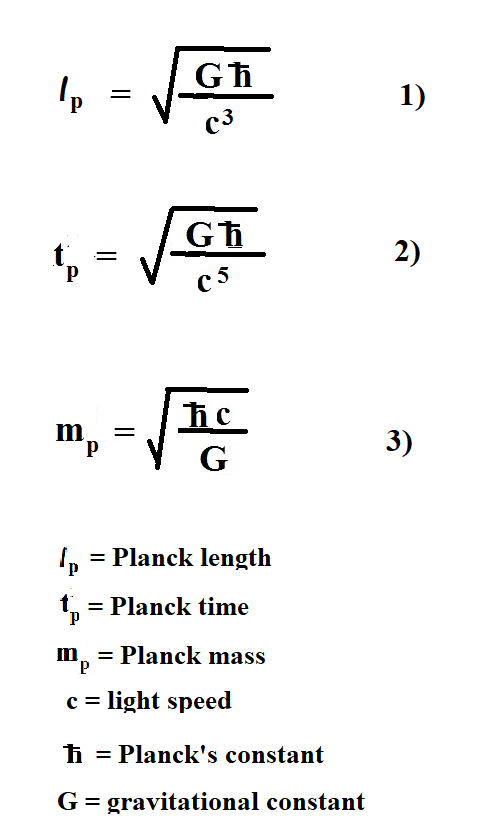
According to all string theories, the Planck length and Planck time are the smallest units. In fact, the string is considered the smallest bit of matter. That brings us to the proverbial question: How long is a string? A string theorist will tell you it is the Planck length. The equations below show the components of the Planck units:

As you can see, the Planck units are made up of the following components: Newton's constant (G), Planck's constant (h-bar) and light speed (c). All these constants are believed to be constant. As long as they are, the Planck units are not just arbitrary units. On the other hand, if one or more of these constants are not always constant ... well that could be a problem.

If we begin with the Lorentz equation, we can derive equation 11 below:

If we assume nothing goes faster than light, then the change in time (delta-t) has an upper limit of t. Also, we know the following is true:

Thus, what follows is also true:

Now, let's assume black holes exist, look what happens when we let radius (r) fall to zero:

The light-speed barrier is broken and energy is no longer conserved. But, then again, if radius r is really small, Heisenberg's uncertainty principle might save the day.

Whoops! Nevermind. A particle, or black hole singularity in this case, can borrow energy from nothing but has to pay it back quickly, in time t. Since the black hole has to borrow more energy than is estimated for the entire universe, it's time is short indeed. The black hole, as we understand it, could not exist. Yet there is a black hole at the center of our galaxy--and it has been there much much longer than time t. How is that possible? Check this out:

If the constant G is allowed to shrink along with radius r, energy is conserved, so the black hole doesn't have to borrow--it can exist as long as it wants. Plus, the light-speed barrier is conserved as well. Unfortunately, the Planck units are arbitrary units. They are not constants of nature.

But does G really shrink? If so, when is it constant and when is it not? If we revisit equation 10, we can derive the following:

Equation 26 shows that delta-t has an upper limit of t but radius r has a lower limit of zero. Since these are components of G, G shrinks to zero as r shrinks to zero. By contrast, equation 27 shows that as r goes to infinity, delta-t goes to zero. As a result, G remains constant. So it appears G is constant at large distances. At small distances, G is no longer constant. For G to be constant at the quantum scale, delta-t needs to grow to infinity as r shrinks to zero. But if that were the case, energy would not be conserved:

Therefore, the gravitational constant G destroys much of modern physics if it remains constant at small scales, and, makes the Planck units arbitrary if it doesn't.

Friday, August 26, 2016

Deriving the Planck Length, the Planck Time and Planck Mass

To derive the Planck length we start with the Schwarzschild radius (x=length; m=mass; G=Newton's constant; E=energy; c=light speed). (To find out how the Schwarzschild radius is derived, click here.)

We also need Heisenberg's Uncertainty Principle (p=momentum; x=position; h-bar=Planck's constant). (To find out how to derive the Uncertainty Principle, click here.) For our convenience we convert momentum (p) to energy (E) by multiplying both sides by light speed (c):

Divide both sides by E:

Multiply the above result by the Schwarzschild radius, then do some algebra to get the Planck length (x with a sub p):

To get the Planck time (t with a sub p), take the Schwarzschild radius and divide it by c:

Shall we call the above result the Schwarzschild time? We also need the other Heisenberg Uncertainty Principle, the one with energy (E) and time (t). Now do some more algebra to get the Planck time:

To get the Planck mass, set the Schwarzschild time equal to the Heisenberg time, then solve for E-squared:

Let's assume E is kinetic energy. Square it, make a substitution, do some more algebra, and get the Planck mass (m with a sub p):