Featured Post

Breakdown of Navier-Stokes Equations

Find PDF version here. Abstract: Given limited energy and a small mass density or large kinematic viscosity, this work shows why...

Showing posts with label Lorentz factor. Show all posts

Monday, May 25, 2020

Why Time is More Than Real

"Reality is merely an illusion, albeit a very persistent one."--Albert Einstein

It is apparent from the above quote that reality distinguishes itself from ordinary illusions by its persistent nature. Reality is true even if you choose not to believe in it. Thus, if we are trying to settle the question whether time is real, we should examine time to see, if like reality, it too is a persistent illusion.

The time variable is very persistent and ubiquitous in so many physics equations. On that basis we can claim it's real, but just how real is it compared to things like matter, energy, mass, distance, force, your neighbor's barking dog? It's not like we can grab time out of the air, hold in hand and look at it like a hunk of clay. However, like clay, time can be stretched or compressed depending on how close to the speed of light you are traveling. How is that possible if time is just a product of human imagination? Surely any relative differences in time would also be limited to the human imagination and not an empirical reality.

When examining time, one has to make the distinction between how we measure time and time itself. One popular argument claims that if all particles in the universe stopped changing their states and came to rest, time would stop and cease to exist. This seems reasonable. If nothing happens, how would we experience the "flow of time"?

But what if the "flow of time" is just our experience when we measure time? If your watch stops, you don't assume that time has stopped. You only assume your ability to measure and experience "the flow of time" has stopped. So it seems reasonable to assume that time continues even if every particle comes to a grinding halt. Think of a stalled universe as one big watch that stopped.

So what exactly is time if not a flowing, evolving, ever-changing environment of entropy? The following equation, for me, is a real eye-opener and has forced me to rethink time:

E is energy and psi is the wave function, tp is the Planck time, G, c, and h-bar are the gravitational constant, light speed and Planck's constant, respectively. The above equation shows that it doesn't matter how much or little energy there is, or whether states change frequently or not at all, whether they go forward or backward. No matter what values you plug in for E and psi, you get forward time, specifically, the Planck time. Imagine having zero energy, zero change and still having a Planck time. How is that possible? Thought experiment time:

Imagine a universe with no energy, no distance or space, no charges, no masses, no momentum, no oscillators--just a single zero-dimensional point, a singularity. According to the above equation, time still exists. Why? Because the singularity is persistent--it is real. What exactly is this singularity? It's literally nothing ... except time at a single reference frame, at a single point. No clocks, no observers, just pure time.

Time is so essential to reality, that no "persistent illusion" can persist without it. Time can persist without anything else we would deem real, but nothing we deem real can persist without time. The words "reality," "existence," "persistence," "presence" all imply the passage of time. At this juncture, one could argue that time is not only real, but reality's most essential component. And, when we perform the above thought experiment, we witness time in its purest form.

So if you ever encounter a skeptic who believes time isn't real, that particles exist without time, ask the following question (but don't hold your breath):

"How long do particles exist without time?"

Tuesday, October 23, 2018

How Entropy, Temperature and Chemical Reactions Impact Time Dilation

How do we measure time? Normally we take some event that happens over and over again, and, we assign it a time unit. For example, the complete rotation of the earth we call a day. We can take that time unit (or any fraction thereof) and assign it to other events--that may or may not be periodic--such as a chemical reaction, for instance. We say the chemical reaction happened in time t.

What if that chemical reaction were to slow down? Can we say its rate of time has slowed? If we define time as the rate of change, then the change in the rate of chemical reactions, entropy, or the earth's rotation would indeed impact the rate of time.

Consider the famous twin paradox, where one twin boards a rocket that hurls him into outer space close to light speed. According to Einstein, his time slows, he ages more slowly than his twin back on earth. His body's biochemical reactions are slower, entropy is reduced--at least that is the implication.

When he arrives back on earth, he will be younger than his twin brother. But his twin has a plan: while he's out in space, his twin cryogenically freezes himself. His twin will be thawed out by the time he gets back to earth. If his twin's plan works, they will both be the same age. Now, did the twin on earth reduce his time rate? Can the rate of time be reduced by means other than high velocities and mass density? This post shall address these questions, but first, let's define the variables we will use:

Let's start with entropy. If we somehow reduce the rate of entropy, will the time rate also be reduced?

If we take the Boltzmann constant (which has entropy units) and multiply it by the unit-less Lorentz factor's squared reciprocal, we derive equation 2 below:

Equation 2 shows that entropy is reduced when velocity (v) is increased. The time rate is also reduced. So far it appears we have a correlation between entropy and time. If equation 2 is valid, we should be able to use it to derive a more standard entropy equation:

Equation 6 above confirms the validity of equation 2. So we can say the twin in outer space, traveling near light speed, has reduced his entropy. Now the twin on earth wants to freeze himself, i.e., lower his body's temperature. Will this reduce his entropy? Equation 8 below confirms that it will. From 8 we derive equation 12 which shows lowering the temperature (T) reduces the time rate.

According to equation 12, the twin on earth will age more slowly. Does this imply the rate of his body's biochemical reactions will slow down?

Equation 13 is the Arrhenius equation, where k is the rate of a chemical reaction. When temperature T is reduced, so is the rate of the chemical reaction. From 13 we derive a new entropy equation at 19:

Equation 19 tells us that when the rate of a chemical reaction is reduced, so is entropy. And the reduced chemical-reaction rate reduces the rate of time:

So the age difference between the twins could be nil when the space twin arrives back on earth. If the earth twin cryogenically freezes himself, he may be younger than the space twin. Both twins have found a way to reduce their respective time rates, they have found ways to time travel into the future. Here are four ways to reduce the time rate:

Thursday, May 10, 2018

How to Whip Time Dilation During High-Speed Interstellar Space Flight.

In our previous post we showed that infinite energy is not necessary to accelerate a mass to light speed. Click here and read all about it. From the Einstein Field equations we were able to derive equation 10 below. Equation 10 shows that faster-than-light speed is possible in a gravitational field. (Equations 11 and 12 show how energy is conserved.)

Of course the problem with going at, near, or above light speed is the time dilation problem. If you travel at light speed, theoretically time does not pass for you. It's as though you reach your destination instantaneously. The only problem is, the exoplanet you were planning to visit and colonize is long gone, its sun was a supernova eons ago. That's because time passed normally for the rest of the universe. If we are to explore the cosmos, we need to solve this time dilation problem.

To find a solution we need to take a closer look at the Lorentz factor and its limitations. If we create a time unit using Planck's constant, we can derive equation 18:

With another step we derive equation 19. At equation 20 we assume a particle is traveling at light speed. We get eye-opening results at 23 and 24:

Equation 23 shows the particle has infinite energy! This is expected if the particle has mass. But what if the particle is a photon? Most photons don't have or require infinite energy to go light speed. Assuming the particle is a photon and said photon has finite energy, then equation 24 shows that proper time for said photon is greater than zero!

We can spot another problem if we assume the particle is going faster than light. Equations 25 through 29 demonstrate that faster-than-light speed requires less energy than light speed!

To make matters worse, the energy for faster-than-light speed is an imaginary number. Surely we want a real number.

Below are some more problems. First the value of proper time (t') depends on the value of t. The Lorentz equation fails to give us an exact proper time. It just gives a relative proper time. Further, the energy needed to go velocity v is the same for all masses! The Lorentz equation fails to take into account how much mass a particle has.

But that's not all! If you change your energy units from electron volts to Joules, the energy is increased! Just compare equations 30 and 31 above. And, more significantly, the value for proper time (t') changes! Yet, we are talking about the same particle, going the same velocity, with the same energy.

What we want is better precision. We want a true value of proper time (t'). Perhaps we can get that by dividing Plank's constant by the energy (E):

At 33 and 34 we realize we can convert the non-specific proper time into a specific number by using a unit-less conversion factor alpha. Using a Minkowski diagram we can graphically show the conversion factor works:

We derived the Lorentz equation at 36. Equation 37 demonstrates that time (t) does not know how big or small it should be, so why not set it to t/a? That way the precise proper time we get from equation 34 agrees with the Lorentz equation.

OK, let's take what we discovered and derive a precise way of finding proper time in a gravitational field with energy GMm/r. We derive equation 51 below:

At equations 52 and 53 we steal an idea from quantum physics and apply it to conserving the energy of a star:

At 53, even if the gravitational energy is infinite (a black hole?), time (t') is zero and the finite energy of the the original star is conserved. So far, so good. But notice the proper time will never go to zero unless energy is infinite. Is this really true? Photons allegedly experience zero proper time with their finite energy. To resolve this contradiction, we need to understand the nature of time better. We can do this by building a quantum clock. First, here are the variables:

At equation 54 we put the gravitational energy into one mass variable. At equation 55, momentum (rho) is conserved--an increase in mass (m) causes a decrease in velocity (v). At 56, momentum (p) is not conserved--an increase in mass does not change velocity (c). At 57 we give time (t) and frequency (omega) definite values by dividing Planck's constant by ground-state energy. At 58 we take the ratio of conserved momentum to non-conserved momentum. (Note when mass increases, velocity v decreases and proper time decreases.) At 59 we cancel the masses. At 60 and 61, we convert the velocities into oscillators. Because oscillators are cyclical, they make excellent little clocks.

At equation 62 we see that when velocity v slows, the wavelength lambda shortens. So we discover a correlation between more mass, shorter wavelengths, and slower time. At 63 through 65 we prove that the wavelength is proper time t' multiplied by light speed c. At 66 through 68, we set the final parameters for our quantum clock.

Below is a diagram of the quantum clock. The clock's imaginary hand is radius mu. When there is more mass or energy, it goes around the clock slower. To stop the clock requires infinite energy. Thus, it appears to be true! Photons with finite energy experience non-zero proper time.

To be sure we are right about proper time, let's take another look at the Lorentz factor equation for mass. Photons have zero mass and have velocity c (see equations 69 and 70). At 73 we get a relative mass (m') that is between zero and infinity. At 74 we convert the relative mass into photon energy divided by c^2. Thus we confirm the photon's energy can be less than infinite.

At 75 we convert the photon's frequency into the reciprocal of its proper time (t'). If we convert the photon's zero mass into photon energy, variable t would need to be infinite (see equations 76 and 77). At 78 we make some substitutions and with a few more steps we get 81 and 82.

Looking at 81 and 82 we see that a photon's proper time does not have to be zero. And, equations 83 to 88 confirm that infinite energy is required to have zero proper time.

Thus our formula for calculating a precise proper time is correct. Our final formula for a gravitational field is at equation 90:

What does equation 90 tell us. It tells us that proper time never goes below zero even if velocity squared Gm/r goes to infinity! This means if you have a twin, if he/she stays on earth, and you traveled to the nearest star at, say, 24 times the speed of light (using a gravitational warp drive), your round trip would take about four months (instead of years at light speed). Your twin will only be four months older than you. The age gap decreases if you travel at even faster speeds. Plus, you can reach that exoplanet mentioned earlier in a timely fashion. Of course this is more science fiction than science. It is not clear how one can travel faster than light without violating the second postulate of relativity which states that all observers must see the photons in your spaceship going light speed in a vacuum.

Sunday, December 24, 2017

How the Gravitational Constant G Destroys Modern Physics

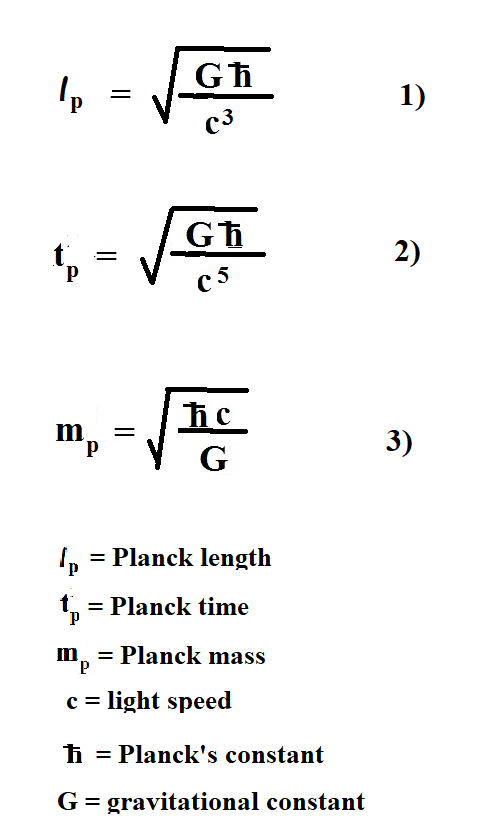
According to all string theories, the Planck length and Planck time are the smallest units. In fact, the string is considered the smallest bit of matter. That brings us to the proverbial question: How long is a string? A string theorist will tell you it is the Planck length. The equations below show the components of the Planck units:

As you can see, the Planck units are made up of the following components: Newton's constant (G), Planck's constant (h-bar) and light speed (c). All these constants are believed to be constant. As long as they are, the Planck units are not just arbitrary units. On the other hand, if one or more of these constants are not always constant ... well that could be a problem.

If we begin with the Lorentz equation, we can derive equation 11 below:

If we assume nothing goes faster than light, then the change in time (delta-t) has an upper limit of t. Also, we know the following is true:

Thus, what follows is also true:

Now, let's assume black holes exist, look what happens when we let radius (r) fall to zero:

The light-speed barrier is broken and energy is no longer conserved. But, then again, if radius r is really small, Heisenberg's uncertainty principle might save the day.

Whoops! Nevermind. A particle, or black hole singularity in this case, can borrow energy from nothing but has to pay it back quickly, in time t. Since the black hole has to borrow more energy than is estimated for the entire universe, it's time is short indeed. The black hole, as we understand it, could not exist. Yet there is a black hole at the center of our galaxy--and it has been there much much longer than time t. How is that possible? Check this out:

If the constant G is allowed to shrink along with radius r, energy is conserved, so the black hole doesn't have to borrow--it can exist as long as it wants. Plus, the light-speed barrier is conserved as well. Unfortunately, the Planck units are arbitrary units. They are not constants of nature.

But does G really shrink? If so, when is it constant and when is it not? If we revisit equation 10, we can derive the following:

Equation 26 shows that delta-t has an upper limit of t but radius r has a lower limit of zero. Since these are components of G, G shrinks to zero as r shrinks to zero. By contrast, equation 27 shows that as r goes to infinity, delta-t goes to zero. As a result, G remains constant. So it appears G is constant at large distances. At small distances, G is no longer constant. For G to be constant at the quantum scale, delta-t needs to grow to infinity as r shrinks to zero. But if that were the case, energy would not be conserved:

Therefore, the gravitational constant G destroys much of modern physics if it remains constant at small scales, and, makes the Planck units arbitrary if it doesn't.

Thursday, August 17, 2017

Deriving the Gravitational Constant G

Today we will derive the gravitational constant G, also known as Newton's constant. Here are the variables we will be working with:

Below is a crude diagram of a satellite orbiting a star or planet at velocity v, at a distance of radius r. According to its clock, the proper time is t'. The star or planet has a mass of m.

Our starting point shall be the Lorentz equation, courtesy of Einstein's theory of special relativity:

By doing some algebra we can derive equation 7 below:

Equation 7's right side expresses v^2 in terms c^2 and a time ratio. The bigger the time ratio, the faster the velocity and vice versa.

We manipulate Einstein's energy equation to get equation 8:

We make a substitution, then do some more algebra until we derive G at equation 15:

We can now see why G is the constant it is: Any change in velocity (v^2) is offset by a change of the radius-mass ratio. Any change in radius-mass ratio is offset by a change in the time ratio.

Update: Here we relativize G and make use of the velocity addition formula so Gm/r will always be no more than the speed of light squared: