Featured Post

Breakdown of Navier-Stokes Equations

Find PDF version here. Abstract: Given limited energy and a small mass density or large kinematic viscosity, this work shows why...

Monday, February 7, 2022

Quantizing Gravity without the Graviton

Abstract:

This paper shows the connection between "dark energy" and gravity, the equivalence between matter and space, and how gravity works without the graviton or gravitational waves. It also suggests an alternate way to quantize gravity using smaller units--of mass, space and time--than the Planck units.

The same force acting on different masses will cause each mass to move at a different rate: F = ma, where m is mass and a is acceleration. However, the same "gravitational force" causes different masses to fall at the same rate. How can this be? Einstein proposed that when a body appears to be falling to earth, it is really at rest, and the earth is accelerating towards the body at a given rate. Thus the body's mass is irrelevant.

Below is a diagram of Alice who is surrounded by four bodies, including Bob. Bob and the others appear to be either moving away from Alice or towards her, depending on how you follow the arrows. But if we go from left to right, we can think of Alice as the one who is moving away from the surrounding bodies. If we go from right to left, we can think of Alice as the one who is moving towards the surrounding bodies. As a consequence, the surrounding bodies can have any mass and the rate at which Alice and the surrounding bodies diverge or converge will be the same.

Equations 1 and 2 below were derived from Einstein's field equations. Equation 3 was derived from a Friedmann equation where k is set to zero due to spacetime being flat at a large scale where the mass density (rho) is a small number and so is the curvature which is represented by the cosmological constant.

At 4 and 5 we set up a couple of substitutions to be made at 7 and 8 below. Equation 6 shows how mass and space are equivalent. Divide any mass by the vacuum-mass density to get the equivalent volume. Equation 7 shows the universe must expand faster than light as the radius r tends to infinity; otherwise, light speed in a vacuum is not conserved! If both sides of the equation are multiplied by the universe's mass, then the universe's energy is conserved no matter how big or small the universe becomes.

Also, the vacuum-mass density rho correlates with outward pressure, and that pressure is not diminished by an increase in distance r, so the outward pressure continues and so does the universe's expansion. At equation 8 we see that gravity looks similar to equation 7. As the speed of gravity increases, it is offset by the increase in spacetime curvature. As a result, the constant c and energy are conserved.

Equation 9 below shows that gravitational waves are caused by gravity and angular frequency, so they cannot be the cause of gravity. In fact, if angular frequency is zero, there is still gravity but no gravitational waves.

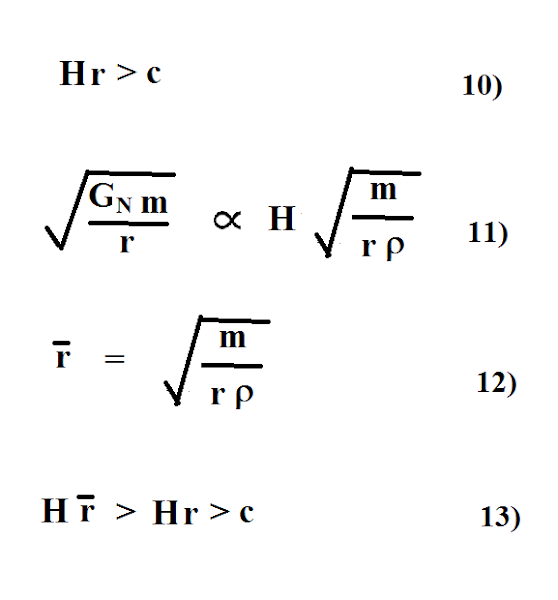
Now, let's imagine Alice and Bob are so far apart that Bob is moving away from Alice faster than light (see 10 below). Alice starts out with very little mass, but decides to go off her diet. As a result, she gains an enormous amount of mass. So much so that she becomes a black hole (see equation 11). The distance between her and Bob is the same but it is now less than Alice's Scharzschild radius. So are Alice and Bob still diverging or are they now converging?

We know that no signal, limited to light speed, ever reached Bob. This includes gravitons, gravitational waves, light, etc. At 12, Alice's mass is converted to it's equivalent space. Finally, the inequality at 13 shows that Bob is still moving faster than light if Alice is at rest, but Alice is no longer at rest--she's moving faster than Bob towards Bob. Thus Alice and Bob are converging as if a "gravitational force" is present.
Take a proton and electron. Equation 14 below shows acceleration depends on both their respective charges, their masses and distance r. Clearly there is an information exchange between them. At equation 15 it's a different story: acceleration only depends on the mass of the proton and distance r. It is clear the two masses don't exchange information. It's as if the proton simply accelerates towards the electron.

Now, let's consider Alice, Bob and Carl below. How fast Alice accelerates depends on the distance of the targets, the targets being Bob and Carl. Surely Alice needs to know the distance of each target so she can adjust her rate of acceleration accordingly?

Consider the diagram below. The numbers in each section add up to the total volume of the 3X3X3 cube. At 17 the volume of each cube is divided by its square. If we multiply each term by the square of Hubble's parameter it becomes apparent that Alice is accelerating less than Bob and Bob is accelerating less than Carl. These three are diverging as if they are in an expanding universe.

Now, let's add mass to the red section. Let's convert it to its equivalent volume which is 100 units. That brings the total to 101 units. Notice that the state of Bob's section (blue) and the state of Carl's section (green) do not change. Each have their previous volume. Also notice that the square areas do not change. This implies no information exchange between Alice, Bob and Carl. But now Alice is accelerating more than Bob and Bob is accelerating more than Carl. The three are converging is if they are in a gravitational field.

The rate of acceleration depends on distance but, as demonstrated above, this does not imply an information exchange between the parties. To drive this point home, imagine we divide up our universe into volume cells, each cell expands at a given rate independently of every other cell. More cells cause a greater rate of expansion, but each cell has no clue how many cells an observer is looking at or what the other cells are doing. The cells exchange no information. Thus the rate of expansion is really up to the observer. Now, suppose you add more volume (cells) to the system without increasing the space. This was done when mass was added to Alice's section (red). Mass's equivalent volume doesn't change the distances between Alice, Bob, and Carl. The result is what we call gravitational acceleration (see equation 20 below). Again, each cell need not know the state of the others. The rate of acceleration depends on the distance the observer chooses to consider.

Now let's turn to quantizing gravity. The popular choice is, of course, the graviton, but the graviton causes a major setback. If we assume the graviton is a real thing, surely we can come up with a reasonable estimate of how many gravitons are in the universe. For example, we could figure the total gravitational energy of the universe and divide that by the average energy of the graviton. At 21 below we plug in the entire mass of the universe to get the gravitational energy, but we don't get units of energy. Instead, we get velocity squared. One could argue that there is no gravitational energy, so there are no gravitons. Equation 22 is an attempt to counter this argument. It uses two masses which give an energy term, but how much gravitational energy there is depends on how much of the universe's total mass we assign to m and m'. Also, whatever gravitational-energy total we arrive at will be exceeded by a single black hole singularity and a single particle that have virtually zero distance between them.

At equation 23 we switch to a smaller scale. We assume the gravitational energy produced by an electron and proton is nEg, where Eg is the energy of one graviton and n is the number of gravitons. Therefore two electron-proton pairs produce 2nEg or 2n gravitons? Not so fast. Since gravitons have energy, they also produce gravitons. At 24 they produce up to an infinite number of gravitons if the distance r limit is zero! So how many gravitons are in the universe? It depends on how you crunch the numbers.

By contrast, it is much easier to estimate how many photons are in the universe, since photons don't produce photons. Electromagnetic energy is a function of charge and not energy or mass. So as long as photons don't have charge, they don't infinitely reproduce themselves. We can take the total luminous energy of the universe and divide it by a photon's average energy to get a reasonable estimate of how many photons there are.

For the above reasons, the graviton is untenable. So then how should we quantize gravity? Gravity is a function of mass (defined as energy divided by light speed squared), space and time. Thus it would make sense to quantize these fundamental dimensions. We could ask, what is the shortest length or time, and, what is the smallest mass? The popular response is, the Planck length, the Planck time and the Planck mass, respectively. But are these really the smallest units? The Planck mass clearly is not the smallest mass. An electron mass is smaller. Also, the Scharzschild radius of an electron is much shorter than a Planck length. The time it takes for a photon to travel the shorter distance is less than the Planck time. So what are the smallest units? Here are the smallest units I have found so far. I call them the Hubble units:

We could take the Hubble length, for example, and quantize equation 13 as follows:

At equation 29 the first term has alpha Hubble lengths; the second term has beta Hubble lengths. The smallest rate of expansion is Hubble's parameter times one Hubble's length. Now, one probable objection to this scheme is space is chaotic and stochastic on the quantum scale, so how can we have such nice, neat units? The Hubble length, for example, could be an expectation value (average) of all the chaotic activity that may make up space. We can think of the Hubble units as perhaps the smallest average units that can be derived from fundamental constants and Hubble's parameter.

In conclusion, unlike the other fundamental interactions, gravity does not appear to have any means for bodies to communicate with each other, nor is communication necessary. Thus the graviton is unnecessary. Further, the graviton fails to conserve energy like its electromagnetic counterpart the photon. A better way to quantize gravity is to quantize space, time and/or mass.

Acknowledgments:

Amber Strunk. Education and Outreach Lead. LIGO Hanford Observatory.

Peter Laursen, Astrophysicist and science communicator at the Cosmic Dawn Center, University of Copenhagen.

References:

1. Parikh, Wilczek, Zahariade. 2020. The Noise of Gravitons. arxiv.org.

2. Feynman, R.P. 07/03/1963. Quantum Theory of Gravitation. Acta Physica Polonica. Vol. XXIV.

3. Graviton. Wikipedia.

4. Carlip, S. 12/1999. Aberration and the Speed of Gravity. arxiv.org.

5. Van Raamsdonk, M. 05/17/2010. Building up spacetime with quantum entanglement. arxiv.org.

6. Hanson, R.; Twitchen, D. J.; Markham, M.; Schouten, R. N.; Tiggelman, M. J.; Taminiau, T. H.; Blok, M. S.; Dam, S. B. van; Bernien, H. (2014-08-01). Unconditional quantum teleportation between distant solid-state quantum bits. Science. 345 (6196): 532–535.

7. Gravitational Wave. Wikipedia.

8. de Rham, C., Tolley, A.J. 03/17/2020. Speed of Gravity. arxiv.org.

9. Carroll, S.M. 12/1997. Lecture Notes on General Relativity. Enrico Fermi Institute.

10. Marsh G.E., Nissim-Sabat. 3/18/1999. Comment on an article by Van Flandern on the speed of gravity. Physics Letters A Vol. 262, pp. 257-260 (1999)

11. Suede M. 11/29/2012. The Speed of Gravity: Why Einstein Was Wrong and Newton Was Right. Blog commentary re: Tom Van Flandern.

12. Cornish N., Blas D., and Nardini, G. 10/18/2017. Bounding the Speed of Gravity with Gravitational Wave Observations. Phys. Rev. Lett. 119, 161102

13. Van Flandern, T. 1999. The Speed of Gravity What the Experiments Say. Meta Research University of Maryland Physics Army Research Lab.

14. Nix, E. 08/22/2018. Who Determined the Speed of Light. History.com.

15. Speed of Gravity. Wikipedia.

16. Tests of General Relativity. Wikipedia.

17. Decross, M. et al. Gravitational Waves. Brilliant.com.

18. Lawden, D.F. 1982. Introduction to Tensor Calculus, Relativity and Cosmology. Dover Publications, Inc.

19. Stefanovich, E. V. 09/16/2018. A relativistic quantum theory of gravity. arxiv.org.

20. Light-time correction. Wikipedia.

21. Liénard–Wiechert potential Wikipedia.

22. Kopeikin, S. M. Fomalont, E. B. 03/27/2006. Aberration and the Fundamental Speed of Gravity in the Jovian Deflection Experiment. arxiv.org.

23. Faber, J. A. 11/24/2018. The Speed of Gravity Has Not Been Measured From Time Delays. arxiv.org.

24. Yin Zhu. 08/18/2011. Measurement of the Speed of Gravity. arxiv.org.

25. Perihelion of Mercury’s Orbit. macmillanlearning.com.

26. Belenchia A, Wald, R.M., Giacomini, F., Castro-Ruiz, E., Brukner, C., Aspelmeyer, M., 03/22/2019. Information Content of the Gravitational Field of a Quantum Superposition. Gravity Research Foundation.

Friday, January 21, 2022

The Faulty Premises of Black-hole Physics

ABSTRACT:

Re: the information paradox. When a theory contains a paradox, it is a clue that one or more premises the theory relies on are faulty. In this paper, we examine the premises, arguments and assumptions that are the foundation of black-hole physics.

All roads lead to Rome. Somewhere in Rome there is a particle trapped in a rotating potential well. Which road (or path) did the particle take to get to Rome? The Heisenberg Uncertainty Principle prevents us from simultaneously knowing the particle's position and momentum. That information could help us determine from whence the particle came.

Prior to being trapped in the potential well, the particle's momentum vector could have given us a sense of direction, but that vector is now rotated. The the information we need is lost. We can't determine the particle's previous positions and momenta, i.e., the road it took to Rome. This is one example of irreversibility that flies in the face of the claim that the state of a particle is always reversible. Yet, it is this claim or premise that leads to the black-hole information paradox.

According to the current paradigm, quantum information is conserved. With perfect knowledge of a particle's current state, it should be possible to trace it backwards and forwards in time. This principle would be violated if information were lost. When information enters a black hole we might assume the information is inside, but then black holes evaporate due to Hawking radiation, and the black hole's temperature is as follows:

As the black hole evaporates, its mass shrinks and its temperature increases. Take note that equation 1 fails to tell us what information went into the black hole, so looking at the final information (remaining mass, momentum, charge) pursuant to the no-hair theorem we can't extrapolate that data backwards and determine what information went into the black hole. It's irreversible. But as shown earlier, irreversibility is not unique to black holes.

Here is yet another example of irreversibility: take two systems, each containing various particles with either positive or negative charge. Coarse grain both systems to get a final result of negative charge for each. The final result is identical for each system; yet, what went into each system varied widely. The final information (negative charge) fails to tell us what went in. A unitary operator would erroneously give the same previous state for each system:

The premise that irreversibility can't and should never happen seems untenable.

Now let's shift our focus to Hawking radiation. If Hawking radiation does not exist, life would be easy. The second law of thermodynamics would never be violated if the black hole maintains or gains mass:

One argument used to justify the existence of Hawking radiation is, "Black holes have temperature; therefore, they radiate." Unfortunately, temperature is not the only variable that determines how much a body radiates. The Stephan-Boltzmann equation below shows that emissivity also plays a role:

The black hole's temperature is irrelevant if the emissivity is zero. And why would the emissivity be zero? Because a black hole's gravity is so strong ... nothing can escape--not even light. Of course, at the quantum scale, there are likely to be events that defy classical physics, but we don't observe them at the macro scale. Apparently, they cancel each other and the classical events are what we observe. So it is not a stretch to assert that a black hole's emissivity is zero (or negative if you count the stuff falling in).

Even if the emissivity is positive, large black holes have a lower temperature than the surrounding environment, so they won't be evaporating any time soon. Small black holes that have a higher temperature probably don't exist, since at least three solar masses are required to create a black hole. Thus, it is no surprise that Hawking radiation has not been observed.

Hawking radiation may also be untenable if the following axiom is true: a system's total mass and temperature emerge from smaller constituents. So the question arises: can a quantum particle pair emerge from parameters such as temperature and total mass? Take note of the following equations:

Equation 4 is consistent with the axiom: a sum of quantum masses make up the total black-hole mass. But at equation 5 we have a pair of radiation particles that depend on the black hole's average temperature which, in turn, depends on the black hole's mass. To sort this out, imagine a single photon at the sun's surface. It's frequency is independent of the sun's average temperature; but the average temperature depends on the photon's frequency along with countless other photons and their frequencies.

To assert that a photon's frequency depends on the temperature is to turn the axiom on its head. Put aside such an assertion and imagine each Hawking particle with its own frequency and other quantum parameters. Together they could be constituents of the black-hole temperature just like the information that entered the black hole. Thus one might be tempted to argue that, at least quantitatively, Hawking radiation preserves the information that entered the black hole. At the very minimum, if black holes evaporate, mass is conserved, so we can justify the following:

Equations 5b and 5c confirm that what leaves the black hole is equivalent to what went in. This may be the inspiration behind another premise: Information is conserved. Really? If it is proportionate to energy, yes. But it is not. It is proportionate to the imaginary surface area A of the event horizon (see equation 3).

Adding a qubit of information to a black hole is done in the following manner:

The result of equations 6 and 7 is one Planck area is added to the surface if a photon with the same wavelength as the Scharzschild radius falls into a black hole. The premise here is the Planck length is the shortest possible length; however, the change-of-Scharzschild radius is shorter than the Planck length if the Scharzschild radius is large (see equation 6). And then there's the sloppy math. Here's the math done properly:

As you can see, at equation 8, there is an extra term added to the Planck-area term, and both terms are multiplied by 8pi. At 9 and 10, The change-of-radius variable is made independent of the Scharzschild radius, and, why not? What are the odds that a particle falling into a black hole will have a wavelength equal to the the Scharzschild radius? Equation 8 shows that the amount of area the particle contributes can vary depending on the size of the Scharzschild radius. If information is proportionate to area, then the amount of information contributed will vary as well. Also, at equation 3, entropy is a function of area. Since entropy must either remain the same or increase, so must information. Information (proportionate to entropy or area) is not conserved!

In conclusion, it is not surprising there is an information paradox, but that paradox is just the tip of the iceberg. It is a clue that one or more premises are flawed. Theorists need to re-examine them. And while they're at it, check the math.

References:

1. Hossenfelder, Sabine (23 August 2019). "How do black holes destroy information and why is that a problem?". Back ReAction. Retrieved 23 November 2019.

2. Hawking, Stephen (1 August 1975). "Particle Creation by Black Holes" (PDF). Commun. Math. Phys. 43 (3): 199–220.

3. Susskind, Leonard (2008-07-07). The Black Hole War: My Battle with Stephen Hawking to Make the World Safe for Quantum Mechanics. Little, Brown and Company.

4. Black hole information paradox. Wikipedia.

5. Mathur, Samir D. 03/21/2021. The Elastic Vacuum. Gravity Research Foundation.

6. Chaisson, Eric. Astronomy Today. Englewood, NJ: Prentice Hall, 1993: 503

Sunday, August 8, 2021

Is Math Reality?

Is math reality or just a proposed description of reality which may falsely describe, or not accurately or fully describe reality? According to some, the fact that 2 + 2 = 4 is proof that math is reality and vice versa. But what about 2 + 2 = 5? One could argue that this is wrong and fits no reality and isn't real. The counter argument is 2 + 2 = 5 is real (like many string theories) in some parallel universe inside a megaverse.

Unfortunately, there is no empirical evidence of parallel universes--only mathematical evidence. Yet, it is argued that mathematical evidence is every bit as valid as empirical evidence. When these two types of evidence disagree, we simply invent a new universe, i.e., a reality where they do agree. Problem solved?

Hmmmm ..., if math is always right somewhere within a megaverse, wouldn't every crackpot idea be right somewhere within a megaverse? For example, our earth isn't flat, but surely there is some parallel universe that contains a flat earth? It looks as though the scientific method becomes a joke if we are allowed to move the goalpost (invent new unobserved universes) when the math or theory is wrong in this universe.

To claim that math is reality is to ignore infinities--that have never been observed or verified--and negative probabilities (predicted by quantum physics math) and all the instances where the math is wrong, or, where the math is approximate. When calculating the area of a circle, who knows and uses the exact value of pi? No one to my knowledge. If we don't know and can't determine the exact value of pi, then how can we say with confidence that it is real? Our math in general is riddled with approximations and error margins. From an empirical standpoint, we have yet to make a perfect measurement of the circumference of an ellipse or calculate it with a perfect value of pi; yet, some argue that math is reality and reality is math.

Friday, May 21, 2021

The Relativistic Nature of the Expanding Universe

Our expanding universe is not thought to be relativistic. Technically, the galaxies receding away from us are at rest. The space between them is expanding and creating the impression that the galaxies are in motion. However, each galaxy can be treated as a clock, and, it is not likely that any of these clocks tell time at the same rate.

Using the diagram below as a reference, consider Alice and Bob living in a static universe. Alice lives in galaxy A and Bob lives in galaxy B. Each has a photon gun and shoots one photon per second at the other. The vertical red arrows represent the photons fired from one galaxy to the other. When the first photon from Alice (after traveling light years) finally arrives at galaxy B, Bob intercepts it and records it as a unit of time. Since Alice fired photons at regular intervals, Bob only has to wait one second for the next photon and another second for the next one after that and so forth. He receives one photon per second from Alice, and, for similar reasons, Alice receives one photon per second from Bob. This is how Alice and Bob keep track of each other's time rate.

You will note there are some horizontal red arrows at the top of the above diagram. Also located at galaxy A is Gertrude. She also has a photon gun. She fires one photon per second at Alice. Alice therefore intercepts and records one photon per second from Gertrude. Bob also receives photons in the same manner from Norbert who is also lacated at galaxy B (see horizontal red arrows at the diagram's bottom). This is how Alice and Bob keep track of their own time rates.

When the universe is static, both Alice and Bob receive fired photons from all directions at a rate of one photon per second. All clocks seem to agree and equations 1 and 2 provide the relevant math. But suppose the galaxies move away from each other at velocity v due to expanding space. The next diagram represents this scenario:

The vertical red arrows show that the photons take longer to reach their respective destinations and fewer photons are received per second compared to photons represented by the horizontal arrows. Since each photon is counted as a unit of time, Alice and Bob have the impression that the other's time rate is slower. Since Gertrude is located in the same galaxy as Alice, she isn't receding from Alice the way Bob is, so Alice sees no change in her time rate, since she receives the same number of photons (time units) from Gertrude. Ditto for Bob and Norbert at galaxy B.

If we do a little algebra we can derive the Lorentz equation from equation 3 above. The final result is equation 10:

Equation 10 shows each galaxy's proper time (t') shrinking as they accelerate further apart. It does not matter if the galaxies are technically at rest, since the space inbetween and the photons are not at rest. If the space is at rest, here's the result after firing a photon gun for five seconds:

Notice the steady stream of photons. This is where t' = t. The next diagram shows what happens if space expands at a steady rate of v. The photons still have a steady rate but the interval between them has increased, so they are not counted as frequently. Time t' is less than t.

Finally, the next diagram is the most realistic, since the expansion of space is accelerating. Here the the interval between photons continues to grow and they are counted less and less frequently. Time t' is shrinking.

When Alice and Bob are far enough apart, neither will receive any photons from the other. Time t' will be zero. Thus the expanding universe is relativistic if one keeps track of the various time rates at different distances.

Friday, August 14, 2020

The Beautiful Destruction of the Graviton


ABSTRACT:

In his paper titled "Aberration and the Speed of Gravity," S. Carlip argues that gravity propagates at light speed, and, its "action at a distance" and the lack of observed aberration is canceled by velocity dependent interactions. However, the underlying assumption of his thesis is that gravity is caused by gravitational radiation propagating at light speed. Another assumption held by much of the physics community is the quantization of gravitational waves will lead to a spin-2 massless particle known as the graviton. In this paper, I show why gravitational waves and gravitons are not the root cause of gravity. Gravity emerges from an entangled relationship between spacetime and matter.

Modern physics has two conflicting ideas: 1. gravity propagates at light speed, and 2. the equivalence principle. Why are these two ideas in conflict? The first proposes that gravity works in the following manner: a person holds a pen in his hand and drops it. Before it hits the floor, however, the floor must emit gravitons that propagate at c to create a field of gravity, so the pen can receive the gravitational information; otherwise, the pen won't fall.

The second idea is often set forth using a thought experiment where the person holding the pen is in a spaceship. The thrust of the engines cause the floor to accelerate toward the pen when the pen is dropped; otherwise, the pen would float freely in space and never make contact with the floor. In this scenario, no gravitons or gravitational field are needed. The floor is on a collision course with the pen and does not need to send a signal to the pen to let it know it's coming. According to Einstein, this is indistinguishable from gravity.  Therefore, this great idea and the one that precedes it create a paradox: the first idea implies a force is causing the pen to fall, so a force-carrying particle is necessary.  The second idea implies there is no force. 

That begs the question: does gravity require gravitons? Let's examine what may be a source of gravitons and strong evidence that gravity's velocity is c: gravitational waves. Equation 2 below is a gravitational-wave equation:

From equation 2 we derive equation 3 which emphasizes that c is a component of rest-mass energy and not propagation speed.

Does gravity exist if there are no gravitational waves? To find out, we take angular frequency to zero. The time (t') it takes for no waves to propagate a distance r is also zero. The final result is equation 5:

Where there are no gravitational waves there is zero angular frequency and zero strain measured at distance r, but on the left side of equation 5 we see Newtonian gravity is not zero. Thus, the magnitude of gravitational acceleration does not depend on the magnitude of gravitational waves nor their quanta. Further, a zero time delay (t') implies action at a distance.

A comparison between electric waves and gravitational waves reveals why photons are observable and gravitons are not. The wave equation i below represents an electric field (photons) propagating at c. Equations ii through iv demonstrate how the removal of the electric field (photons) leads to no electromagnetic force:

By contrast, if the gravitational field (gravitons) is removed, Newtonian gravity still exists:

What's been shown so far is not surprising when you consider problems surrounding the hypothetical graviton:

1. Since electromagnetic force is around 1037 times greater than gravity, one might imagine a graviton with 1037 times the Compton wavelength of an electron. The graviton's wavelength would span much of the known universe! Not exactly quantum scale.

2. Or, one could imagine one graviton (with the same Compton wavelength as an electron and same speed as a photon) per 1037 photons. If it takes 1037 photons one second to interact with X number of atoms, the graviton would take 1037 seconds to interact with X number of atoms--many orders of magnitude longer than the age of the universe! Further, each graviton interaction would have the same strength as a photon interaction or electromagnetic force.

3. One expects gravitons to spread out to form a field. It is not clear how the gravitons of a black hole can escape each other (if they have a light-speed limit) and not clump together due to mutual attraction (caused by their spin, angular momentum, mass-energy equivalence, etc.).

4. Gravitational wave wavelengths are inconsistent with hypothetical graviton wavelengths.

5. There's a renormalization problem.

6. The graviton has never been observed.

Assuming gravitons are not the root cause of gravity, what exactly is? If we begin with the spacetime metric (equation 6), we can derive equations 9 and 10 below:

Imagine, for the sake of argument, there is a graviton propagating at velocity c. Equation 9 shows if the graviton's energy (E) changes, the spacetime must also change instantaneously; otherwise the constant c would have a different value during the time it takes the graviton to emit another graviton which then transports information to surrounding spacetime. In other words, if the speed of gravity is limited to c, there would be a time lag where c is no longer c! The same holds for Planck's reduced constant at equation 10. The very constants physics relies on would fail to be constant if gravity is required to propagate an information-carrying particle no faster than c.

A careful examination of equation 9 reveals the graviton's energy, when divided by Planck's constant, has the same dimension as frequency, and the spacetime has the same dimension as wavelength. Frequency and wavelength have an entangled relationship. If you measure the value of one, you instantaneously know the value of the other.


In the case of our graviton, a change in its energy instantaneously updates its surrounding spacetime. Our graviton does not need to emit a graviton--and neither does any particle, planet, star, or black hole.

Thus, if the graviton is ever discovered, it is not the root cause of gravity. Gravity is the result of an entangled relationship between matter and spacetime. Matter has a certain energy and moves in certain ways because of a certain configuration of spacetime, and spacetime has a certain configuration because matter has a certain energy and moves in certain ways. Like frequency and wavelength, one does not exist without the other. This new hypothesis is consistent with "action at a distance" observations but inconsistent with the highly contraversial Jovian deflection experiment (see endnote 22).

Acknowledgements:

Amber Strunk. Education and Outreach Lead. LIGO Hanford Observatory.

References:

1. Parikh, Wilczek, Zahariade. 2020. The Noise of Gravitons. arxiv.org.

2. Feynman, R.P. 07/03/1963. Quantum Theory of Gravitation. Acta Physica Polonica. Vol. XXIV.

3. Graviton. Wikipedia.

4. Carlip, S. 12/1999. Aberration and the Speed of Gravity. arxiv.org.

5. Van Raamsdonk, M. 05/17/2010. Building up spacetime with quantum entanglement. arxiv.org.

6. Hanson, R.; Twitchen, D. J.; Markham, M.; Schouten, R. N.; Tiggelman, M. J.; Taminiau, T. H.; Blok, M. S.; Dam, S. B. van; Bernien, H. (2014-08-01). Unconditional quantum teleportation between distant solid-state quantum bits. Science. 345 (6196): 532–535.

7. Gravitational Wave. Wikipedia.

8. de Rham, C., Tolley, A.J. 03/17/2020. Speed of Gravity. arxiv.org.

9. Carroll, S.M. 12/1997. Lecture Notes on General Relativity. Enrico Fermi Institute.

10. Marsh G.E., Nissim-Sabat. 3/18/1999. Comment on an article by Van Flandern on the speed of gravity. Physics Letters A Vol. 262, pp. 257-260 (1999)

11. Suede M. 11/29/2012. The Speed of Gravity: Why Einstein Was Wrong and Newton Was Right. Blog commentary re: Tom Van Flandern.

12. Cornish N., Blas D., and Nardini, G. 10/18/2017. Bounding the Speed of Gravity with Gravitational Wave Observations. Phys. Rev. Lett. 119, 161102

13. Van Flandern, T. 1999. The Speed of Gravity What the Experiments Say. Meta Research University of Maryland Physics Army Research Lab.

14. Nix, E. 08/22/2018. Who Determined the Speed of Light. History.com.

15. Speed of Gravity. Wikipedia.

16. Tests of General Relativity. Wikipedia.

17. Decross, M. et al. Gravitational Waves. Brilliant.com.

18. Lawden, D.F. 1982. Introduction to Tensor Calculus, Relativity and Cosmology. Dover Publications, Inc.

19. Stefanovich, E. V. 09/16/2018. A relativistic quantum theory of gravity. arxiv.org.

20. Light-time correction. Wikipedia.

21. Liénard–Wiechert potential Wikipedia.

22. Kopeikin, S. M. Fomalont, E. B. 03/27/2006. Aberration and the Fundamental Speed of Gravity in the Jovian Deflection Experiment. arxiv.org.

23. Faber, J. A. 11/24/2018. The Speed of Gravity Has Not Been Measured From Time Delays. arxiv.org.

24. Yin Zhu. 08/18/2011. Measurement of the Speed of Gravity. arxiv.org.

25. Perihelion of Mercury’s Orbit. macmillanlearning.com.

26. Belenchia A, Wald, R.M., Giacomini, F., Castro-Ruiz, E., Brukner, C., Aspelmeyer, M., 03/22/2019. Information Content of the Gravitational Field of a Quantum Superposition. Gravity Research Foundation.