Featured Post

Giving Neutrinos Mass

PDF version here. Abstract: We introduce an alternative mechanism for generating neutrino masses by mapping the traditional left-han...

Showing posts with label planck time. Show all posts

Monday, May 25, 2020

Why Time is More Than Real

"Reality is merely an illusion, albeit a very persistent one."--Albert Einstein

It is apparent from the above quote that reality distinguishes itself from ordinary illusions by its persistent nature. Reality is true even if you choose not to believe in it. Thus, if we are trying to settle the question whether time is real, we should examine time to see, if like reality, it too is a persistent illusion.

The time variable is very persistent and ubiquitous in so many physics equations. On that basis we can claim it's real, but just how real is it compared to things like matter, energy, mass, distance, force, your neighbor's barking dog? It's not like we can grab time out of the air, hold in hand and look at it like a hunk of clay. However, like clay, time can be stretched or compressed depending on how close to the speed of light you are traveling. How is that possible if time is just a product of human imagination? Surely any relative differences in time would also be limited to the human imagination and not an empirical reality.

When examining time, one has to make the distinction between how we measure time and time itself. One popular argument claims that if all particles in the universe stopped changing their states and came to rest, time would stop and cease to exist. This seems reasonable. If nothing happens, how would we experience the "flow of time"?

But what if the "flow of time" is just our experience when we measure time? If your watch stops, you don't assume that time has stopped. You only assume your ability to measure and experience "the flow of time" has stopped. So it seems reasonable to assume that time continues even if every particle comes to a grinding halt. Think of a stalled universe as one big watch that stopped.

So what exactly is time if not a flowing, evolving, ever-changing environment of entropy? The following equation, for me, is a real eye-opener and has forced me to rethink time:

E is energy and psi is the wave function, tp is the Planck time, G, c, and h-bar are the gravitational constant, light speed and Planck's constant, respectively. The above equation shows that it doesn't matter how much or little energy there is, or whether states change frequently or not at all, whether they go forward or backward. No matter what values you plug in for E and psi, you get forward time, specifically, the Planck time. Imagine having zero energy, zero change and still having a Planck time. How is that possible? Thought experiment time:

Imagine a universe with no energy, no distance or space, no charges, no masses, no momentum, no oscillators--just a single zero-dimensional point, a singularity. According to the above equation, time still exists. Why? Because the singularity is persistent--it is real. What exactly is this singularity? It's literally nothing ... except time at a single reference frame, at a single point. No clocks, no observers, just pure time.

Time is so essential to reality, that no "persistent illusion" can persist without it. Time can persist without anything else we would deem real, but nothing we deem real can persist without time. The words "reality," "existence," "persistence," "presence" all imply the passage of time. At this juncture, one could argue that time is not only real, but reality's most essential component. And, when we perform the above thought experiment, we witness time in its purest form.

So if you ever encounter a skeptic who believes time isn't real, that particles exist without time, ask the following question (but don't hold your breath):

"How long do particles exist without time?"

Sunday, December 24, 2017

How the Gravitational Constant G Destroys Modern Physics

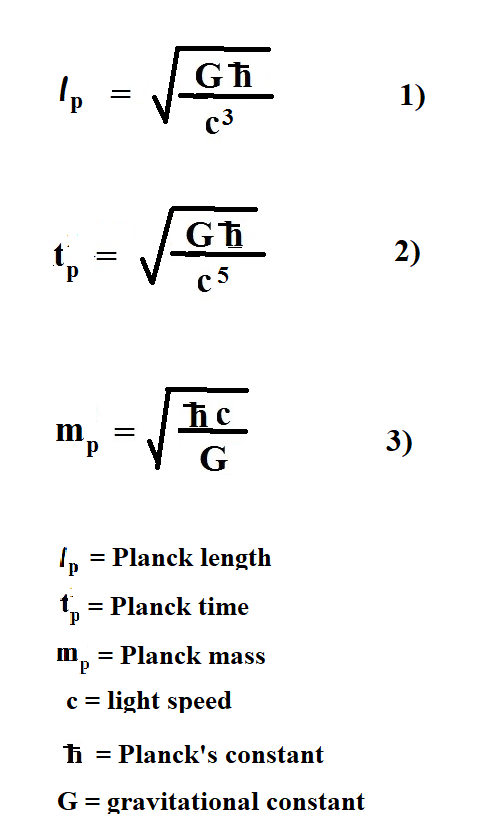
According to all string theories, the Planck length and Planck time are the smallest units. In fact, the string is considered the smallest bit of matter. That brings us to the proverbial question: How long is a string? A string theorist will tell you it is the Planck length. The equations below show the components of the Planck units:

As you can see, the Planck units are made up of the following components: Newton's constant (G), Planck's constant (h-bar) and light speed (c). All these constants are believed to be constant. As long as they are, the Planck units are not just arbitrary units. On the other hand, if one or more of these constants are not always constant ... well that could be a problem.

If we begin with the Lorentz equation, we can derive equation 11 below:

If we assume nothing goes faster than light, then the change in time (delta-t) has an upper limit of t. Also, we know the following is true:

Thus, what follows is also true:

Now, let's assume black holes exist, look what happens when we let radius (r) fall to zero:

The light-speed barrier is broken and energy is no longer conserved. But, then again, if radius r is really small, Heisenberg's uncertainty principle might save the day.

Whoops! Nevermind. A particle, or black hole singularity in this case, can borrow energy from nothing but has to pay it back quickly, in time t. Since the black hole has to borrow more energy than is estimated for the entire universe, it's time is short indeed. The black hole, as we understand it, could not exist. Yet there is a black hole at the center of our galaxy--and it has been there much much longer than time t. How is that possible? Check this out:

If the constant G is allowed to shrink along with radius r, energy is conserved, so the black hole doesn't have to borrow--it can exist as long as it wants. Plus, the light-speed barrier is conserved as well. Unfortunately, the Planck units are arbitrary units. They are not constants of nature.

But does G really shrink? If so, when is it constant and when is it not? If we revisit equation 10, we can derive the following:

Equation 26 shows that delta-t has an upper limit of t but radius r has a lower limit of zero. Since these are components of G, G shrinks to zero as r shrinks to zero. By contrast, equation 27 shows that as r goes to infinity, delta-t goes to zero. As a result, G remains constant. So it appears G is constant at large distances. At small distances, G is no longer constant. For G to be constant at the quantum scale, delta-t needs to grow to infinity as r shrinks to zero. But if that were the case, energy would not be conserved:

Therefore, the gravitational constant G destroys much of modern physics if it remains constant at small scales, and, makes the Planck units arbitrary if it doesn't.

Friday, August 26, 2016

Deriving the Planck Length, the Planck Time and Planck Mass

To derive the Planck length we start with the Schwarzschild radius (x=length; m=mass; G=Newton's constant; E=energy; c=light speed). (To find out how the Schwarzschild radius is derived, click here.)

We also need Heisenberg's Uncertainty Principle (p=momentum; x=position; h-bar=Planck's constant). (To find out how to derive the Uncertainty Principle, click here.) For our convenience we convert momentum (p) to energy (E) by multiplying both sides by light speed (c):

Divide both sides by E:

Multiply the above result by the Schwarzschild radius, then do some algebra to get the Planck length (x with a sub p):

To get the Planck time (t with a sub p), take the Schwarzschild radius and divide it by c:

Shall we call the above result the Schwarzschild time? We also need the other Heisenberg Uncertainty Principle, the one with energy (E) and time (t). Now do some more algebra to get the Planck time:

To get the Planck mass, set the Schwarzschild time equal to the Heisenberg time, then solve for E-squared:

Let's assume E is kinetic energy. Square it, make a substitution, do some more algebra, and get the Planck mass (m with a sub p):